
This article's table of contents introduction:
- What is an Induced Draft (ID) Fan?
- How it Works & Its Position in the System (The Flow Path)
- Key Functions & Why it's Critical
- Technical Characteristics
- Common Challenges & Problems
- Why "Air Exhaust Blower" is an Accurate Term
- Summary Table: ID Fan vs. FD Fan
- Conclusion
This is a very specific and important piece of equipment in a thermal power plant. Here is a detailed breakdown of the Induced Draft (ID) Fan, its role, and why it's often referred to as an "Air Exhaust Blower."
What is an Induced Draft (ID) Fan?
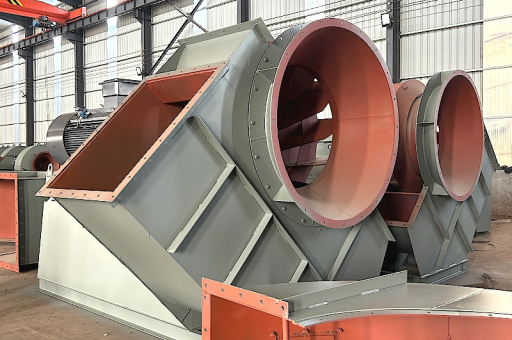
An Induced Draft Fan is a large, powerful fan located at the end of the flue gas path (between the Air Preheater and the Chimney). Its primary job is to pull or exhaust the hot, dirty flue gases out of the boiler furnace, through the pollution control equipment, and up the chimney.
In the context of "Air Exhaust Blower," the ID fan is the final, most powerful "blower" in the system, tasked with exhausting the air that has already been used for combustion and heat transfer.
How it Works & Its Position in the System (The Flow Path)
- Forced Draft (FD) Fan: Pushes fresh air into the furnace.
- Boiler Furnace: Fuel (coal, oil, gas) burns. Air becomes hot flue gas (CO2, SOx, NOx, fly ash).
- Heat Exchangers: Flue gas passes through superheaters, reheaters, economizer, and Air Preheater (APH), losing heat.
- Pollution Control: Flue gas goes through ESP (Electrostatic Precipitator) or Bag Filters to remove fly ash, and often a FGD (Flue Gas Desulfurization) system.
- ID Fan: Sucks the cleaned, cooled gas from the FGD/ESP.
- Chimney (Stack): The ID fan pushes the gas out into the atmosphere.
Key Functions & Why it's Critical
- Maintains Furnace Draft: The ID fan creates a slight negative pressure (vacuum) inside the boiler furnace. This prevents hot, poisonous flue gas from leaking out of the boiler casing into the plant building where operators work. (Safety!)
- Overcomes System Resistance: The flue gas path is not a straight pipe. It has to pass through narrow heat exchanger tubes, dust collectors, and scrubbers. The ID fan provides the massive suction power to pull the gas through all this resistance.
- Ensures Complete Combustion: By pulling gases away, it maintains a steady flow of air through the furnace, which is essential for complete fuel burning.
Technical Characteristics
- Type: Usually Centrifugal (for high pressure, moderate flow) or Axial (for very high flow, lower pressure). Modern large plants often use Axial Fans.
- Blades: Can be Backward Curved (more efficient, less prone to dust buildup) or Forward Curved. To handle the abrasive fly ash, blades are often made of hardened steel or have wear-resistant coatings.
- Control Method:
- Inlet Guide Vanes (IGV): Adjusts the angle of vanes at the fan inlet to control flow. Most common method.
- Variable Speed Drive (VSD): Uses a hydraulic coupling or VFD (Variable Frequency Drive) to change the fan's RPM. Most energy-efficient method.
- Location: Usually outdoors, on a dedicated concrete foundation to handle the massive weight and vibration.
Common Challenges & Problems
Because it handles the worst part of the combustion process, ID fans have a hard life:
- Erosion (Wear & Tear): Despite fly ash removal, fine abrasive particles still hit the blades at high speed, eroding the metal over time. This is the #1 cause of failure.
- Vibration: Unbalanced rotating blades due to uneven wear or fly ash buildup on the blades can cause severe vibration, leading to bearing failure.
- High Temperature: Even though the gas has been cooled, it can still be 130-160°C (266-320°F). Bearings and the fan casing need special heat-resistant materials and cooling systems.
- Corrosion: If the fuel has sulfur (coal/oil), and the gas temperature drops below the "acid dew point," sulfuric acid can form and eat away the fan blades and casing.
Why "Air Exhaust Blower" is an Accurate Term
- "Air" : The gas being moved is actually flue gas (products of combustion), but in the context of the plant's air system, it is the air that has already been used.
- "Exhaust" : This perfectly describes its function: to exhaust the gases from the boiler system.
- "Blower" : In industrial terms, a large fan that moves gas against a significant pressure is technically called a blower. An ID fan is, in fact, a high-pressure, high-volume blower.
Summary Table: ID Fan vs. FD Fan
| Feature | Induced Draft (ID) Fan | Forced Draft (FD) Fan |
|---|---|---|
| Location | End of flue gas path (after APH/ESP) | Start of air path (before furnace) |
| What it moves | Hot, dirty, corrosive flue gas | Clean, ambient air |
| Purpose | Pull (exhaust) gases out of boiler | Push (force) air into boiler |
| Pressure in Furnace | Negative (vacuum / suction) | Positive (just slightly) |
| Material | Heavy-duty, erosion-resistant steel | Standard carbon steel |
| Temperature | High (130°C - 160°C) | Ambient (30°C - 40°C) |
| Key Risk | Blade erosion & corrosion | Low risk |
Conclusion
An Induced Draft Fan is the critical final "Air Exhaust Blower" in a thermal power plant. It creates the necessary suction to pull flue gases through the entire system, ensures operator safety by maintaining negative furnace pressure, and handles the harshest conditions—hot, abrasive, and corrosive gas. Its reliable operation is essential for the plant to run safely and at full capacity.





