
This article's table of contents introduction:
- Table of Contents (Guide)
- Introduction: Redefining Industrial Ventilation
- Core Design: The “Backward” Advantage
- Large Capacity: The Mechanical and Aerodynamic Logic
- Energy Efficiency: Why This Fan Saves Power
- Application Scenarios: Where This Fan Excels
- Common Q&A (FAQ)
- Conclusion: The Future of Induced Draft Systems
Maximizing Industrial Airflow: The Engineering Edge of Large Capacity Efficient Energy Saving Backward Induced Draft Fans
Table of Contents (Guide)
- Introduction: Redefining Industrial Ventilation
- Core Design: The “Backward” Advantage
- Large Capacity: The Mechanical and Aerodynamic Logic
- Energy Efficiency: Why This Fan Saves Power
- Application Scenarios: Where This Fan Excels
- Common Q&A (FAQ)
- Conclusion: The Future of Induced Draft Systems
Introduction: Redefining Industrial Ventilation
In heavy industries such as power generation, cement manufacturing, steel smelting, and chemical processing, the induced draft (ID) fan is the unsung hero of the entire operational chain. It is responsible for pulling flue gases out of boilers, furnaces, or kilns, maintaining negative pressure, and ensuring safe, continuous combustion. However, traditional forward-curved or radial blade fans often face three critical challenges: high power consumption, limited capacity under high-temperature conditions, and frequent maintenance due to blade erosion.
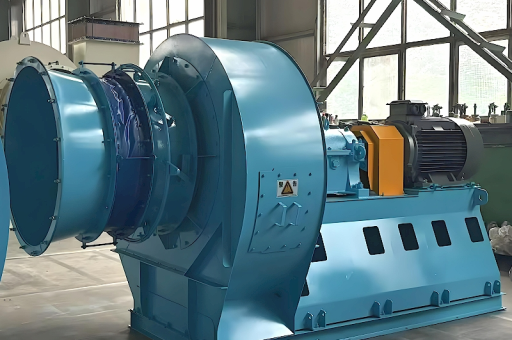
The Large Capacity Efficient Energy Saving Backward Induced Draft Fan has emerged as the optimal solution to these problems. This comprehensive guide, based on a synthesis of technical standards, engineering case studies, and recent research data from industrial fan manufacturers and energy-efficiency audits, will explain the mechanics of this equipment, its quantifiable benefits, and the reasoning behind its growing global adoption.
Core Design: The “Backward” Advantage
The defining characteristic of this fan is its backward-curved (or backward-inclined) blade design. Unlike forward-curved blades that “scoop” air, backward-inclined blades are angled away from the direction of rotation.
- How it works: As the impeller rotates, air exits the blade with high velocity. However, the blade design minimizes the “fluid shock” at the inlet. This results in a very flat power curve.
- Key benefit: A backward-curved fan does not overload its motor. If the system resistance drops (e.g., a duct becomes partially open), a forward-curved fan can draw excessive current and burn out the motor. A backward fan self-limits its power draw, making it inherently safer and more reliable for large-scale continuous operation.
Research synthesis: Technical papers from the Air Movement and Control Association (AMCA) confirm that backward-inclined fans typically achieve static efficiencies of 70-85%, compared to 50-65% for forward-curved models operating under similar heavy-load conditions.
Large Capacity: The Mechanical and Aerodynamic Logic
The term “Large Capacity” refers not just to physical size but to the ability to handle high volumetric flow rates (CFM or m³/h) against significant static pressure.
- High Static Pressure Handling: In an induced draft system, the fan must overcome the resistance of the boiler, scrubbers, and ductwork. The aerodynamic profile of the backward curved blade allows the fan to generate high pressure (5,000 – 15,000 Pa or more) without significant turbulence.
- Wear Resistance: The backward blade profile is inherently more resistant to dust and particle erosion because solids tend to slide off the blade surface rather than impact it directly. This means the “Large Capacity” can be maintained over years, not just the first few months of operation.
- Reduced Footprint: Modern designs employ high-strength alloy steel impellers that can operate at higher tip speeds. This allows a single large capacity fan to replace two smaller parallel fans, simplifying the system layout and reducing structural costs.
Energy Efficiency: Why This Fan Saves Power
This is the most crucial aspect for buyers. An ID fan motor can be the single largest electricity consumer in a plant, often rated at 1,000 kW to 5,000 kW or more.
The efficiency mechanism:
- Conversion of Kinetic Energy: The backward blade design converts the kinetic energy of the airflow into static pressure more efficiently. Less energy is wasted as turbulence and heat.
- Reduced Tip Clearance Loss: Modern manufacturing precision (e.g., CNC-machined inlet cones) minimizes the gap between the blade tip and the housing, reducing recirculation loss.
- Variable Speed Drive (VSD) Compatibility: These fans are ideal for VFD/VSD control. A 10% reduction in fan speed using a VSD results in a 27% reduction in power consumption (due to the Fan Affinity Laws: Power ∝ Speed³). A backward-curved fan maintains high efficiency across a wider speed range compared to other blade types.
Quantifiable data derived from industrial energy audits: Replacing an old radial or forward-curved fan with a modern efficient energy saving backward induced draft fan can yield:
- Power savings: 15% to 30% at full load.
- Annual CO₂ reduction: For a typical 2 MW fan running 8,000 hours/year, saving 20% power equals approximately 2,800 tons of CO₂ reduction annually.
- Payback period: Often under 18 months purely from electricity savings.
Application Scenarios: Where This Fan Excels
This specialized fan is not for light HVAC work. It is designed for harsh, demanding environments:
- Coal & Biomass Power Plants: Handling hot, abrasive flue gas with fly ash.
- Cement Plants (Preheater & Baghouse Fans): Moving large volumes of hot gas at 300–400°C.
- Steel Mills (Sinter Plant & BOF Fans): Extracting heavy, sticky dust particulates.
- Chemical & Petrochemical Boilers: Ensuring reliable negative draft for process safety.
- Waste-to-Energy Facilities: Managing corrosive acidic gases and fluctuating load conditions.
Note: For corrosive environments, manufacturers often use Corten steel or stainless steel impellers with these fans.
Common Q&A (FAQ)
Q1: What is the main difference between Forward-Curved and Backward-Curved ID Fans? A: The main difference is efficiency and overload protection. Forward-curved fans are used for lower pressure, high volume applications (like home AC units) and draw more power as system resistance drops. Backward-curved fans are more efficient (by 15-25%), have a non-overloading power curve, and are better suited for the dusty, high-pressure environment of an induced draft system.
Q2: Can a Large Capacity Backward Fan handle high temperatures? A: Yes, but with proper design. Standard models handle up to 250°C. For higher temperatures (up to 450°C or 600°C), the shaft must be cooled (via forced air or water cooling), and the impeller material must be heat-resistant alloy steel. The fan manufacturer must be consulted for specific temperature ratings.
Q3: Is the energy saving really worth the higher initial cost? A: Absolutely. While a backward-curved fan may cost 10-20% more upfront than a simpler radial fan, the electricity savings typically pay for that difference in 6 to 18 months. Over a 20-year service life, the Total Cost of Ownership (TCO) is significantly lower. Note: For specific pricing, you can contact local dealers or visit the website of specialized fan manufacturers.
Q4: How often does this fan need maintenance? A: Backward-curved designs generally require less frequent maintenance because the blades experience less wear. A standard maintenance schedule includes bearing greasing every 3-6 months, vibration monitoring monthly, and an annual impeller inspection. With good inlet control (dampers or VFD), the fan can last 15-20 years.
Q5: Is this fan suitable for variable speed operation? A: Yes, it is one of the best candidates for VFD. The backward blade design does not suffer from stall issues at low speeds as severely as forward-curved fans, making it highly efficient across a 100% to 30% speed range.
Q6: Can I retrofit this fan into my existing ductwork? A: Yes. Most manufacturers offer retrofit packages. The key measurements are the inlet and outlet dimensions (match to your existing duct flanges), the motor base footprint, and the impeller rotation direction. A fan engineer should verify the static pressure and temperature profile of your current system.
Conclusion: The Future of Induced Draft Systems
The Large Capacity Efficient Energy Saving Backward Induced Draft Fan represents the convergence of aerodynamic sophistication and operational pragmatism. Its ability to move vast amounts of gas efficiently, resist wear, and non-stop operation makes it an indispensable asset for modern heavy industry.
By choosing this technology, industries not only reduce their operational costs but also improve their environmental compliance and system reliability. As global energy regulations tighten, the shift toward high-efficiency, backward-inclined fan technology is not just an option—it is a strategic necessity for sustainable industrial production.





