
This article's table of contents introduction:
- Core Specification: The "Q235" Factor
- Critical Design Parameters for Steel Plant Boilers
- Recommended Fan Design (For Q235 ID Fan)
- Key Features for Steel Plant Reliability
- Suggested Performance Specification Table (Example)
- Where to Source (Typical Chinese Suppliers)
- Final Summary Recommendation
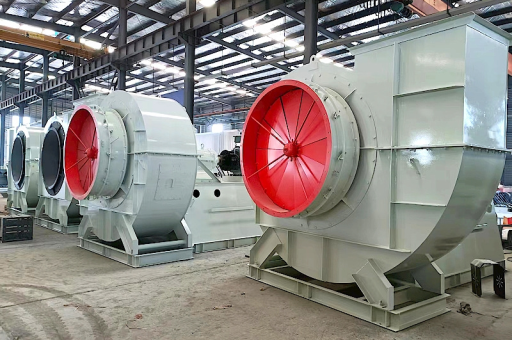
For a steel plant requiring a high air flow Q235 material Induced Draught (ID) Fan for an industrial boiler, you need a fan that is robust, efficient, and designed for high-temperature, particulate-laden flue gas.
Here is a technical breakdown of the specification, key design considerations, and what you should look for in a supplier.
Core Specification: The "Q235" Factor
- Material: Q235 is a Chinese standard carbon structural steel (equivalent to ASTM A36 or EN S235JR).
- Application in ID Fans: It is suitable for rotor (impeller), casing, and inlet box.
- Limitation: Q235 has a maximum operating temperature limit. For ID fans handling flue gas, you must ensure the gas temperature at the fan inlet is below 250°C (482°F) . If the gas is hotter or has high sulfur content (causing acid dew point corrosion), you must upgrade to:
- Q345R (for higher temperature strength)
- 16Mn (for wear resistance)
- Stainless Steel (304/316L) (for corrosion resistance)
- Corten Steel (for weather resistance)
Critical Design Parameters for Steel Plant Boilers
Steel plant boilers often use blast furnace gas (BFG), coke oven gas (COG), or waste heat recovery. This makes the ID fan design different from a standard power plant fan.
| Parameter | Requirement | Why it matters for Steel Plant |
|---|---|---|
| Flow Rate (Q) | Very High (e.g., 200,000 - 1,000,000 m³/h) | Steel boilers are large. High flow is mandatory. |
| Static Pressure (P) | Moderate to High (e.g., 3000 - 8000 Pa) | Must overcome draft loss of boiler, economizer, scrubber, and chimney. |
| Gas Temperature | Usually 140°C - 200°C | Lower than power plant, but can spike during startups. |
| Gas Composition | BFG/COG (Low calorific, high CO), High dust load | Critical: Dust can cause severe erosion. |
| Fan Type | Backward Inclined (BI) or Airfoil | BI is very efficient and self-cleaning for dusty gas. |
| Drive Method | VFD (Variable Frequency Drive) | Essential for precise draft control and energy savings in steel plants. |
Recommended Fan Design (For Q235 ID Fan)
Configuration:
- Type: Centrifugal, Single Inlet (or Double Inlet for ultra-high flow)
- Impeller: Backward Inclined (BI) or Backward Curved (BC) with wear-resistant liners at the leading edge (hardsurfacing or ceramic tiles).
- Housing: Volute casing made of Q235 plate (6-10mm thick) with a wear-resistant lining in the cut-off area.
- Shaft: 45# steel (or 40Cr) heat-treated.
- Bearings: Spherical roller bearings with a forced grease or oil-lubrication system. Shaft cooling (fan wheel or water cooling) is mandatory for heat dissipation.
- Coupling: Flexible coupling (Diaphragm or Gear type) to handle misalignment and thermal expansion.
- Baseplate: Heavy-duty Q235 I-beam frame with vibration isolators.
Key Features for Steel Plant Reliability
-
Wear Protection (Most Important):
- Flue gas from steel plant boilers contains iron oxide, scale, and unburned carbon.
- Solution: Install ceramic tiles or hard-faced wear plates on the impeller blades and the casing wetted area.
- If using plain Q235 with no liner, the fan will fail within 6-12 months.
-
Corrosion Protection:
- If burning BFG/COG, moisture can form sulfuric acid.
- Solution: Ensure the Q235 surfaces are painted with a high-temperature anti-corrosive primer (e.g., Inorganic Zinc Rich or Epoxy) or consider a rubber/glass flake lining on the casing.
-
Variable Speed Control:
- Use a VFD on the motor. Steel plant boiler loads fluctuate significantly (e.g., BFG pressure changes).
- Avoid IGV (Inlet Guide Vanes) on Q235 fans in high-dust environments—vanes erode quickly.
-
Inlet Box Design:
- Use a straight, long inlet box to ensure uniform flow onto the impeller. Non-uniform flow causes vibration and premature wear.
-
Drainage:
Include a drain valve at the lowest point of the casing to remove condensation.
Suggested Performance Specification Table (Example)
Note: This is a sample. You must specify your actual duty point.
| Item | Specification |
|---|---|
| Fan Type | Centrifugal, Backward Inclined (BI) |
| Material (Main) | Q235B |
| Material (Impeller) | Q235B + Hard-facing (Wear Protection) |
| Flow Rate (Design) | 450,000 m³/h |
| Static Pressure | 5,500 Pa |
| Gas Temp. (Normal) | 180°C |
| Max. Gas Temp. | 260°C (for 20 mins) |
| Speed | 980 RPM (via VFD) |
| Motor Power | 1,200 kW (10kV) |
| Drive | VFD + Flexible Coupling |
| Cooling | Water-cooled shaft (or fan wheel cooling) |
Where to Source (Typical Chinese Suppliers)
Since you specified Q235, you are likely looking for a cost-effective, robust solution. The following Chinese manufacturers are well-known for industrial ID fans for steel plants:
- Shenyang Blower Works Group (SBW) – High-end, large fans.
- Shandong Zhangqiu Blower Co., Ltd. – Professional, heavy-duty.
- Shanghai Blower Works Co., Ltd. – Known for customization.
- Wuxi Huadong Blower Co., Ltd. – Economic, reliable for steel.
- Nantong Hengda Blower Manufacturing Co., Ltd. – Mid-range ID fans.
Recommendation: When contacting them, provide:
- Gas analysis (O2, CO, H2, H2O, Dust concentration).
- Boiler load fluctuation range (min/normal/max flow).
- Desired fan inlet temperature (min/normal/max).
- Desired fan location (Indoor/Outdoor, altitude).
Final Summary Recommendation
For your Q235 High Air Flow Industrial Boiler Induced Draught Fan:
- Do NOT buy a plain Q235 fan without wear protection. Mandatory: Ceramic lining or hard-facing on impeller.
- Specify: Backward Inclined (BI) design with VFD drive.
- Check: Shaft cooling system is included.
- Budget: A high-quality Q235 ID fan (e.g., 450,000 m³/h) will cost approximately $80,000–$150,000 USD (depending on accessories). A full ceramic-lined design may be 20-30% more.
If you provide the specific flow rate (m³/h) and pressure (Pa) required, I can refine this further.





