
This article's table of contents introduction:
- Understanding the Application (Engineering Construction)
- Typical Technical Specifications (Example)
- Critical Selection Factors for Construction
- Sizing & Selection Logic (Simplified)
- Potential Suppliers (for construction industry)
- Important Safety Requirement for ID Fans
- Next Steps
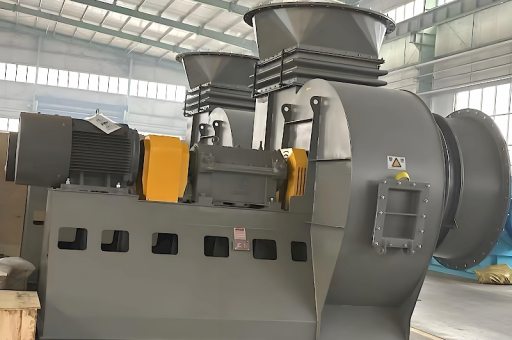
I understand you are looking to procure or specify a Medium Pressure Induced Draft Fan rated at 1450 RPM for engineering construction applications.
Because "Induced Draft" (ID) fans handle hot, often dirty, and potentially corrosive gases, the specifications are critical for safety and performance. The 1450 RPM rating suggests a direct-coupled unit (typically using a 4-pole motor on a 50Hz supply).
Here is a detailed breakdown of what you need to know, typical specifications, and key considerations for this equipment.
Understanding the Application (Engineering Construction)
In construction and heavy engineering, these fans are used for:
- Industrial Boilers: Removing flue gases from steam boilers.
- Furnaces & Kilns: Drawing exhaust from industrial heating units.
- Dust Collection Systems: Providing the negative pressure to pull air through dust filters (baghouses).
- Tunnel Ventilation: In temporary construction tunnels.
- Foundation Dewatering: (less common for ID, more for axial) but can be used for general site ventilation.
Key Challenge: Induced Draft fans operate under negative pressure (suction side) and handle hot, abrasive, and often corrosive gas. They must be robust.
Typical Technical Specifications (Example)
To ensure you get the correct fan, you must match these parameters. Here is a typical specification for a 1450 RPM Medium Pressure ID Fan:
| Parameter | Typical Value / Requirement | Notes |
|---|---|---|
| Speed | 1450 RPM (4-pole motor) | At 50 Hz. For 60 Hz systems, this is ~1750 RPM. Ensure compatibility. |
| Type | Centrifugal (Backward Inclined or Radial Tip) | Backward Inclined is more efficient for medium pressure. |
| Static Pressure | 1000 – 3000 Pa (4 – 12 inches w.g.) | Medium Pressure typically ranges 700–3500 Pa. |
| Air Volume | 10,000 – 150,000 m³/hr (varies by size) | Dependent on impeller diameter. |
| Max. Gas Temp | 150°C – 250°C (Standard) 400°C+ (High-Temp) |
Impeller & shaft material changes for higher temps. |
| Material | Impeller: Carbon Steel (St-37) or Corten Steel Shaft: 40C8 / EN8 Housing: MS with stiffeners |
For corrosive gases, use Stainless Steel (SS304/SS316) or rubber lining. |
| Drive Type | Direct Drive (Most common for 1450 RPM) or Belt Drive (for flow tuning) |
Direct is simpler, no belt maintenance, no power loss. Belt allows speed variation. |
| Motor | IE3 / IE4 Efficiency IP55 Protection Insulation Class F or H |
For outdoor construction use, IP55 is minimum. |
| Standard | ISO 12499 / AMCA 210 / IS 4894 | For performance testing. |
Critical Selection Factors for Construction
When ordering or specifying this fan, ask the manufacturer/supplier these questions:
Gas Temperature:
- What is the maximum operating temperature?
- Will it handle cold starts (condensation)? (Drain should be provided at the bottom of the housing).
Dust & Abrasion:
- Is the gas clean? (HVAC grade).
- Does it have high dust load? (Requires wear-resistant liners or hard-faced impeller).
Spark Resistance:
- If used near combustible gases (drying ovens, grain dryers), the impeller must be non-sparking (Aluminum or special plastic).
Vibration & Bearings:
- Bearing Life: Minimum L10 life of 40,000 hours.
- Vibration: Must meet ISO 14694 (Balance Grade G6.3 or better).
- Lubrication: Pre-lubricated and sealed for life, or re-greasable bearings for high-temp.
Installation Environment:
- Indoor or Outdoor? (Weather cover for motor/bearings).
- Accessibility for Maintenance: (Drain plugs, inspection doors, cleanout doors).
Sizing & Selection Logic (Simplified)
To find the right fan, you need to solve for:
- Airflow (Q): m³/s or m³/hr.
- Static Pressure (SP): Pa or mmWc.
- Gas Density: Correct for temperature (Hot air is less dense, so the fan must generate more pressure to move the required mass).
Example Expression for Supplier:
"I need a 1450 RPM, medium pressure, direct-drive induced draft fan for a construction boiler. Duty point: 15,000 m³/hr at 2000 Pa static pressure, gas temperature 180°C. Gas contains moderate fly ash. Material: Carbon Steel with abrasion-resistant lining. Motor: 30 kW, IE3, IP55, 415V/3ph/50Hz."
Potential Suppliers (for construction industry)
- Europe/Global: FläktGroup, Howden, Systemair, Nicotra Gebhardt, ebm-papst.
- India/Asia: Kruger Ventilation (India), Reitz India, Dynamic Fan Engineering, AEROVENT.
- Specialist: For high-temperature or abrasive conditions, contact furnace equipment manufacturers (e.g., Hauck, Maxon (now part of Honeywell) for combustion-related ID fans).
Important Safety Requirement for ID Fans
Since these fans operate under negative pressure, a duct safety damper (isolation damper) and an anti-condensation drain at the fan inlet are highly recommended to prevent moisture accumulation and fan inlet blockage.
Next Steps
- Do you have the exact Duty Point (Airflow & Pressure) or a specific manufacturer in mind?
- What is the fluid? (Hot air, flue gas, corrosive fumes, dust-laden air)?
- What is your budget and delivery timeline?
If you provide the exact duty required, I can help you match the correct frame size (e.g., #30, #35, #40 impeller diameters) or calculate the required motor power.





