
This article's table of contents introduction:
- What is an Induced Draft (ID) Fan?
- The Role of the AC Motor
- Why "Efficient Air Management" Matters
- The Path to High Efficiency: The Motor-Fan Control Loop
- Essential Components for a Modern, Efficient System
- Application Example: Power Plant Boiler
- Maintenance for Long-Term Efficiency
- Summary of Best Practices for Efficiency
This is a highly specific and important topic in industrial systems. An AC Motor Induced Draft (ID) Fan is a cornerstone of efficient air management, particularly in thermal power plants, cement factories, steel mills, and large-scale HVAC systems.
Here is a comprehensive breakdown of how this system works, why it is critical, and how modern technology makes it efficient.
What is an Induced Draft (ID) Fan?
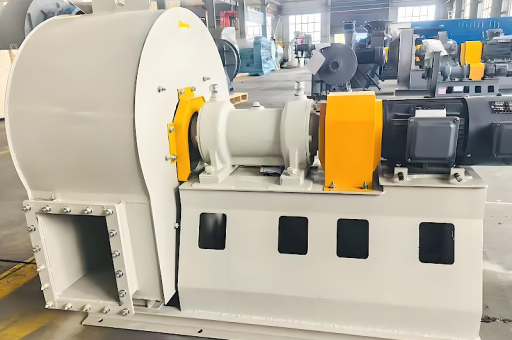
An ID fan is located at the end of the air path (downstream of the process). It pulls flue gases or exhaust air out of a system (like a boiler or furnace), creating a negative pressure (vacuum) inside the ductwork and combustion chamber.
- Contrast with FD (Forced Draft) Fans: FD fans push fresh air into the system. ID fans pull exhaust out of the system.
- Action: It "induces" the draft by sucking gases through the system, overcoming pressure losses from scrubbers, filters, and heat exchangers.
The Role of the AC Motor
The AC Induction Motor is the prime mover for the ID fan. It converts electrical energy into mechanical rotation to spin the fan impeller.
Key Motor Characteristics for ID Fans:
- High Power: Motors can range from 100 kW for small industrial boilers to over 10,000 kW (10 MW) for large power plant boilers.
- High Torque: Requires high starting torque to overcome the inertia of a large, heavy fan wheel.
- Squirrel Cage Induction Motor: Most common due to its robustness, low cost, and low maintenance.
- Wound Rotor Induction Motor: Once common for speed control, now largely replaced by VFDs.
Why "Efficient Air Management" Matters
Incorrect air management leads to:
- Fuel Waste: Too much air cools the flame; too little air causes incomplete combustion (soot/CO).
- Emissions: Poor draft can cause leakage of harmful gases.
- Equipment Damage: Positive pressure in the furnace (when ID fan fails) can push hot gases and flames out through gaps.
- Energy Waste: Fans account for 15-30% of a plant's total electrical load.
The Path to High Efficiency: The Motor-Fan Control Loop
The key to efficiency is matching the fan's output to the process demand. This is achieved primarily through Variable Frequency Drives (VFDs) on the AC motor.
| Control Method | Motor Action | Fan Action | Efficiency (Typical) | Notes |
|---|---|---|---|---|
| Damper Control (Outlet louvres) | Runs at 100% speed | Restricts flow | Very Low (~30-50%) | Wastes energy by pushing against a closed valve. Like driving a car with the brakes on. |
| Inlet Guide Vanes | Runs at 100% speed | Pre-swirls air | Moderate (~70%) | Better than dampers, but still inefficient at low flow. |
| Variable Frequency Drive (VFD) | Changes speed (e.g., 45 Hz) | Matches flow perfectly | High (~85-95%) | Most Efficient. Energy use drops with the cube of the speed reduction (Fan Affinity Laws). |
The Formula (Fan Affinity Laws): Power ∝ (Speed)³
- Example: Reducing motor speed from 100% to 80% reduces power consumption by 50% (0.8³ = 0.51).
Essential Components for a Modern, Efficient System
A modern AC Motor ID Fan system includes:
- The AC Motor: (Typically 6.6kV, 11kV or 415V) - Sized for continuous operation (S1 duty).
- Variable Frequency Drive (VFD): The brain of the system. It converts fixed frequency AC (e.g., 50/60 Hz) to variable frequency AC, precisely controlling motor speed.
- Controller (PLC/DCS): Receives process signals (e.g., "Furnace pressure is -5 mbar") and sends a command to the VFD ("Speed up to 48 Hz").
- Sensors:
- Pressure Transmitter: The primary feedback. Measures furnace/duct negative pressure.
- Temperature Sensors (RTD/TC): Monitors motor winding temperature, bearing temperature, and gas temperature (which can be 150°C+).
- Vibration Sensors: Crucial for detecting blade imbalance or bearing failure early.
- Protection System:
- Motor Protection Relay: Protects against overload, short circuit, phase failure, and earth fault.
- Surge Arrestors: Protect VFD and motor from lightning or grid surges.
- Thermal Protection: Motor winding PTC thermistors.
Application Example: Power Plant Boiler
- Coal is burned in the furnace. Hot flue gas rises.
- FD Fans push air in.
- ID Fan (with AC Motor & VFD) pulls the flue gas through:
- Economizer: Recover heat.
- ESP (Electrostatic Precipitator) / Bag Filter: Remove fly ash.
- FGD (Flue Gas Desulfurization): Remove SOx.
- The AC Motor RPM is continuously adjusted by the VFD to maintain a constant, slightly negative pressure inside the furnace (e.g., -2 to -5 mbar).
- Result: Optimum combustion, maximum thermal efficiency, minimal pollutant leakage.
Maintenance for Long-Term Efficiency
- Bearing Lubrication: Use correct grease type/quantity. Over-lubrication is as bad as under-lubrication.
- Vibration Analysis: Monthly or online. Check for imbalance due to blade erosion or ash buildup.
- Winding Insulation Testing (Megger): Critical for high-voltage motors. Check insulation resistance (IR) and Polarization Index (PI).
- Cooling System Check: Ensure motor cooling fan (TEFC or IC611) is working and air channels are clear.
- VFD Health: Check DC bus capacitors (they dry out), cooling fans, and heatsink cleanliness.
Summary of Best Practices for Efficiency
| Parameter | Best Practice |
|---|---|
| Control Method | Use a VFD for the AC motor. Avoid dampers. |
| Motor Selection | High-efficiency (IE3/IE4) motor. Correct voltage rating. |
| Speed Management | Operate as slow as possible to meet demand (use Affinity Laws). |
| System Design | Minimize duct bends and restrictions. Keep duct diameter large. |
| Maintenance | Implement predictive maintenance (vibration, thermal, oil analysis). |
| Automation | Integrate with DCS for automatic, closed-loop pressure control. |
Conclusion: An AC Motor ID fan, when controlled by a modern VFD within a closed-loop automation system, is the most effective and energy-efficient method for managing draft and air balance in industrial processes. Proper sizing, control logic, and predictive maintenance are the three pillars that ensure optimal performance and operational cost savings.





