
This article's table of contents introduction:
- The Core Components Explained
- Key Advantages of this Combination
- Common Applications
- Critical Design & Selection Factors
- Typical Sizing & Performance (Hypothetical)
- Cost & Sourcing
- Maintenance Tips for Your System
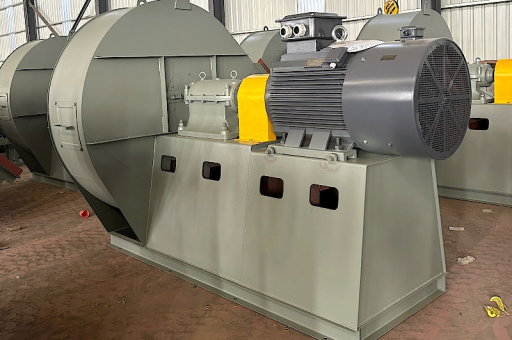
This is a very specific and high-performance industrial application. Combining a Stainless Steel (SS) customized fan with a V-belt drive for an Industrial Dust Collector is a standard solution for demanding environments (hygienic, corrosive, or high-temperature).
Here is a detailed breakdown of what this specification entails, why it’s chosen, and key considerations for procurement or design.
The Core Components Explained
- Stainless Steel Fan (Customized):
- Material: Typically SS304 or SS316L. Used for the impeller (wheel), housing, and inlet cone.
- Why SS: Corrosion resistance (chemical dust, moisture), hygiene (food/pharma), spark resistance (combustible dust), and high-temperature capability.
- Customization: Non-standard inlet/outlet angles, special shaft seals (air purge, labyrinth), reinforced wheels for heavy dust loads, or special coatings (if partial SS is used).
- V-belt Drive:
- Function: Transfers power from the motor to the fan.
- Why V-belt over Direct Drive: Allows for speed adjustment (by changing pulley diameters) to match system pressure/flow requirements without changing the motor. It also provides a mechanical "fuse" (belt slip) that protects the motor from sudden overload or fan lock-up.
- Components: Motor pulley, fan pulley, and V-belts (A, B, C, D sections or narrow wedge SPZ, SPA, SPB, SPC). For dust collectors, notched or cogged belts are preferred for flexibility and heat dissipation.
- Industrial Dust Collector Fan:
- Design: Usually a radial (paddle wheel) or radial-tip design. These have straight or slightly backward-inclined blades that are robust and non-clogging.
- Purpose: Must handle high static pressure (to overcome filter resistance) and abrasive contaminants.
Key Advantages of this Combination
| Feature | Benefit |
|---|---|
| Stainless Steel | Prevents rust from moisture in the air or corrosive dust (e.g., in battery recycling, chemical plants, or food processing). |
| V-belt Drive | Allows tuning of fan speed (RPM) to meet exact CFM/Static Pressure requirements. Easier to replace belts than a motor. |
| Customized | Optimized footprint, specific bolt patterns, or unique inlet/outlet configurations for tight spaces or retrofits. |
| Dust Collector Duty | Designed for continuous operation, high inertia, and resistance to imbalance from dust accumulation. |
Common Applications
- Chemical Processing: Handling corrosive fumes or reactive dust.
- Pharmaceuticals: Clean rooms and material transfer (SS prevents contamination and is easy to sanitize).
- Food & Beverage: Flour, sugar, spice dust (hygiene requirements).
- Powder Coating & Metal Finishing: Handling fine, flammable powders (SS is non-sparking when struck).
- Wastewater Treatment: Corrosive hydrogen sulfide gas.
Critical Design & Selection Factors
When buying or specifying this fan, pay attention to the following:
A. Construction Details (Crucial for SS)
- Wheel Type: Open paddle wheel? Closed radial tip? Backward inclined? Open wheels are best for sticky or fibrous dust.
- Weld Quality: Must be fully welded and ground smooth (especially for food/pharma) to prevent dust accumulation and bacterial growth.
- Shaft & Bearings: The shaft is usually carbon steel (plated) or SS, but bearings must be external to the airstream (pillow block mounted on a pedestal) and protected from dust ingress.
- Clearance: Radial clearance between the wheel inlet and the inlet cone must be tight (1/8" to 1/4") to prevent recirculation.
B. Drive System (V-belt)
- Pulley Guard: Mandatory. A robust steel guard that is OSHA-compliant.
- Belt Tensioning: The motor base must have a slide rail or adjustable jacking bolts for tensioning (not a lever-type).
- Motor Frame: The motor should be TEFC (Totally Enclosed Fan Cooled) or Explosion-Proof if the dust is combustible.
C. Dust Characteristics
- Temperature: SS is great up to 800°F (SS316) or 1500°F (SS310/SS309 for high-temp).
- Abrasiveness: SS is softer than carbon steel. For extremely abrasive dust (sandblasting debris), carbon steel with a replaceable liner (or hardened steel wheel) is often cheaper and lasts longer than SS.
- Explosion Hazard: If the dust is combustible (grain, coal, metal, sugar), you likely need NFPA-compliant features:
- SS construction (to prevent sparks).
- Conductive V-belts (to prevent static buildup).
- Grounding of the fan housing and shaft.
- Backward-inclined wheel (more efficient, but less robust).
Typical Sizing & Performance (Hypothetical)
For a medium-sized dust collector:
- Airflow: 5,000 to 20,000 CFM.
- Static Pressure: 10 to 30 inches w.g. (water gauge).
- Motor: 10 HP to 50 HP, 1800 RPM (TEFC).
- Drive Speed (Fan RPM): 1500 to 3000 RPM (depending on pressure requirement).
- SS Material: 304L (standard) or 316L (for chlorides/high corrosion).
Cost & Sourcing
- Cost Ratio: An SS fan is typically 2x to 4x the cost of an equivalent carbon steel fan.
- Customization Cost: Custom bolt patterns, special flanges, or non-standard wheel diameters add another 15-30%.
- Lead Time: Custom SS fans (especially with special alloys) often have a lead time of 8-16 weeks.
- Sourcing: Look for manufacturers like New York Blower, Chicago Blower, Cincinnati Fan, or specialized SS fabricators (e.g., Met-Pro, Strobl, or local sheet metal shops with certified welders).
Maintenance Tips for Your System
- V-belt Inspection: Check for cracking, glazing, or fraying monthly. Replace in matched sets.
- Bearing Lubrication: Use high-temperature grease; do not over-grease.
- Wheel Balance: Due to dust accumulation, an SS wheel can easily go out of balance. Clean the wheel with compressed air or water (if wash-down rated).
- SS Passivation: Occasionally clean the SS housing with a passivating solution (citric or nitric acid based) to restore the chromium oxide layer.
In short: You are looking for a robust, corrosion-resistant, speed-tunable solution for a heavy-duty industrial environment. Ensure the fan wheel matches your specific dust type (heavy, fibrous, sticky, or explosive).





