
This article's table of contents introduction:
- Parameter Breakdown
- What you are likely looking at:
- Key Products / Components
- Is there a specific question you have about this setup?
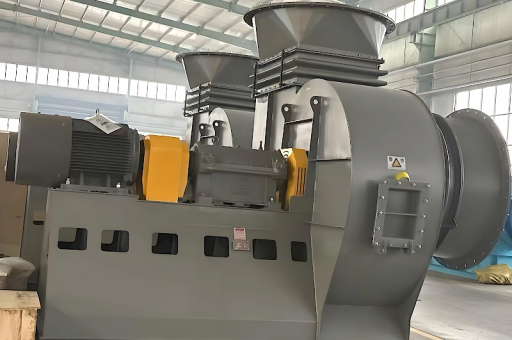
This sounds like a specification summary for a specific type of Industrial Induced Draft (ID) Fan. Let's break down what these parameters mean and what kind of motor and application you are likely dealing with.
This is a high-temperature, heavy-duty industrial fan system.
Parameter Breakdown
-
ID Motor (Induced Draft Motor):
- Function: It powers a fan that pulls hot gases (flue gas, exhaust air) through a system (like a boiler, furnace, or kiln) and then expels them up a stack or chimney. It creates a negative pressure (draft) in the system.
- Type: Almost certainly an AC Induction Motor (Squirrel Cage or Wound Rotor).
-
1450-2900 RPM:
- Speed Range: This is the motor's operating speed.
- 1450 RPM: Corresponds to a 4-pole motor (running on 50Hz mains, synchronous speed 1500 RPM, slip ~3.3%) or a 6-pole motor on 60Hz (synchronous speed 1200 RPM, but 1450 is more typical for 4-pole on 50Hz).
- 2900 RPM: Corresponds to a 2-pole motor (running on 50Hz mains, synchronous speed 3000 RPM, slip ~3.3%).
- Implication: The wide range (1:2 ratio) strongly suggests the motor is driven by a Variable Frequency Drive (VFD) . A fixed-speed motor is locked to one speed (e.g., 1460 for a 4-pole or 2930 for a 2-pole). The specification "1450-2900" implies the drive is capable of running the motor across that entire speed range by varying the output frequency (e.g., 25Hz to 50Hz on a 4-pole motor, or 24Hz to 50Hz on a 2-pole motor).
-
Induced Draft Fan Blower:
- Fan Type: Typically a Centrifugal Fan (often a radial blade, backward-curved, or airfoil design) specifically designed for high-volume, low-to-medium static pressure applications with dirty or hot air.
-
20℃ - 500℃ Ambient Temperature:
- Critical Specification: This is the process gas temperature range that the fan is designed to handle.
- Low End (20°C): Startup, normal ambient air.
- High End (500°C / 932°F): Very hot process gases. This dictates the fan's construction.
- Engineering Implications:
- Shaft Cooling: The fan shaft must be long and air-cooled (or water-cooled) to prevent heat from traveling to the motor bearings.
- Bearing Type: High-temperature rated bearings (e.g., with specialized grease or oil rings) are required.
- Material Selection: The fan impeller and housing must be made of materials that can withstand thermal expansion and high temperatures (e.g., Carbon Steel, Corten, or even Stainless Steel for the hottest applications). The impeller might have a shroud or cooling disk to handle the temperature differential.
What you are likely looking at:
This is a Variable Speed ID Fan System designed for a Boiler, Furnace, Cement Kiln, or Incinerator.
- Application: Pulling combustion gases from the system before they go to the stack.
- Control: A VFD controls the motor speed (1450-2900 RPM) to precisely control the negative pressure in the furnace/boiler.
- Duty: Severe duty, often running 24/7 for years.
Key Products / Components
- Motor: A TEFC (Totally Enclosed Fan Cooled) or TENV (Totally Enclosed Non-Ventilated) motor. Given the temperature, a standard TEFC motor cannot cool itself effectively from the ambient air if the air is cold, but the motor itself gets hot. For the gas being at 500°C, the motor is not inside the gas stream. The motor is typically mounted outside the ducting. The fan itself handles the 500°C gas.
- VFD (Variable Frequency Drive): This is essential for the speed range.
- Fan Wheel: Heavy-duty, high-temperature alloy wheel, often with a stainless steel hub and special welding techniques to avoid fatigue.
Is there a specific question you have about this setup?
For example:
- "What size motor?" (Needs power rating, e.g., 150 kW, 250 HP)
- "Can it handle higher temperatures?" (500°C is a standard limit for many industrial fans; beyond that requires special alloys)
- "What is the correct installation method?" (Needs alignment, baseplate design, flexible connections)
- "How do I select a VFD for this?" (Needs Overload rating, braking requirements, ambient conditions for the VFD)
Bottom line: You have a high-performance, rugged industrial fan system designed for pulling very hot gas out of a combustion process, with a VFD allowing precise speed control to match the process demand.





