
This article's table of contents introduction:
- Introduction: The Critical Role of Circulation Fans in Cement Grinding
- Why "Large Air Volume" Matters in Raw Material Mills
- How a Centrifugal Circulation Fan Works: Design Principles
- Key Selection Criteria for Cement Plant Circulation Fans
- Common Operational Challenges and Solutions (Q&A Section)
- Maintenance Strategies for Long-Term Reliability
- Conclusion: Achieving Energy Efficiency Through Fan Optimization
** Optimizing Cement Plant Raw Material Mill Performance with Large Air Volume Centrifugal Circulation Fans
Table of Contents (TOC)
- Introduction: The Critical Role of Circulation Fans in Cement Grinding
- Why "Large Air Volume" Matters in Raw Material Mills
- How a Centrifugal Circulation Fan Works: Design Principles
- Key Selection Criteria for Cement Plant Circulation Fans
- Common Operational Challenges and Solutions (Q&A Section)
- Maintenance Strategies for Long-Term Reliability
- Conclusion: Achieving Energy Efficiency Through Fan Optimization
Introduction: The Critical Role of Circulation Fans in Cement Grinding
In a modern cement plant, the raw material mill (often a vertical roller mill or ball mill) consumes a significant portion of total electrical energy. One of the most heavily loaded components in this grinding circuit is the raw material mill circulation fan. This large air volume centrifugal fan is responsible for transporting the ground material (raw meal) through the separator and back to the mill, while also controlling the gas flow for drying and classification.
Without a properly designed circulation fan, the entire grinding process becomes unstable. The fan must handle high volumes of hot, dusty gas—often exceeding 500,000 m³/h—while maintaining a stable pressure differential across the mill system. Over the past decade, industry leaders have shifted toward custom-engineered centrifugal fans that deliver both high volumetric flow and low specific energy consumption.
Why "Large Air Volume" Matters in Raw Material Mills
Unlike process fans in other industries, a cement plant raw material mill circulation fan must move an extremely large volume of air per unit of time. This is because:
- Material Transport: The gas stream carries the ground particles away from the grinding table and into the classifier.
- Drying Requirement: Raw materials often contain 5–15% moisture. The high air volume enables efficient heat exchange with hot gases from the kiln or preheater, drying the material before classification.
- Pressure Recovery: Large air volume at moderate pressure (typically 7,000–12,000 Pa) ensures the separator can effectively reject oversized particles.
For example, a 5,000 tpd cement line may require two parallel circulation fans, each delivering up to 900,000 m³/h. Selecting a fan with insufficient air volume leads to recirculation losses, higher wear on mill internals, and reduced throughput.
How a Centrifugal Circulation Fan Works: Design Principles
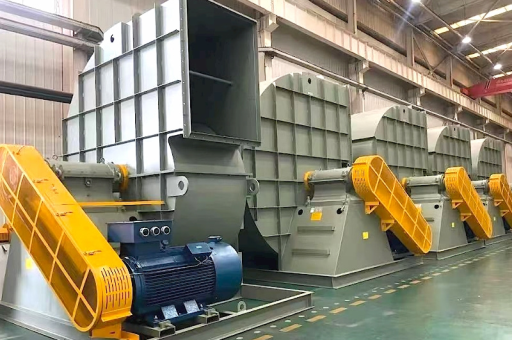
The large air volume centrifugal circulation fan in a cement plant is fundamentally an impeller-based machine. Key design characteristics include:
- Backward-Curved Blades: These provide higher efficiency (up to 85%) and are less prone to dust accumulation compared to radial blades.
- Double- or Single-Inlet Configuration: For extremely high flow rates, double-inlet fans are preferred, as they halve the inlet velocity and reduce vibration.
- Casing Wear Protection: Because the fan handles raw meal dust with particle sizes down to 10–50 microns, the casing is typically lined with abrasion-resistant steel plates or ceramic tiles.
- Vibration Monitoring: Large fans operate at near-critical speeds; therefore, modern designs incorporate proximity probes and online balancing systems.
The fan is typically placed after the mill separator (draw-through configuration), ensuring the gas path remains under negative pressure, minimizing dust leakage into the environment.
Key Selection Criteria for Cement Plant Circulation Fans
When specifying a new raw material mill circulation fan for a cement plant, engineers prioritize the following:
- Flow Capacity (Q): Must match the mill’s maximum designed production rate, plus a 10–15% safety margin for future capacity increases.
- Pressure Rise (ΔP): Determined by mill resistance, ductwork losses, and separator pressure drop. Modern vertical roller mills require 8,000–10,000 Pa.
- Gas Temperature: Raw mill exhaust gases range from 80°C (wet process) to 120°C (dry process). Fans must withstand thermal expansion without blade distortion.
- Dust Concentration: Typically 30–80 g/m³. Fan selection often includes a pre-cleaner (e.g., a settling chamber or cyclone) upstream to reduce wear.
- Drivetrain: Large fans use variable frequency drives (VFDs) to adjust speed and air volume precisely, reducing energy waste during partial load operation.
Common Operational Challenges and Solutions (Q&A Section)
Q1: Why does my raw mill circulation fan vibrate heavily after a shutdown?
A: This is usually due to uneven dust deposition on the rotor blades. During shutdown, hygroscopic raw meal absorbs moisture and forms deposits. Solution: Implement a periodic blade cleaning protocol using a compressed air or water spray system integrated into the fan casing. After each mill stop, rotate the fan manually and clean all blades before restart.
Q2: How can I reduce the specific power consumption of the circulation fan?
A: The key is to operate the fan near its best efficiency point (BEP). Solution: Use a VFD to match fan speed to actual mill load. Additionally, ensure the mill pressure drop is optimized—excessive mill resistance forces the fan to work harder. Regular inspection of the separator (e.g., worn rotor cages) can reduce pressure loss by up to 15%.
Q3: What is the biggest mistake when replacing an old circulation fan?
A: Many plants simply oversize the new fan. This results in off-design operation, lower efficiency, and higher energy bills. Solution: Conduct a full system resistance test before ordering. Measure actual flow, temperature, and pressure at different mill loads. Then request the fan manufacturer to design for those specific conditions, not just a theoretical maximum.
Q4: How do I prevent premature bearing failure in a large centrifugal fan?
A: Bearing failure is often caused by misalignment or insufficient lubrication. Solution: Install online vibration and temperature monitoring on the bearing housings. Use lubricating grease with a high dropping point (≥180°C) to handle the radiant heat from the casing. Re-align the fan shaft and motor coupling after every major maintenance interval.
Maintenance Strategies for Long-Term Reliability
A cement plant raw material mill circulation fan operating 8,000 hours per year requires a rigorous maintenance schedule:
- Weekly: Visual inspection of blade leading edges for erosion. Check bearing oil levels and temperature.
- Monthly: Clean the fan inlet duct and the inlet cone (the area most prone to dust accumulation). Use a stroboscope to check for blade cracks.
- Quarterly: Perform a rotor dynamic balancing test. Even a small imbalance (e.g., 0.5 kg on a 2 m diameter rotor) can significantly shorten bearing life.
- Yearly: Replace worn wear plates in the casing. Inspect the shaft seals for air leakage. Overhaul the variable geometry inlet vanes (if present).
One critical point: never weld directly on a fan rotor unless the manufacturer’s material grade is known. Many high-strength fan steels require preheating to avoid cracking.
Conclusion: Achieving Energy Efficiency Through Fan Optimization
The large air volume centrifugal circulation fan is the heart of a cement plant’s raw material grinding circuit. By focusing on correct fan sizing, VFD integration, and targeted maintenance, plant operators can reduce energy consumption by 10–20% while improving mill throughput.
Future trends include the use of computational fluid dynamics (CFD) to optimize blade shapes for lower noise and higher pressure recovery, as well as the integration of real-time sensor data into a plant’s digital twin. The bottom line is clear: when the circulation fan is correctly engineered for its specific duty, the entire cement production line performs better, with lower carbon emissions and higher profitability.
Key Takeaway: Don’t treat your raw mill circulation fan as a commodity. Invest in custom design, regular condition monitoring, and proactive cleaning—your cement plant’s capacity and energy bill depend on it.
Disclaimer: This article is intended for engineering professionals in the cement industry. Specific fan selection should always involve a detailed system analysis by a qualified fan manufacturer.





