
This article's table of contents introduction:
- Table of Contents
- Introduction: The Role of High-Voltage Industrial Centrifugal Fans
- Understanding Voltage Ratings: 440V, 660V, 6KV, and 10KV
- The 4-72 Series: Design Features and Construction
- High-Temperature Resistance: Materials and Engineering Solutions
- Applications in Harsh Industrial Environments
- Performance Optimization and Energy Efficiency
- Frequently Asked Questions (FAQ)
- Conclusion: Why the 4-72 Series Stands Out
High-Voltage Industrial Centrifugal Fans 4-72: Engineered for 440V, 660V, 6KV & 10KV High-Temperature Environments**
Table of Contents
- Introduction: The Role of High-Voltage Industrial Centrifugal Fans
- Understanding Voltage Ratings: 440V, 660V, 6KV, and 10KV
- The 4-72 Series: Design Features and Construction
- High-Temperature Resistance: Materials and Engineering Solutions
- Applications in Harsh Industrial Environments
- Performance Optimization and Energy Efficiency
- Frequently Asked Questions (FAQ)
- Conclusion: Why the 4-72 Series Stands Out
Introduction: The Role of High-Voltage Industrial Centrifugal Fans
Industrial centrifugal fans are the lungs of heavy-duty operations. From power plants to steel mills, cement factories to chemical processing units, these fans ensure proper ventilation, material handling, and temperature control. Among the most widely adopted models worldwide, the 4-72 series has earned a reputation for reliability, especially when built to withstand extreme voltages—440V, 660V, 6KV, and 10KV—and high-temperature environments.
In modern industrial settings, equipment must operate under severe electrical and thermal stress. Standard low-voltage fans often fail when exposed to sustained heat above 200°C or when connected to medium-voltage power grids. This article provides a detailed analysis of high-voltage industrial centrifugal fans based on the 4-72 design, focusing on their electrical compatibility, heat-resistant construction, and real-world applications.
Understanding Voltage Ratings: 440V, 660V, 6KV, and 10KV
Selecting the correct voltage rating is critical for safety, motor longevity, and system efficiency. Here is a breakdown:
| Voltage | Typical Application Context | Motor Type |
|---|---|---|
| 440V | Standard three-phase industrial supply | Low-voltage AC motor |
| 660V | Mining, offshore, and heavy machinery | Low-voltage rugged motor |
| 6KV | Medium-voltage distribution in large plants | High-voltage induction motor |
| 10KV | Very large power stations, steel mills | High-voltage synchronous or induction motor |
For the 4-72 centrifugal fan, motors are specifically wound and insulated to match these voltage levels. At 6KV and 10KV, special insulation classes (Class F or H) and partial discharge-resistant materials are used to prevent electrical breakdown—especially important in high-humidity or high-temperature environments.
The 4-72 Series: Design Features and Construction
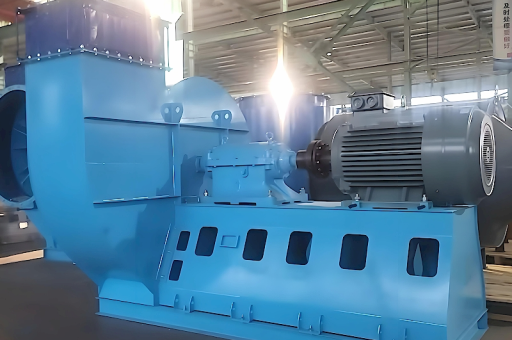
The 4-72 series is a forward-curved centrifugal fan originally designed for general ventilation, but its robust structure makes it adaptable for demanding industrial use. Key features include:
- Casing: Heavy-gauge steel welded construction, reinforced for pressure stability.
- Impeller: Backward-inclined blades (12–16 blades) made from high-strength steel or stainless steel. Balanced dynamically to ISO G6.3 or better.
- Inlet cone: Streamlined to reduce turbulence and improve aerodynamic efficiency.
- Drive system: Direct drive or belt-driven, depending on voltage and speed requirements.
In the high-temperature variant, all internal components are coated or fabricated from heat-resistant alloys such as 304/316 stainless steel or Inconel. Bearings are equipped with high-temperature grease and external cooling fins.
High-Temperature Resistance: Materials and Engineering Solutions
When ambient or process temperatures exceed 200°C (up to 500°C in some exhaust systems), standard fans fail rapidly. The high-temperature 4-72 series addresses this through:
- Thermal expansion compensation: The shaft and impeller hub are designed with clearance to prevent binding.
- Heat slingers on the shaft to dissipate heat away from bearings.
- External bearing housing with cooling fans or water jackets.
- Motor insulation: Class H (180°C) or Class C (220°C) windings.
- Seal materials: Silicone or PTFE gaskets to prevent gas leakage.
This engineering allows continuous operation in environments such as boiler exhaust, hot air circulation in drying ovens, and industrial furnace ventilation.
Applications in Harsh Industrial Environments
The flexibility of voltage and temperature ratings makes the 4-72 series suitable across multiple sectors:
- Steel and metallurgy: 10KV fans for blast furnace exhaust, handling gas temperatures up to 350°C.
- Cement plants: 6KV fans for kiln exhaust and clinker cooling.
- Chemical processing: 440V or 660V fans for corrosive gas extraction, often with epoxy coating.
- Power generation: Induced-draft fans in coal-fired plants requiring 6KV motors with double insulation.
- Mining: 660V explosion-proof variants for underground ventilation.
In each case, the fan is customized with specific impeller pitch, housing thickness, and motor protection to match the local voltage grid and thermal load.
Performance Optimization and Energy Efficiency
High-voltage operation inherently reduces current draw, which minimizes ( I^2R ) losses in cables and switchgear. Combined with the aerodynamic efficiency of the 4-72 impeller (up to 82% static efficiency), these fans offer excellent energy savings over older designs.
Modern variable frequency drives (VFDs) can be adapted for 6KV and 10KV fans—though they require specialized medium-voltage inverters—allowing precise airflow control without mechanical dampers. For 440V and 660V fans, off-the-shelf VFDs are more widely available, making retrofitting easier.
Additionally, advanced impeller design reduces noise levels to below 85 dB(A) in most operating ranges, contributing to better workplace compliance.
Frequently Asked Questions (FAQ)
Q1: Can the 4-72 centrifugal fan operate at voltages between standard ratings?
A: Yes, but only with a properly rewound motor. Running a 440V fan on a 660V supply without modification will cause insulation failure. Always confirm the nameplate voltage range.
Q2: What is the maximum continuous temperature for the 4-72 high-temperature fan?
A: Standard models handle 200°C. With stainless steel impeller and ceramic coating, the limit extends to 450°C. For short bursts (e.g., startup), 500°C is possible with proper derating.
Q3: How do I convert a 4-72 fan from belt drive to direct drive for high-voltage applications?
A: Consult the manufacturer. Direct drive at 6KV or 10KV requires a custom-designed motor with the impeller mounted directly on the shaft, along with vibration isolation and alignment verification.
Q4: Is explosion-proof certification available for the 4-72 series?
A: Yes. ATEX and IECEx certified models exist, featuring spark-resistant impellers, conductive casings, and temperature monitoring for use in hazardous zones.
Q5: Does voltage affect the airflow or pressure of the fan?
A: No. The fan curve (flow vs pressure) is determined by impeller geometry and rotational speed, not voltage. However, voltage affects motor speed in direct-drive systems, so the fan performance will scale with speed.
Q6: What maintenance is required for high-voltage fans in hot environments?
A: Regularly inspect insulation resistance (megger test), bearing temperature, and alignment. Replace high-temperature grease every 2,000 hours. For 6KV and 10KV fans, partial discharge testing is recommended annually.
Q7: Can I use a 4-72 fan for fume extraction at 400°C with 10KV supply?
A: Yes, provided you select the high-temperature version with a stainless steel impeller and an external cooling shroud for the motor. Confirm with the supplier that the motor insulation is Class H or higher.
Q8: Where can I find replacement parts for an older 4-72 fan?
A: Reputable industrial fan manufacturers maintain archives for the 4-72 series. Search for suppliers with "4-72 impeller", "high-temperature fan parts", or contact the original manufacturer via fan.
Conclusion: Why the 4-72 Series Stands Out
The 4-72 industrial centrifugal fan is not just a legacy design—it is a proven platform that has been successfully adapted to meet the demands of modern high-voltage, high-temperature environments. Whether you need a 440V unit for a small chemical plant or a 10KV monster for a steel mill, the series offers flexibility, durability, and energy efficiency that is hard to match.
By understanding the critical interplay between voltage class, thermal stress, and mechanical construction, engineers and plant managers can select or customize a fan that will deliver reliable, safe, and cost-effective performance for decades. Always consult with experienced system integrators or the fan manufacturer to ensure that your specific operating conditions—temperature, voltage, humidity, and corrosive agents—are properly addressed.
For more technical documentation or to request a custom quote, visit fan or contact your local industrial fan distributor.





