
This article's table of contents introduction:
- Understanding the "Forward Curved" (Squirrel Cage) Design
- The "High Temperature" Challenge (350°C / 662°F and above)
- Key Specifications for a Brick Kiln Fan
- Common Applications in a Brick Kiln
- What to look for in a Manufacturer / Supplier
- Summary Table: Heavy Duty High Temp Forward Curved Fan
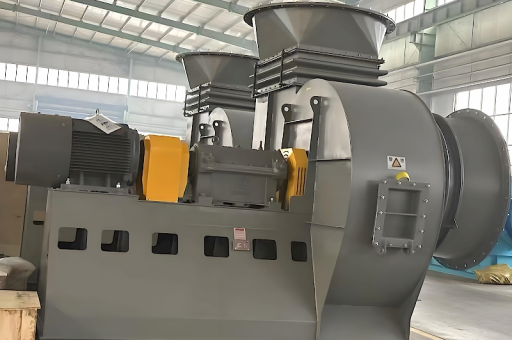
It seems you are looking for information regarding a heavy-duty, forward-curved, high-temperature centrifugal fan specifically used for brick kilns.
This is a very specific industrial application. In a brick kiln (such as a Hoffman, Tunnel, or Zig-Zag kiln), these fans are critical for providing combustion air and, more importantly, for forced draft or induced draft to control the temperature profile and remove exhaust gases.
Here is a breakdown of what defines this equipment and what you need to consider.
Understanding the "Forward Curved" (Squirrel Cage) Design
- How it works: The blades curve in the direction of rotation.
- Pros: High volume of air at relatively low static pressure. Very compact for the airflow it delivers.
- Why for a Kiln? In a brick kiln, you need to move large volumes of hot air and flue gas through the setting (the bricks) to heat them evenly. A forward-curved fan is excellent for overcoming the resistance of the brick setting (static pressure) while moving a massive volume of air.
- Heavy Duty: Standard sheet metal fans will warp or crack. "Heavy Duty" implies:
- Thicker gauge steel (e.g., 8mm, 10mm or more) for the housing and impeller.
- Reinforced impeller with a heavy solid hub and shroud to prevent blade fatigue at high temperatures.
- Robust shaft (often 40mm to 80mm diameter) running in heavy-duty bearings.
The "High Temperature" Challenge (350°C / 662°F and above)
This is the most critical aspect. Standard fans fail immediately in a brick kiln. A high-temp fan must have:
- Material: The impeller, housing, and shaft must be made of Corten Steel (e.g., ASTM A606, S355J2WP) or Stainless Steel (e.g., SS310, SS316) for temperatures above 150°C.
- Thermal Shaft Cooler: A "heat slinger" or a finned cooling disc mounted on the shaft between the fan housing and the bearing. This prevents the heat from traveling down the shaft and destroying the grease or oil in the bearings.
- Bearing Housing: The bearings must be mounted outboard (on a separate pedestal base) or have a water-cooled bearing housing if the gas temperature exceeds 350°C.
- Expansion: The fan housing must have allowance for thermal expansion. Bolts may use spring washers, and the shaft must have an expansion joint.
Key Specifications for a Brick Kiln Fan
When ordering or specifying this fan, you need these parameters:
| Parameter | Typical Kiln Values | Why it matters |
|---|---|---|
| Volume (m³/hr or CFM) | 10,000 to 200,000+ | Must match the kiln size and firing rate. |
| Static Pressure (mmWC or Pa) | 100 to 400 mmWC | Must overcome the resistance of the brick setting and the kiln. |
| Temperature | 150°C (cooling air) to 400°C (exhaust gas) | The single most important factor for material choice. |
| Gas Composition | Contains hot air, CO2, SOx, dust, moisture | May require corrosion-resistant coatings or stainless steel. |
| Speed (RPM) | 1000 to 2900 RPM | Balanced impeller is critical to avoid vibration. |
Common Applications in a Brick Kiln
- Induced Draft (ID) Fan: The main exhaust fan pulling flue gases through the kiln. This is the most demanding job (highest temperature, most corrosive gas).
- Forced Draft (FD) Fan: Pushes cooling air through the finished bricks to recover heat.
- Cooling Fans: Used in the cooling zone of the kiln.
- Air Blast Fans: For the burners.
What to look for in a Manufacturer / Supplier
If you are sourcing this fan, look for a manufacturer that specializes in Industrial Fans (not HVAC fans) and ask them specifically for:
- Certified high-temp impeller: Ask for a balance report at operating speed.
- Material Certificate: Insist on the Mill Test Certificate for the Corten or SS steel used.
- Cooling System: Confirm if the shaft cooler is adequate for your peak temperature.
- Direct Drive vs. Belt Drive:
- Direct Drive: More efficient, less maintenance (no belt dust), but the motor must be rated for the ambient heat or located far away.
- Belt Drive: Allows speed changes easily, but belts degrade in heat.
Summary Table: Heavy Duty High Temp Forward Curved Fan
| Feature | Specification |
|---|---|
| Type | Forward Curved (Squirrel Cage) Centrifugal |
| Duty | Heavy Duty (Industrial; 24/7 operation) |
| Air Temp | Max 350°C - 450°C (with cooling shaft) |
| Material | Corten Steel (S355J2W) or SS 310/316 |
| Bearing | Outboard pedestal with heat slinger / water cooling |
| Max Pressure | Up to 400 mmWC (roughly 4 kPa) |
| Drive | V-Belt or Direct Coupled |
Are you looking for help with a specific symptom (e.g., fan is vibrating, overheating, or not pulling enough air)? Or are you trying to find a specific manufacturer or part number? Providing those details would allow me to give you a far more precise answer.





