
This article's table of contents introduction:
- Article Navigation / Table of Contents (导读目录)
- 1. Introduction: The Heat Challenge in Carbon Steel Kilns
- 2. Why Cooling Matters: Thermal Stress, Product Quality, and Energy Waste
- 3. Industrial Centrifugal Fans: The Core of Kiln Cooling Systems
- 4. Energy Saving Strategies for Kiln Cooling Fans
- 5. Frequently Asked Questions (常见问答)
- 6. Real-World Case Study: Retrofitting Fans for 30% Energy Reduction
- 7. Conclusion: The Future of Sustainable Kiln Operations
Maximizing Energy Efficiency in Industrial Carbon Steel Kilns: The Critical Role of Cooling Centrifugal Fans**
Article Navigation / Table of Contents (导读目录)
- Introduction: The Heat Challenge in Carbon Steel Kilns
- Why Cooling Matters: Thermal Stress, Product Quality, and Energy Waste
- Industrial Centrifugal Fans: The Core of Kiln Cooling Systems
- Energy Saving Strategies for Kiln Cooling Fans
- Variable Frequency Drives (VFDs)
- Aerodynamic Impeller Design
- Automated Temperature Feedback Loops
- Frequently Asked Questions (常见问答)
- Real-World Case Study: Retrofitting Fans for 30% Energy Reduction
- Conclusion: The Future of Sustainable Kiln Operations
Introduction: The Heat Challenge in Carbon Steel Kilns
In industrial heat treatment processes using carbon steel kilns, temperature control is not just a quality metric—it is a critical factor that determines energy consumption, equipment lifespan, and operational cost. After the heating phase, the kiln must undergo a controlled cooling cycle. If cooling is too slow, production throughput drops; if it is uneven, thermal stress can warp the carbon steel components or degrade the refractory lining.
Traditionally, many facilities relied on natural draft or axial fans for cooling. However, the demand for higher throughput and stricter energy regulations has shifted attention to industrial centrifugal fans designed specifically for kiln cooling. These fans, when properly selected and controlled, can dramatically reduce energy usage while improving cooling uniformity.
Why Cooling Matters: Thermal Stress, Product Quality, and Energy Waste
A carbon steel kiln operates at temperatures ranging from 800°C to 1200°C during the heating cycle. Upon completion, the kiln must be cooled to a safe handling temperature—typically below 200°C—without causing microstructural defects in the steel.
- Thermal Stress: Rapid or uneven cooling leads to warping, cracking, or hardness inconsistencies, which can ruin entire batches.
- Energy Waste: Inefficient fans run at full speed regardless of actual cooling needs, wasting electricity and generating unnecessary heat load on the motor windings.
- Operational Costs: A typical large industrial kiln may run a cooling cycle for 4–6 hours. If the fan consumes 75 kW during that period, the annual electricity cost can exceed $50,000 per kiln—before factoring in maintenance.
The choice of cooling fan technology directly impacts all three areas.
Industrial Centrifugal Fans: The Core of Kiln Cooling Systems
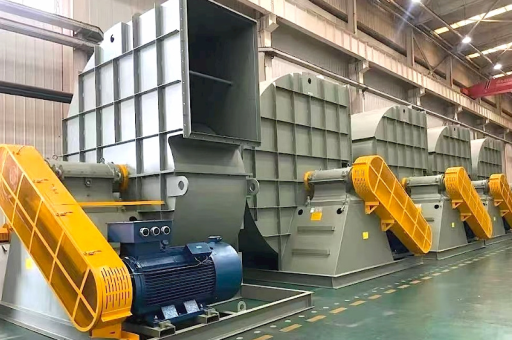
Unlike axial fans, which move air along the fan axis, centrifugal fans (also called radial fans or squirrel-cage fans) use a rotating impeller to accelerate air radially outward. This design creates higher static pressure, which is essential for overcoming the resistance of ductwork, heat exchangers, and the dense hot air inside a kiln.
Key technical advantages for carbon steel kiln cooling include:
- High Static Pressure Capability: Centrifugal fans can push cool air through long duct runs and across the hot kiln surface, ensuring uniform heat extraction.
- Dust and Particle Tolerance: The enclosed housing and backward-curved or radial blades handle particulates better than axial fans, reducing fouling.
- Variable Airflow Control: When paired with a variable frequency drive (VFD), centrifugal fans can modulate airflow precisely to match the temperature curve, avoiding overcooling.
Fan Materials: For carbon steel kiln environments, fan housings are often constructed from welded carbon steel with heat-resistant coatings, while the impeller may use high-strength alloy steel or stainless steel to avoid deformation at elevated temperatures.
Energy Saving Strategies for Kiln Cooling Fans
Variable Frequency Drives (VFDs)
The most impactful energy saving measure is installing a VFD on the fan motor. According to the fan affinity laws:
- Airflow is proportional to motor speed.
- Power consumption is proportional to the cube of speed. A 20% reduction in fan speed results in approximately 50% less power draw. For kilns that do not require full cooling capacity during the entire cycle, VFDs can reduce annual energy consumption by 25–40%.
Aerodynamic Impeller Design
Modern backward-curved impeller blades reduce turbulence and energy loss. Compared to older forward-curved or radial blade designs, backward-curved centrifugal fans achieve higher efficiency (up to 85%) at design point conditions. This directly translates to lower electricity bills.
Automated Temperature Feedback Loops
Integrating thermocouples inside the kiln with a PID (Proportional-Integral-Derivative) controller, which commands the VFD to adjust fan speed, creates a closed-loop system. The fan runs only as fast as needed to maintain the desired cooling rate. This eliminates the common practice of running fans at full speed "just in case."
| Strategy | Estimated Energy Saving | Payback Period |
|---|---|---|
| VFD Retrofit | 25–40% | 12–18 months |
| Impeller Replacement | 5–15% | 8–14 months |
| Automated PID Control | 10–20% (additional) | 6–10 months |
Frequently Asked Questions (常见问答)
Q1: Can I use a standard industrial fan for a carbon steel kiln cooling application?
A: Not reliably. Carbon steel kilns produce high ambient heat and may release scale or dust. Standard axial fans lack the static pressure needed to move air through the kiln's restrictive geometry. A specialized centrifugal fan with heat-resistant bearings and a robust housing is essential for long-term reliability.
Q2: How do I calculate the required fan airflow for my kiln?
A: The basic formula is:
CFM = (Heat Load in BTU/hr) / (1.08 × Temperature Difference in °F)
Where Heat Load is the total heat that must be removed from the kiln walls and product. For precise sizing, consult a fan manufacturer’s engineering data or use computational fluid dynamics (CFD) simulation.
Q3: Is it worth retrofitting an old fan with a VFD?
A: Yes, especially if the fan currently runs at constant speed. Most industrial fans are oversized for average conditions. A VFD retrofit typically pays for itself within 18 months in energy savings alone, not including reduced mechanical wear.
Q4: What is the typical lifespan of a centrifugal fan in a kiln cooling role?
A: With proper maintenance (bearing lubrication, cleaning, balance checks), a well-built centrifugal fan can last 15–20 years. The motor and VFD may require replacement earlier, but the fan housing and impeller are durable.
Q5: Can energy saving fans also reduce noise levels?
A: Yes. Running a fan at lower speed with a VFD reduces both mechanical noise and aerodynamic turbulence. Many users report a noise reduction of 5–10 dB(A) after installing a VFD or replacing an old impeller with a backward-curved design.
Real-World Case Study: Retrofitting Fans for 30% Energy Reduction
A mid-size carbon steel forging plant operated three batch kilns, each cooled by a 100 hp constant-speed centrifugal fan (model: BC-100, similar to a typical backward-curved industrial fan). The fans ran at full speed for the entire 6-hour cooling cycle, consuming 450 kWh per cycle per kiln.
After an energy audit:
- Each fan received a VFD (Yaskawa U1000 series).
- The impeller was replaced with a high-efficiency backward-curved design.
- A temperature sensor and PID controller were installed to modulate fan speed.
Results after 12 months:
- Average power consumption dropped from 450 kWh to 280 kWh per cycle (37% reduction).
- Cooling time reduced by 18% due to better air distribution.
- Motor bearing temperatures dropped by 15°C, extending service intervals.
- Annual electricity savings: $48,000 across three kilns.
The total retrofit cost was $56,000, yielding a payback period of 14 months. The plant now operates its cooling fans more intelligently, contributing to its ISO 50001 energy management certification.
Conclusion: The Future of Sustainable Kiln Operations
Efficient cooling of carbon steel kilns is no longer an afterthought—it is a strategic lever for reducing energy costs and improving product quality. Industrial centrifugal fans, with their high static pressure, robust construction, and compatibility with modern variable speed drives, are the ideal solution for this demanding application.
By adopting VFDs, optimized impeller designs, and automated controls, manufacturers can cut fan energy consumption by 30–50%, reduce thermal stress on kiln components, and achieve faster production cycles. As energy prices rise and environmental regulations tighten, investing in carbon steel kilns cooling with energy-saving industrial centrifugal fans is not just good engineering—it is good business.
For those considering a retrofit or new installation, consult with a qualified fan manufacturer to model your specific kiln geometry and cooling profile. The path to lower energy bills and higher productivity begins with the fan.





