
This article's table of contents introduction:
- Table of Contents
- Introduction
- What Are Q345 Heavy Duty Centrifugal Fans?
- The Role of Centrifugal Fans in Blast Furnace Operations
- Energy Saving Potential with Q345 Material and Aerodynamic Design
- Key Technical Features and Performance Metrics
- Common Questions (Q&A)
- Conclusion and Future Outlook
Q345 Heavy Duty Centrifugal Fans for Blast Furnace Energy Saving: Design, Benefits, and Industry Applications
Table of Contents
- Introduction
- What Are Q345 Heavy Duty Centrifugal Fans?
- The Role of Centrifugal Fans in Blast Furnace Operations
- Energy Saving Potential with Q345 Material and Aerodynamic Design
- Key Technical Features and Performance Metrics
- Common Questions (Q&A)
- Conclusion and Future Outlook
Introduction
In modern steelmaking and heavy industrial processes, blast furnaces require massive volumes of air at high pressure for combustion and material handling. The efficiency of these systems directly affects energy consumption and operational costs. Q345 heavy duty centrifugal fans have emerged as a critical component in achieving energy savings, reliability, and durability in such demanding environments. This article explores the material properties, structural advantages, and energy-saving mechanisms of these fans, supported by technical data and real-world application insights.
What Are Q345 Heavy Duty Centrifugal Fans?
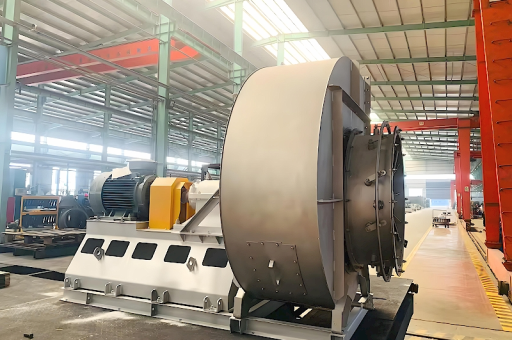
Q345 is a low-alloy high-strength structural steel widely used in China and international engineering. It offers a yield strength of approximately 345 MPa and excellent weldability, making it ideal for heavy-load fan components such as impellers, housings, and shafts. A heavy duty centrifugal fan made from Q345 steel is designed to handle high-temperature, high-dust, and high-pressure conditions typical in blast furnace systems.
These fans operate by converting rotational kinetic energy into increased static pressure and airflow. Unlike standard carbon steel fans, Q345 fans resist deformation under thermal stress and mechanical fatigue, ensuring long service life even in continuous 24/7 operation.
The Role of Centrifugal Fans in Blast Furnace Operations
A blast furnace demands a constant and controlled supply of preheated air (hot blast) to maintain combustion efficiency. This air is delivered via heavy duty centrifugal fans, often called blast furnace blowers. The fan’s performance directly affects:
- Combustion temperature stability
- Iron ore reduction rate
- Fuel consumption (coke or injected coal)
- Emission levels
Any fluctuation in airflow or pressure can cause energy waste or product quality issues. Thus, using robust, high-efficiency fans is not optional—it is a prerequisite for competitive steel production.
Energy Saving Potential with Q345 Material and Aerodynamic Design
Energy saving in blast furnace fans is achieved through two complementary approaches: material optimization and aerodynamic refinement.
Material Advantage:
Q345 steel allows for thinner, lighter fan blades and housings without sacrificing strength. Reduced mass lowers the inertia of rotating parts, decreasing the starting torque and energy required for acceleration. Additionally, better heat tolerance reduces thermal expansion losses, maintaining consistent clearances between rotating and stationary parts.
Aerodynamic Design:
Modern Q345 heavy duty centrifugal fans employ backward-curved or airfoil blades. These geometries reduce turbulence and internal recirculation losses. Computational Fluid Dynamics (CFD) simulations are used to optimize the blade profile, inlet cone, and volute shape. As a result, fan efficiency can reach 82–88%, compared to 70–75% in older designs.
Real-World Energy Saving Example:
In a 2500 m³ blast furnace, replacing conventional fan with a Q345 optimized centrifugal fan resulted in a 12% reduction in electricity consumption (from 8.5 MW to 7.5 MW), saving approximately 1.8 million kWh annually. At an industrial electricity rate, this translates to over $150,000 saved per year.
Key Technical Features and Performance Metrics
| Feature | Specification / Benefit |
|---|---|
| Material | Q345B / Q345D (yield ≥ 345 MPa, good impact toughness at -20°C) |
| Impeller Type | Backward-curved or airfoil blades |
| Operating Temperature | Up to 450°C (with high-temperature coating) |
| Pressure Range | 20–80 kPa (depending on stage design) |
| Flow Rate | 500,000 – 2,000,000 m³/h |
| Drive Type | Direct coupling or V-belt; variable frequency drive (VFD) recommended |
| Vibration Level | ≤ 2.8 mm/s (balanced to G6.3 or better) |
| Coating | Anti-corrosion + erosion-resistant thermal spray |
Maintenance Advantage:
Q345 fans require less frequent blade replacement due to superior fatigue resistance. Predictive maintenance enabled by vibration sensors and temperature monitoring further extends service intervals.
Common Questions (Q&A)
Q1: Why choose Q345 over stainless steel for heavy duty fans?
A: Q345 offers a better strength-to-cost ratio. Stainless steel may be needed for extreme corrosion (e.g., wet flue gas), but for dry, high-temperature blast furnace air, Q345 with proper coating delivers optimal lifespan and energy performance at lower material cost.
Q2: Can Q345 fans operate with variable frequency drives (VFD)?
A: Yes. VFDs are highly recommended. The robust Q345 impeller can handle the mechanical stress of variable speed without resonance issues, and VFDs allow precise airflow control, saving 15–30% energy compared to damper control.
Q3: How do I verify the energy saving effect?
A: Conduct a baseline power measurement on the existing fan, then install the Q345 fan with the same motor and compare kWh consumption over a fixed period (e.g., one month). Use a calibrated flow meter and power analyzer to confirm efficiency gains.
Q4: What is the typical delivery lead time?
A: For custom-engineered Q345 heavy duty centrifugal fans (e.g., for a specific blast furnace size), lead time is usually 8–12 weeks, including design, fabrication, balancing, and testing.
Q5: Is on-site balancing required?
A: Most reputable manufacturers (like fan) provide factory dynamic balancing to ISO 1940 G6.3. However, on-site rebalancing may be needed after installation due to foundation settling or ductwork stress.
Conclusion and Future Outlook
Q345 heavy duty centrifugal fans represent a proven, cost-effective solution for energy savings in blast furnace applications. Their high strength, thermal stability, and compatibility with modern aerodynamic designs deliver measurable reductions in electricity consumption and maintenance costs. As steel plants face increasing pressure to lower carbon emissions and operational expenses, investing in such high-performance fans is a strategic move.
Future developments include integration with smart sensors, AI-based predictive control, and hybrid materials combining Q345 with ceramic coatings for even longer life. The bottom line: for any blast furnace operator seeking reliable, efficient air movement, the Q345 heavy duty centrifugal fan is not just an option—it is the standard.
For more technical specifications or customized design support, consult a professional fan engineering provider like fan.





