
This article's table of contents introduction:
- The Core Specification Breakdown
- The Specific Fan Type: Heavy-Duty Backward Curve (Airfoil or Flat-Bladed)
- Critical Corrosion-Proofing & Material Specifications
- Key Engineering Features for a "Cement Fan"
- Where to Find this Fan?
- To get a proper quote, you MUST provide:
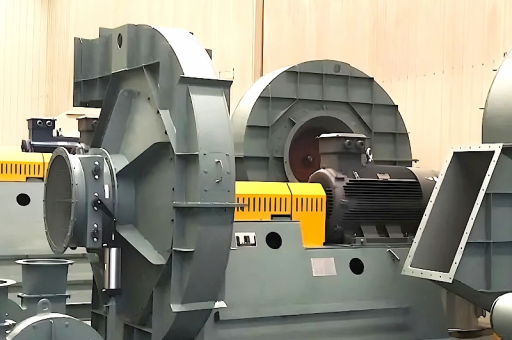
It appears you are looking for a specific type of industrial fan. Based on the keywords Low Pressure, Large Capacity, Anticorrosion, and Gas Delivery (specifically for Cement), you are likely describing a Cement Mill Exhaust Fan or a Kiln ID (Induced Draft) Fan used in the cement manufacturing process.
Here is a breakdown of what this specification means and what type of equipment you are actually looking for.
The Core Specification Breakdown
- Low Pressure: In cement plants, this usually means the fan needs to overcome system resistance (ductwork, baghouses, cyclones) without needing to push/pull against extremely high static pressure. Typically, this falls in the range of 500 to 1,500 Pa (approx. 2" to 6" w.g.).
- Large Capacity: Cement plants move massive volumes of air and hot gas. "Large Capacity" for this application means flow rates from 200,000 m³/h up to 1,000,000+ m³/h (120,000 to 600,000+ CFM).
- Anticorrosion: This is critical because the gas in a cement plant contains:
- Moisture & Acid: Raw materials contain sulfur and chlorine. When heated, these form sulfuric acid (H₂SO₄) and hydrochloric acid (HCl), which condense and corrode standard carbon steel.
- Abrasive Dust: Cement clinker dust is highly abrasive and can erode fan blades if not handled correctly.
- Gas Delivery (Cement): The fan is moving hot, often humid, gas from the raw mill, kiln, or cement mill.
The Specific Fan Type: Heavy-Duty Backward Curve (Airfoil or Flat-Bladed)
The most common fan design meeting these criteria is a Single-Inlet or Double-Inlet Centrifugal Fan with Backward-Inclined (Backward-Curved) Blades.
Why this fan?
- High Efficiency: Handles large volumes of gas efficiently.
- Stable Performance (Low Pressure): The flat pressure curve of a backward-curved fan matches the "low pressure, high volume" requirement perfectly.
- Self-Cleaning (Relative): The design reduces dust buildup on the blades compared to forward-curved or radial-blade fans.
Critical Corrosion-Proofing & Material Specifications
This is where "Anticorrosion" becomes specific. Standard carbon steel will fail quickly.
For the Fan Material:
- Cor-Ten Steel (Weathering Steel): A common choice for raw mill and kiln exhaust fans. It forms a stable rust layer that is significantly more resistant to atmospheric corrosion than standard steel.
- Stainless Steel (SS304 or SS316L): Used when the gas contains very high acid concentrations (e.g., near kiln inlets with heavy chlorides). SS316L is preferred for high chloride environments.
- High-Chrome Alloys: For the most extreme conditions (e.g., raw gas fans near the kiln), the impeller may be made of Duplex Stainless Steel (e.g., SAF 2205) or a high-chrome cast iron.
For the Fan Coating (If not using solid alloy):
- Zinc-Rich Primer + High-Build Epoxy or Polyurethane Coating: For less severe conditions.
- Rubber Lining (Hard or Soft): Used as a sacrificial barrier against severe chemical attack. Very common in wet scrubber exhaust fans.
- Tungsten Carbide Coatings: Applied to the leading edge of blades specifically to resist erosion from cement dust particles. This is often more critical than pure corrosion.
Key Engineering Features for a "Cement Fan"
- Shaft Seal: Must be airtight to prevent gas leakage. A carbon ring seal or labyrinth seal is typical.
- Bearing Cooling: Usually requires water-cooled or oil-lubricated bearings with a cooling system, as the gas temperature can be high (150°C to 400°C / 300°F to 750°F).
- Drainage: The fan housing must have drain plugs at the lowest point to remove condensed acid.
- Bypass Damper: Often required to prevent condensation when the fan is running at low speed.
Where to Find this Fan?
You should search for suppliers specializing in Cement Plant Fans. Look for these specific models:
| Supplier | Potential Product Name |
|---|---|
| Howden | Bullnose Axial / Centrifugal Kiln Gas Fans (Their "FN" or "AN" series) |
| New York Blower (NYB) | Series 30 or 40 DH (Double Width, Double Inlet) with special coating |
| Chicago Blower | RF (Rugged Duty) / HP (High Pressure) for Cement |
| TLT-Turbo (Germany) | Gas Fans for Cement Kilns |
| Citic Heavy Industries (China) | Various Cement Mill Exhaust Fans |
| Soler & Palau (S&P) | Industrial Process Fans (specific models vary) |
To get a proper quote, you MUST provide:
- Gas Temperature: (e.g., 200°C / 400°F or 350°C / 660°F) - Crucial for material selection.
- Gas Composition: (% O₂, CO₂, H₂O, SO₂, Cl, Dust content). "Corrosive" is subjective. Is it just humidity, or actual acid?
- Flow Rate (m³/h or CFM): Normal or standard conditions?
- Static Pressure (Pa or in. w.g.): The total system resistance.
- Density of Gas: If the gas is hot, it's less dense, which changes fan performance.
- Mounting: Open Drip-proof motor? Direct drive? Belt drive?
Summary: You need a heavy-duty, backward-inclined centrifugal fan (single or double width) made from Cor-Ten or stainless steel, with tungsten carbide hard-facing on the blades, and a high-temperature, water-cooled bearing system. It will likely be called a Cement Mill Exhaust Fan or Kiln Induced Draft Fan.





