
This article's table of contents introduction:
- Introduction to the Grate Cooler System in Cement Plants
- The Cooling ID Centrifugal Fan: A Core Component
- Why High-Pressure Fans Are Essential for Grate Cooler Performance
- Technical Specifications and Operating Principles
- Common Challenges and Maintenance Best Practices
- FAQ: Answering Key Questions About Grate Cooler Fans
- Conclusion: Enhancing Plant Reliability and Energy Efficiency
*Optimizing Cement Plant Efficiency: The Critical Role of the Grate Cooler Cooling ID Centrifugal Fan in High-Pressure Applications*
Table of Contents
- Introduction to the Grate Cooler System in Cement Plants
- The Cooling ID Centrifugal Fan: A Core Component
- Why High-Pressure Fans Are Essential for Grate Cooler Performance
- Technical Specifications and Operating Principles
- Common Challenges and Maintenance Best Practices
- FAQ: Answering Key Questions About Grate Cooler Fans
- Conclusion: Enhancing Plant Reliability and Energy Efficiency
Introduction to the Grate Cooler System in Cement Plants
In modern cement manufacturing, the grate cooler is a critical piece of equipment located downstream of the rotary kiln. Its primary function is to rapidly cool hot clinker (typically at 1200–1400°C) to a manageable temperature (below 100°C) while recovering waste heat for preheating combustion air. Without efficient cooling, clinker quality deteriorates, and downstream handling equipment suffers from thermal stress.
The cooling process relies heavily on forced airflow. This is where the Cooling ID (Induced Draft) Centrifugal Fan comes into play. Specifically, a high-pressure centrifugal fan is required to overcome the resistance posed by the thick clinker bed on the grate plates. The term "ID" indicates that the fan pulls air through the cooler system, creating negative pressure that ensures uniform air distribution across the clinker bed.
The Cooling ID Centrifugal Fan: A Core Component
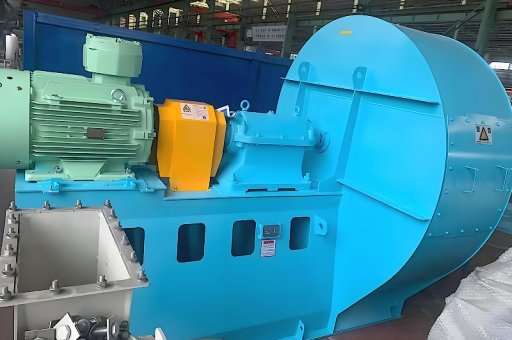
The Grate Cooler Cooling ID Centrifugal Fan is not a standard low-pressure ventilation fan. It is a heavy-duty, high-static-pressure machine designed to:
- Deliver air at pressures ranging from 2500 to 5000 Pa (sometimes higher, depending on cooler design).
- Operate continuously at high temperatures (inlet air temperature can reach 150–250°C).
- Provide a stable flow rate of 200,000 to 600,000 m³/h for large-scale cement lines.
Constructed with abrasion-resistant materials (e.g., wear liners on the impeller and casing), these fans often feature backward-curved blades for higher efficiency and lower noise. In many cement plants, the fan is driven by a variable frequency drive (VFD) to modulate airflow precisely according to clinker production rates.
Why High-Pressure Fans Are Essential for Grate Cooler Performance
A common misconception is that any large fan can cool clinker. However, the high-pressure requirement is non-negotiable. Here’s why:
- Clinker Bed Resistance: Fresh clinker forms a porous but dense bed on the grate. The fan must overcome the pressure drop across this bed, which can exceed 1500–2000 Pa.
- Air Distribution Uniformity: Insufficient pressure leads to "channeling" – where air bypasses the thickest clinker zones, leaving hot spots. A high-pressure ID fan ensures that even the deepest layers receive adequate cooling.
- Heat Recovery Efficiency: Higher pressure allows the fan to push air through the recuperation zones (where hot air is directed back to the kiln), improving thermal efficiency by up to 10%.
Technical Specifications and Operating Principles
A typical Grate Cooler Cooling ID Centrifugal Fan operates on the following principles:
- Induced Draft (ID): The fan is positioned at the cooler outlet, pulling air through the clinker bed and the grate. This creates a negative pressure inside the cooler housing, preventing dust leakage.
- Centrifugal Design: Air enters axially and is expelled radially, gaining kinetic energy that converts to pressure. The impeller diameter often exceeds 2 meters for large plants.
- High Static Pressure: The fan’s total pressure (static + dynamic) is designed to handle system resistance. For ultra-high-pressure applications, some plants use two-stage centrifugal fans in series.
- Temperature Resilience: Bearings and shaft seals are cooled by external air or water, and the impeller is often made from wear-resistant steel or coated with ceramic.
Common Challenges and Maintenance Best Practices
Even robust fans face operational challenges in cement plants:
| Challenge | Cause | Solution |
|---|---|---|
| Vibration | Clinker dust buildup on impeller | Regular cleaning; balancing after maintenance |
| Overheating | Inadequate bearing cooling or high inlet temperature | Install cooling ducts; monitor bearing temperature with sensors |
| Erosion | Abrasive clinker particles at high velocity | Use wear liners; replace impeller vanes every 6–12 months |
| Motor overload | Damper misalignment or VFD failure | Inspect dampers weekly; calibrate VFD parameters |
Pro Tip: Always maintain a log of fan current, vibration, and pressure differential. A sudden drop in differential pressure often signals a blocked grate, not a fan issue.
FAQ: Answering Key Questions About Grate Cooler Fans
Q1: Why is a high-pressure fan preferred over a low-pressure fan for grate coolers?
A: Low-pressure fans cannot penetrate the dense clinker bed, resulting in poor cooling and reduced clinker quality. High-pressure fans (2500 Pa+) ensure airflow reaches the bottom of the bed.
Q2: Can a standard centrifugal fan be retrofitted for a grate cooler?
A: Not recommended. Standard fans lack the high static pressure capability and heat resistance. Always use a fan specifically designed for industrial cement applications.
Q3: What is the lifespan of a cooling ID centrifugal fan?
A: With proper maintenance (including impeller balancing and bearing replacement), the fan casing can last 15–20 years. Impeller vanes may need replacement every 3–5 years depending on clinker abrasiveness.
Q4: How does a variable frequency drive (VFD) optimize fan performance?
A: A VFD adjusts fan speed to match real-time clinker flow, reducing energy consumption by 20–30% compared to damper control. It also extends motor and bearing life.
Q5: What should I check when the fan suddenly runs hotter than normal?
A: Inspect the inlet damper (could be closed too much), check for dust accumulation on the impeller, and verify that the bearing cooling system is functional. If all else fails, shut down and inspect the VFD output.
Conclusion: Enhancing Plant Reliability and Energy Efficiency
The Grate Cooler Cooling ID Centrifugal Fan serves as the lungs of the clinker cooling system. Without a properly sized, high-pressure ID fan, cement plants risk thermal inefficiency, clinker quality issues, and frequent unscheduled downtime. By selecting a fan that matches the pressure and flow demands of your specific cooler model, and by adhering to a rigorous maintenance schedule, you can significantly extend equipment life and reduce energy costs.
In an era where every kilowatt-hour counts, investing in a reliable, high-efficiency ID centrifugal fan is not an expense—it is a strategic decision that pays dividends in production stability and operational savings.
For more information on fan specifications or to request a sizing calculation for your cement plant, consult a reputable industrial fan manufacturer—or visit fan for detailed product comparisons and technical white papers.





