
This article's table of contents introduction:
- Why Use a 380V (Three-Phase) Fan for Dust Extraction?
- Common Types of 380V Dust Extraction Fans
- Critical Specifications & How to Choose
- Important Safety and Installation Considerations
- Example Applications
- Where to Look / Purchase
Here is a detailed overview of 380V power supply dust extraction fans used for effective air cleaning, covering their advantages, types, key specifications, and considerations.
Why Use a 380V (Three-Phase) Fan for Dust Extraction?
While single-phase (110V/230V) fans are common for small workshops, 380V (three-phase) motors are the standard for industrial and heavy-duty commercial applications.
Key Advantages:
- Higher Power & Efficiency: 380V systems can deliver significantly more power (HP/kW) than single-phase without drawing excessive current. They are typically up to 5-10% more efficient.
- Smoother Operation: Three-phase power provides a constant torque, reducing vibration and mechanical stress on the fan and ductwork.
- Lower Starting Current: Three-phase motors require a lower starting current compared to a single-phase motor of the same power, reducing strain on electrical systems.
- Better for Continuous Duty: Ideal for systems that run 8+ hours a day, as they run cooler and are more reliable than single-phase motors of similar power.
- Scalability: Can easily drive large centrifugal fans, powerful industrial cyclones, or baghouse systems needed to clean the air in factories.
Common Types of 380V Dust Extraction Fans
The most effective type for air cleaning depends on the specific dust (e.g., wood chips, metal grinding dust, chemical fumes).
| Fan Type | Description | Best For |
|---|---|---|
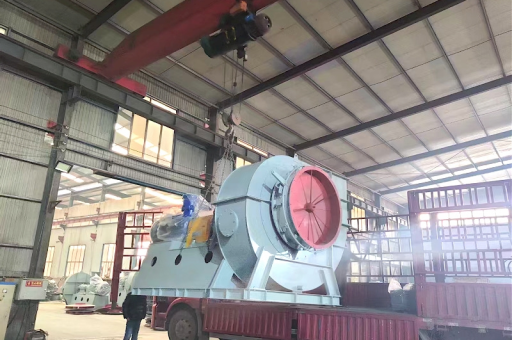
| Centrifugal (Radial) Fan | Air enters axially and exits radially (90-degree turn). Creates high static pressure. The most common type for dust extraction. | Moving heavy dust, chips, and debris through long duct runs. Very effective for woodworking, metal fabrication, and cement plants. |
| Backward Curved (BC) Fan | A specific type of centrifugal fan with blades curved away from the rotation direction. Very efficient and non-overloading (motor won't burn out if duct is blocked). | High-volume systems where efficiency and energy savings are critical. Good for fine dust and general industrial ventilation. |
| Inline Duct Fan | A cylindrical fan designed to be mounted directly in the ductwork. Can be single or three-phase. | Spaces where floor space is limited. Good for moving cleaner air (filtered exhaust) or for boosting airflow in long runs. |
| High-Pressure Blower | A specialized centrifugal fan designed for very high static pressure, often using a vortex impeller. | Central vacuum systems or pneumatic conveying of light materials. |
Critical Specifications & How to Choose
To ensure effective air cleaning, match these specs to your needs:
- Airflow (CFM / m³/h): This is the volume of air moved per minute. For dust extraction, you need to capture dust at the source (typically 400-800 CFM for a single woodworking machine, 2000+ CFM for a central system).
- Static Pressure (SP / inches of water gauge): This is the force needed to overcome resistance in the ductwork, filters, and cyclone. A fan with high CFM but low SP will fail if your duct is long or has many bends. For effective extraction, you need BOTH high CFM and sufficiently high SP.
- Motor Power (HP / kW):
- 2-3 HP (1.5-2.2 kW): Suitable for a single machine or a small shop with short duct runs.
- 5-7.5 HP (3.7-5.6 kW): Good for a central system serving 3-5 machines.
- 10+ HP (7.5+ kW): Required for large industrial facilities with multiple collection points.
- Duct Diameter: A 380V fan typically requires a 6-inch (150mm) to 8-inch (200mm) or larger duct. Never reduce the duct size too much, as it drastically reduces performance.
Important Safety and Installation Considerations
- Electrical Requirements: Ensure your facility has a 3-phase, 4-wire or 5-wire supply (Live 1, Live 2, Live 3, Neutral, Ground). You will need a qualified electrician to install the correct circuit breaker, contactor, and thermal overload relay.
- Filtration: The fan itself just moves air. The dust collector (cyclone, baghouse, or cartridge filter) does the actual cleaning. The fan is typically placed after the filter (on the clean air side) to protect the impeller from abrasive dust.
- Noise: 380V centrifugal fans can be very loud. You may need to install sound enclosures or mufflers, especially for indoor use.
- Maintenance: Regularly check fan belt tension (if belt-driven), bearing lubrication, and impeller balance. An unbalanced impeller can cause catastrophic failure.
Example Applications
- Woodworking Factory: A 10 HP (7.5kW) 380V centrifugal fan pulling 3000 CFM through a cyclone separator and a baghouse filter.
- Welding Shop: A 3 HP (2.2kW) 380V high-pressure fan drawing fumes from multiple welding stations through a cartridge filter.
- Pharmaceutical Plant: A 5 HP (3.7kW) 380V backward-curved fan moving fine powder through a HEPA filter system.
Where to Look / Purchase
You can find these from:
- Industrial Supply Companies: Grainger, McMaster-Carr (US) / RS Components, Hagemeyer (Global).
- Specialist Manufacturers: Oneida Air Systems, PennBarry, Greenheck, New York Blower.
- Online Marketplaces: Alibaba (for Chinese manufacturers), eBay (for used industrial fans).
Recommendation: If you are unsure which model is right for your facility, consult with a HVAC or dust collection engineer. They can calculate the exact CFM and static pressure needed based on your machine's port size, duct length, and target air velocity (often 4000 fpm for horizontal ductwork).





