
This article's table of contents introduction:
- What is a 15 kW Centrifugal Fan?
- Common Applications
- Estimated Performance & Specifications
- Key Components & Design Considerations
- How to Select the Correct 15 kW Fan (Crucial Steps)
- Cost & Procurement (Estimated - 2024/2025)
- Important Safety Considerations
- Summary Table
Okay, let's break down the specification of a 15 kW centrifugal fan. This is a common, heavy-duty piece of industrial equipment.
A "15 kW centrifugal fan" refers to the motor power. This is a significant amount of power, indicating a large fan designed for high-volume or high-pressure air movement.
Here’s a comprehensive overview covering what it is, what it's used for, its key components, and how to select one.
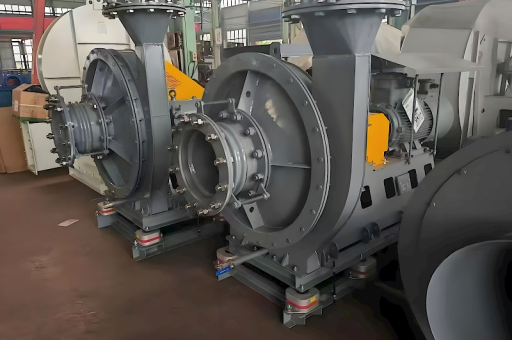
What is a 15 kW Centrifugal Fan?
- Drive Power: The electric motor that turns the fan impeller is rated at 15 kilowatts (or approximately 20 horsepower).
- Type: It's a "centrifugal" fan, meaning air enters the center of a rotating wheel (impeller) and is thrown outwards to the discharge by centrifugal force. This creates higher pressure than axial fans.
- Purpose: It moves large volumes of air or gas against a moderate to high resistance (static pressure).
Common Applications
Because of its power and pressure capabilities, a 15 kW centrifugal fan is a workhorse in many industries:
- HVAC Systems: Moving air in large commercial buildings, factories, or warehouses.
- Dust Collection: Sucking dust, wood chips, or powder from machinery through ductwork (e.g., in woodworking shops, cement plants, or grain handling).
- Industrial Exhaust: Removing fumes, smoke, hot air, or chemical vapors from industrial processes.
- Material Handling: Conveying light materials (pellets, flakes, dust) through pipes.
- Drying Systems: Forcing air through crops, textiles, or paper.
- Boiler & Combustion Air: Supplying air for burners or removing flue gases.
- Mine & Tunnel Ventilation: Providing fresh air or exhausting stale air.
Estimated Performance & Specifications
This is a general range. Actual specs depend on the fan design (forward-curved, backward-curved, radial, etc.).
- Airflow (CFM / m³/hr):
- High Volume, Low Pressure: Up to 60,000 CFM (100,000 m³/hr)
- High Pressure, Lower Volume: 3,000 - 15,000 CFM (5,000 - 25,000 m³/hr)
- Static Pressure:
- Low-Medium Pressure: 4 - 12 inches WG (1000 - 3000 Pa)
- High Pressure: 12 - 30+ inches WG (3000 - 7500 Pa)
- Motor Speed:
- Direct Drive: Typically 1800 RPM or 3600 RPM (4-pole or 2-pole motor)
- Belt Drive: Can vary widely (e.g., 800-3000 RPM at the fan wheel)
- Power Consumption: ~15 kW (approx. 20 HP). Actual draw depends on the fan's operating point on its curve.
- Sound Level: Can be very loud (85-105+ dB) without silencers. A silencer is highly recommended for indoor use near personnel.
Key Components & Design Considerations
- Motor (15 kW):
- Voltage: 380-480V 3-phase (most common industrial), 200-240V 3-phase, or higher (575V, 690V).
- Enclosure: TEFC (Totally Enclosed Fan Cooled) is standard for dusty/dirty environments. Explosion-proof (XP) is needed for flammable environments.
- Impeller:
- Forward-Curved: High volume, low pressure, smaller size, quieter. Good for clean, low-pressure HVAC.
- Backward-Curved/Inclined: Higher efficiency, lower noise, good for medium pressure. Most common general-purpose type.
- Radial/Straight Blade: Rugged, handles dust and high pressure, but less efficient and louder. Essential for material handling.
- Airfoil: Most efficient and quietest, but more expensive. Best for clean air.
- Housing (Scroll):
- Material: Mild steel (standard), stainless steel (corrosive), aluminum, or coated/fiberglass (chemical resistance).
- Inlet/Outlet: Round, square, or rectangular. Outlet orientation (e.g., top horizontal, down blast, angle ring) is critical for layout.
- Drive System:
- Belt Drive: Most flexible. Allows speed changes (changing pulley) to adjust airflow/pressure without changing motor. Motor is outside airstream (safer for hot/corrosive air).
- Direct Drive (Coupled or Overhung): More efficient, less maintenance, but fixed speed. Motor shaft is connected directly to impeller.
- Mounting:
- Base Mounted: Fan and motor on a common steel base.
- Plinth Mounted: Fan on a pedestal, motor on a separate base (for belt drives).
- Inlet Box: For duct connections.
- Dampers: Inlet vanes or outlet dampers for airflow control.
How to Select the Correct 15 kW Fan (Crucial Steps)
Do not just buy a 15 kW fan. You must match the fan to the System Resistance Curve.
- Define the System:
- Total Air Volume (CFM / m³/hr): How much air do you need to move?
- Total Static Pressure (inches WG / Pa): The total resistance of the entire system (ductwork, filters, dampers, elbows, pollution control equipment). This is the most common mistake.
- Plot System Curve: The system's static pressure increases with the square of the airflow (SP2 = SP1 x (CFM2/CFM1)²).
- Overlay Fan Curves: A fan manufacturer will provide curves for different impeller sizes and speeds. You need a fan whose curve intersects your system curve at the desired operating point. The fan should operate in its peak efficiency region.
- Check Motor Power: The fan's power draw at the operating point must be less than or equal to the 15 kW motor's rated power. Oversizing a motor is fine, but undersizing is a problem (motor overload). Motor power at the operating point is typically read from the fan curve.
- Consider Operating Margin: A fan is often selected to operate at a slightly lower CFM than its maximum at the given pressure, allowing for future system changes (e.g., dirty filters).
Cost & Procurement (Estimated - 2024/2025)
- Just the Fan: A standard 15 kW fan with a simple impeller (forward-curved, belt drive) might cost $2,000 - $5,000 USD.
- Inlet/Outlet Type: A heavy-duty material handling radial fan could be $4,000 - $10,000+ USD.
- Complete Unit (Fan, Motor, Base, Drive): $3,500 - $12,000+ USD.
- Stainless Steel / Explosion-Proof: Significantly more (2x-5x) .
Beware of "unbranded" cheap fans. You will have no support, no performance curves, and likely poor construction.
Important Safety Considerations
- Start-Up / Run-Up: This fan draws significant power at start-up (especially if direct drive with a high inertia impeller). Use a soft starter or VFD (Variable Frequency Drive) to limit start-up current.
- Motor Protection: Use a thermal overload relay or circuit breaker sized for the motor's full-load current.
- Isolation: Install a lockable disconnect switch close to the fan for maintenance.
- Guarding: The fan's inlet, outlet, and moving parts (belts, pulleys) must be guarded.
- Noise: This fan will be loud. Hearing protection for personnel is mandatory. Consider silencers on inlet/outlet.
- Vibration: A large, unbalanced fan can be dangerous. Ensure a proper foundation and use isolation pads. Monitor vibration during operation.
- Explosion Risk: If in a flammable environment, the entire fan (motor, impeller, housing, shaft, seals) must be rated as explosion-proof.
Summary Table
| Feature | Typical Value for a 15 kW (20 HP) Fan |
|---|---|
| Motor Power | 15 kW (20 HP) |
| Drive Type | Belt or Direct |
| Airflow (Approx) | 5,000 to 60,000 CFM |
| Static Pressure (Approx) | 4 to 30+ in WG |
| Common Applications | Dust Collection, HVAC, Exhaust, Drying, Material Handling |
| Noise Level | Very Loud (85-105+ dB) |
| Typical Cost (Complete Unit) | $3,500 - $15,000+ USD |
Final Advice: You likely need a fan manufacturer or supplier to provide a selection based on your exact requirements (airflow, pressure, air properties, material). Do not guess the pressure drop in your system – it's almost always higher than you think.





