
This article's table of contents introduction:
- What "2000 Pa" Means for a Fan
- How it Works (The "Centrifugal" Part)
- Common Applications for a 2000 Pa Centrifugal Fan
- Key Features & Construction of a 2000 Pa Fan
- Standard Specifications (Example)
- Advantages of a 2000 Pa Centrifugal Fan
- Disadvantages & Considerations
- How to Select the Correct 2000 Pa Fan
- Manufacturers (Examples)
- Summary
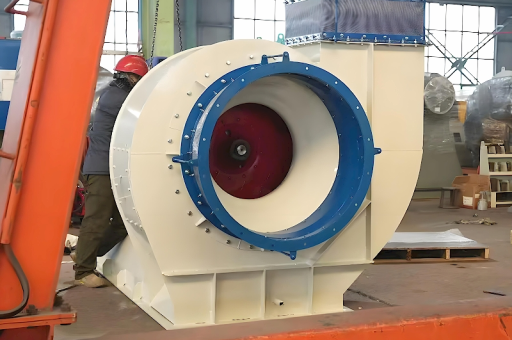
A 2000 Pa centrifugal fan is a type of industrial or commercial fan specifically designed to generate a static pressure of 2000 Pascals (approximately 200 mmH₂O or 8 inches of water gauge).
This is considered medium to high pressure in the fan world (low pressure is <1000 Pa, medium is 1000-3000 Pa, high is >3000 Pa).
Here is a detailed breakdown of what this means, its applications, and typical characteristics.
What "2000 Pa" Means for a Fan
- Static Pressure (SP): 2000 Pa is the resistance the fan can overcome. It's the pressure difference between the inlet and outlet when the fan is running. A higher Pa means the fan can push air through longer, narrower, or more restricted pathways.
- Power Requirement: A fan producing 2000 Pa will require a significantly more powerful motor (often 2.2 kW to 7.5 kW or more, depending on airflow) than a low-pressure fan.
- Noise: At this pressure, the fan will generate noticeable noise, often requiring acoustic enclosures for quiet environments.
- Construction: The housing and impeller must be robust (often steel) to handle the stress.
How it Works (The "Centrifugal" Part)
Unlike a common axial fan (like a desk fan), a centrifugal fan uses a rotating impeller (wheel) to accelerate air outward via centrifugal force.
- Air Inlet: Air enters axially (parallel to the shaft) at the center of the impeller.
- Acceleration: The spinning impeller blades fling the air outward.
- Pressure Build-up: The air is collected in a spiral-shaped housing (volute) which converts the high-velocity air into high static pressure.
- Outlet: The high-pressure air exits at a 90-degree angle from the inlet.
Common Applications for a 2000 Pa Centrifugal Fan
This pressure level is ideal for systems with significant back-pressure. You will find them in:
- HVAC Systems: Large ducted ventilation for multi-story buildings, hotels, or hospitals where ducts are long and have many bends.
- Dust Collection: Medium-scale woodworking shops, cement plants, or textile mills collecting dust from grinding, sanding, or cutting.
- Material Conveying: Light pneumatic conveying of materials like sawdust, chips, granules, or powders through pipes.
- Industrial Process: Drying systems, ovens, fume extraction from welding booths or chemical labs, and cooling for machinery.
- Spray Booths: Providing positive pressure in paint booths to ensure a clean, controlled environment and overcome filter resistance.
Key Features & Construction of a 2000 Pa Fan
| Feature | Typical Specification for 2000 Pa |
|---|---|
| Impeller Type | Backward Curved (BC) or Backward Inclined (BI) are most common. They are non-overloading and efficient at this pressure. Forward Curved (FC) fans typically operate at lower pressures (<1500 Pa). |
| Drive Type | Belt-driven is standard. This allows you to change the fan speed (RPM) to match the exact pressure/airflow needed. Direct-drive is possible but less flexible. |
| Motor | 3-phase induction motor (e.g., 380V / 415V / 480V). Speed is usually 1450 RPM or 2900 RPM (belt drive keeps the fan at a lower speed). |
| Housing Material | Mild Steel (MS) with anti-corrosion paint is the standard. Stainless Steel (SS304/316) is used for corrosive or hygienic environments. |
| Seals | Simple labyrinth seals for clean air. Carbon rings or purge seals for hot or dirty air. |
| Bearings | Heavy-duty, regreasable ball bearings. Pillow block or flanged. |
Standard Specifications (Example)
A typical 2000 Pa centrifugal fan might have these specs on its nameplate:
- Model: SE-315 or 4-72 No. 3A (Chinese standard model)
- Airflow (Volume): 2,500 m³/h (1470 CFM) to 15,000 m³/h (8830 CFM) Highly variable based on size
- Static Pressure: 2000 Pa (200 mmH₂O)
- Speed: 2900 RPM (for a small fan) or 1450 RPM (for a larger fan)
- Power: 3.0 kW (for a small, efficient model) to 7.5 kW (for a larger, less efficient model or higher airflow)
- Sound Level: 70-85 dB(A) measured at 1 meter
Advantages of a 2000 Pa Centrifugal Fan
- High Efficiency: Backward curved impellers provide good aerodynamic efficiency (60-80%).
- Stability: Delivers consistent pressure even with changes in ductwork resistance.
- Durability: Designed for continuous industrial use (24/7 operation).
- Versatility: Airflow and pressure can be easily adjusted by changing the pulley size or motor speed.
- Non-Overloading: With a backward-curved impeller, motor power draw peaks at a specific point and then drops off if airflow is restricted. The motor won't burn up if the outlet is blocked.
Disadvantages & Considerations
- Noise: Louder than a duct fan or a low-pressure axial fan. Sound attenuation (silencers) is often required.
- Cost: More expensive than an axial fan of similar airflow.
- Size & Weight: Larger and heavier than other fan types.
- Belt Maintenance: Belt-driven models require periodic tensioning and replacement.
- Power Consumption: At 2000 Pa, the motor can be a significant consumer of electricity. VFD (Variable Frequency Drive) control is highly recommended for energy savings.
How to Select the Correct 2000 Pa Fan
You cannot buy a generic "2000 Pa fan." It must be matched to your system. You need to know:
- Your Required Airflow (CFM or m³/h): How much air do you need to move?
- Total System Pressure (Pa or mmH₂O): This is the sum of all losses in your ductwork, filters, dampers, and equipment. Your fan's 2000 Pa must be higher than this total.
- Air Density & Temperature: High temperature or altitude reduces air density, affecting fan performance.
Example: If your dust collector requires 10,000 m³/h of air through a 100m duct with 1500 Pa of friction loss, you would select a fan from a manufacturer's catalog that shows:
- Operating Point: 10,000 m³/h @ 1500 Pa in the system.
- Fan Curve: The fan's performance curve at a specific RPM shows that at 2000 Pa (max), it might produce 12,000 m³/h. But at 1500 Pa, it might produce exactly 10,000 m³/h. This is the match.
Manufacturers (Examples)
- China-based: Xinxiang, Shangyu, Zhejiang, (and many OEM suppliers on Alibaba). Look for models like 9-19 (high pressure industrial), 4-72 (medium pressure standard), or Y5-47 (for boiler/industrial).
- European/Global: EBM-Papst (high efficiency, EC motors), Soler & Palau, Greenheck, Woods Air Movement, Nicotra Gebhardt.
- Specialty: Cincinnati Fan, New York Blower (USA).
Summary
A 2000 Pa centrifugal fan is a workhorse for medium-pressure industrial applications. It is not a simple ventilation fan; it is engineered equipment for overcoming resistance in ducts, filters, and conveying systems. When choosing one, focus on matching the fan curve to your system's required flow and total resistance. Always consider belt-driven, backward-curved designs for efficiency and flexibility at this pressure level.





