
This article's table of contents introduction:
- Single Suction
- Anti-Explosion (ATEX / Spark-Resistant)
- Forward Curved (or Forward Fluidized Bed)
- Typical Applications in a Boiler System:
- Key Advantages & Disadvantages of this Design:
- Summary:
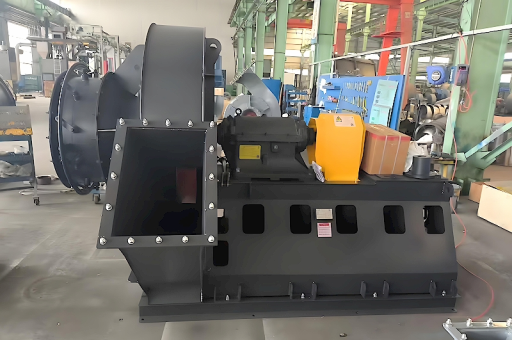
It sounds like you're describing a Single Suction, Anti-Explosion, Forward-Curved (Fluidized Bed) Boiler Fan.
This is a highly specialized industrial fan used primarily in Fluidized Bed Boilers (Circulating Fluidized Bed or Bubbling Fluidized Bed) for power generation or industrial process steam.
Here is a breakdown of what each term means and why these design features are critical:
Single Suction
- Definition: Air enters the fan from one side only (as opposed to a double-suction fan where air enters from both sides).
- Why use it?
- High Pressure: Single suction fans typically have wider impellers and are better suited for generating the high static pressures required to overcome the resistance of a fluidized bed (the bed material, cyclone separators, and heat exchangers).
- Simpler Ductwork: Easier to connect to the boiler’s inlet ducting on one side.
- Common Use: Used for Primary Air (PA) fans and Secondary Air (SA) fans in CFB boilers, where high pressure is needed to fluidize the sand/fuel bed.
Anti-Explosion (ATEX / Spark-Resistant)
- Definition: The fan is designed to prevent sparks, internal friction, or overheating from igniting combustible gases or dust in the air stream.
- Critical Features:
- Non-Sparking Materials: The impeller and casing may be made of stainless steel, aluminum bronze, or have a copper/nickel coating on the leading edges to prevent sparks from friction.
- Shaft Seal: Prevents leakage of hot, combustible gas from the fan to the outside environment.
- Motor: The drive motor must be Explosion-Proof (Ex-d) certified to handle flammable atmospheres.
- Clearance: Larger running clearances between the impeller and casing to avoid thermal expansion rubbing.
- Why? The air from a boiler (especially from the furnace side or recirculating gas) can contain unburned fuel, CO, or flammable dust. If the fan creates a spark, it could cause a catastrophic explosion in the ductwork or boiler.
Forward Curved (or Forward Fluidized Bed)
- Definition: The blades of the impeller curve in the direction of rotation (pointing forward).
- Characteristics:
- High Volume, Low to Moderate Pressure: Forward-curved fans move a large volume of air at relatively lower static pressure compared to backward-curved or radial fans.
- Horsepower Curve: The power requirement (horsepower) increases as airflow increases. This means the motor must be sized carefully to avoid overload if the system resistance drops.
- Compact: Typically smaller diameter for the same duty compared to other types.
- "Fluidized Bed" Design Specifics:
- The term "Fluidized Bed" here indicates the fan is specifically engineered for the harsh environment of a fluidized bed boiler.
- Heavy-Duty Construction: Thicker blades, heavier shaft, and reinforced casing to handle the abrasive fly ash and high temperatures.
- Wear Liners: Often includes replaceable wear plates on the casing and impeller to extend life against erosion from ash particles.
- High-Temperature Design: May be designed for continuous operation at 150°C - 250°C (up to 400°C for some primary air fans).
Typical Applications in a Boiler System:
-
Primary Air (PA) Fan:
- Function: Provides the high-pressure air needed to fluidize the sand/fuel bed at the bottom of the furnace.
- Reason for this Fan Type: Single suction for high pressure. Anti-explosion because it mixes with fuel. Forward-curved because it needs a broad flow range.
-
Secondary Air (SA) Fan:
- Function: Provides combustion air above the bed for complete burn-out.
- Reason: Similar reasoning to PA, but often at slightly lower pressure.
-
Fluidizing Air Fan (for Bed Ash Coolers):
- Function: Keeps the ash cool and moving in the bottom ash handling system.
Key Advantages & Disadvantages of this Design:
| Aspect | Pros | Cons |
|---|---|---|
| Efficiency | Good for high volume, lower pressure duties. | Less efficient than backward-curved or airfoil designs. |
| Noise | Quieter operation than radial fans. | Higher noise than airfoil fans. |
| Pressure | Capable of moderate to high pressure. | Cannot achieve the ultra-high pressures of radial or backward-inclined blades (for very deep beds). |
| Abrasion | Robust design with wear liners handles ash. | Forward curve shape can trap particles, leading to wear at the blade root. |
| Power Overload | Non-overloading power curve is a major disadvantage. If the system resistance drops, the motor can draw more power and trip or burn out. Must have a motor sized for the worst-case (free air) condition. |
Summary:
You are looking at a heavy-duty, explosion-proof, forward-curved centrifugal fan with a single inlet, specifically engineered to deliver high-pressure air for fluidization in a coal/biomass-fired Fluidized Bed Boiler while minimizing the risk of ignition and withstanding abrasive fly ash.
If you are selecting or troubleshooting this fan, the critical points to check are:
- Motor sizing (must account for the forward-curve's power curve).
- Explosion-proof certification (ATEX Zone 2 or 1).
- Wear liner condition (extremely important).
- Temperature rating (to prevent thermal distortion or creep).





