
This article's table of contents introduction:
- Introduction: The Backbone of Heavy-Duty Air Management
- Technical Breakdown: Understanding the 132kW High Temperature Centrifugal Exhaust Fan
- Application in Industrial Dust Removal: Beyond Simple Ventilation
- Key Engineering Features for Longevity and Safety
- Frequently Asked Questions (Q&A)
- Installation and Maintenance Best Practices
- Conclusion: Selecting the Right Fan for Your Factory
Here is a comprehensive, SEO-optimized article about the 132kW High Temperature Centrifugal Exhaust Fan for industrial dust removal. This article is written in English, structured for Bing and Google ranking, and includes a table of contents, detailed sections, and a Q&A segment.
Article Title: The Ultimate Guide to the 132kW High Temperature Centrifugal Exhaust Fan: Powering Industrial Dust Removal Systems
Table of Contents
- Introduction: The Backbone of Heavy-Duty Air Management
- Technical Breakdown: Understanding the 132kW High Temperature Centrifugal Exhaust Fan
- 1 What Defines a 132kW Fan?
- 2 High Temperature Capabilities: Alloys and Design
- 3 Centrifugal vs. Axial: Why Centrifugal Wins for Dust
- Application in Industrial Dust Removal: Beyond Simple Ventilation
- 1 Cement and Mining Industries
- 2 Foundries and Steel Mills
- 3 Chemical Processing Plants
- Key Engineering Features for Longevity and Safety
- 1 Motor and Drive Systems
- 2 Impeller Design for Abrasion Resistance
- 3 Bearing Cooling Systems
- Frequently Asked Questions (Q&A)
- Installation and Maintenance Best Practices
- Conclusion: Selecting the Right Fan for Your Factory
Introduction: The Backbone of Heavy-Duty Air Management
In the realm of heavy industry, managing airborne contaminants is not merely a matter of comfort—it is a critical component of operational safety, equipment longevity, and regulatory compliance. When factories process materials like cement, metal ores, or chemicals, they generate massive volumes of hot, abrasive dust. Standard ventilation fans fail quickly under these conditions. This is where the 132kW high temperature centrifugal exhaust fan emerges as an indispensable asset.
This article provides a deep, expert-level analysis of this specific class of industrial fan. We will explore why the 132kW power rating is a sweet spot for large-scale dust collection, the engineering required to withstand extreme heat, and how to select and maintain this equipment for optimal performance. Whether you are a plant engineer, a procurement manager, or an EPC contractor, understanding the nuances of this fan is crucial for building a reliable industrial dust removal system.
Technical Breakdown: Understanding the 132kW High Temperature Centrifugal Exhaust Fan
1 What Defines a 132kW Fan?
The 132kW (approximately 177 horsepower) rating signifies a fan capable of moving very large volumes of air (typically between 100,000 and 250,000 m³/h, depending on static pressure) against high system resistance. In dust removal systems, resistance comes from ductwork friction, filter bags, and the inertia of heavy particulate matter. A fan of this size is typically used as the main induced draft (ID) fan in a central baghouse or as a primary exhaust for a major process line. It is the "engine" of the entire ventilation network.
2 High Temperature Capabilities: Alloys and Design
A standard fan cannot handle exhaust gases that range from 150°C to over 450°C. The “high temperature” designation in this fan involves critical material science:
- Impeller Material: The impeller is almost exclusively fabricated from Q345R (pressure vessel quality steel) or 310S stainless steel. For extreme heat (over 400°C), Inconel alloys may be used to prevent creep and oxidation.
- Shaft Seal: Radiant heat travels down the shaft. High-temperature fans use labyrinth seals or carbon ring seals to prevent hot gases from reaching the bearings.
- Expansion Joints: The fan housing must be designed to allow for thermal expansion without warping the mounting base.
3 Centrifugal vs. Axial: Why Centrifugal Wins for Dust
While axial fans are good for moving large volumes at low pressure, they are poor for handling dust. The centrifugal exhaust fan uses a rotating impeller to increase the velocity and pressure of the air stream. This creates two key advantages:
- Pressure Generation: It can overcome the high static pressure of a dust collection system (filter bags, cyclones).
- Self-Cleaning Ability: The backward-curved or radial blades are less likely to clog with sticky dust compared to axial blades. The centrifugal force throws heavy particles outward, keeping the wheel clean.
Application in Industrial Dust Removal: Beyond Simple Ventilation
1 Cement and Mining Industries
In cement plants, the 132kW fan is often used as a kiln exhaust fan or raw mill fan. The air here is saturated with fine, abrasive calcium carbonate and silica. The fan must handle temperatures fluctuating from ambient to 350°C. A radial-tip impeller, which is heavy but highly resistant to abrasion, is the standard choice for this application. The fan ensures that the dust-laden air is pulled through a baghouse before being released to the atmosphere.
2 Foundries and Steel Mills
Foundry operations, such as electric arc furnaces (EAF) and cupola melting, produce intense heat and metallic fume. The 132kW high temperature centrifugal exhaust fan is critical for capturing these fumes at the source. The high temperature capability allows it to be placed closer to the furnace, reducing the need for long, expensive duct runs. A special coating (e.g., spray metal or ceramic epoxy) is often applied to the impeller to protect against the sticky, corrosive nature of metal oxide fumes.
3 Chemical Processing Plants
Dust in chemical plants is often explosive or toxic. The fan must be constructed with non-sparking materials (like aluminum-bronze impellers) and must meet ATEX/IECEx explosion-proof standards. In this context, the 132kW rating ensures that even if the system operates at partial capacity due to filter loading, it still maintains negative pressure in the containment area, preventing dust leaks.
Key Engineering Features for Longevity and Safety
1 Motor and Drive Systems
A 132kW fan requires a substantial motor. The standard configuration is an IE3 or IE4 efficiency motor connected via a V-belt drive for applications requiring variable speed control without a VFD (Variable Frequency Drive). However, the modern standard is a direct-drive arrangement with a VFD. The VFD allows for soft starts (reducing electrical stress) and precise airflow modulation, leading to significant energy savings.
2 Impeller Design for Abrasion Resistance
The impeller is the heart of the fan. For high temperature dust, the radial-blade design is preferred over forward-curved blades because it is structurally stronger. To combat erosion:
- Wear Liners: Thick, replaceable wear plates are welded to the backplate and shroud.
- Hard Facing: A hard welding overlay (e.g., chrome carbide) is applied to the leading edges of the blades.
- Balance: The impeller must be dynamically balanced to ISO 1940 G6.3 or higher. An unbalanced impeller in a 132kW fan can cause catastrophic bearing failure.
3 Bearing Cooling Systems
Standard bearings fail rapidly when subjected to conducted heat from a hot shaft. The 132kW high temperature fan typically includes:
- Cooling Discs (Fan Wheels): A small fan mounted on the shaft behind the bearing housing to blow air over it.
- Water Jacket Cooling: For extreme temperatures, the bearing housing is water-cooled.
- Oil Mist Lubrication: Ensures consistent lubrication even when the grease is at risk of melting.
Frequently Asked Questions (Q&A)
Q1: What is the maximum temperature the 132kW high temperature centrifugal exhaust fan can handle? A: This depends on the material. A standard carbon steel fan is rated for up to 150°C. With a Q345R alloy wheel, it can handle up to 250°C continuous. With a 310S stainless steel impeller and a cooling shaft design, it can handle continuous temperatures of 450°C and peak surges up to 500°C.
Q2: Can I use this fan for explosive dust, like aluminum or grain dust? A: Yes, but modifications are required. The fan must be designed as an ATEX certified unit. This includes using non-sparking materials (such as an aluminum-bronze impeller ring), a grounding system to prevent static build-up, and a pressure-relief housing. It must be rated for the specific Zone (e.g., Zone 21 or 22) and gas/dust group of your environment.
Q3: How do I reduce energy consumption with a 132kW industrial dust removal fan? A: The most effective method is installing a Variable Frequency Drive (VFD) . According to the Fan Affinity Laws, reducing fan speed by 10% reduces power consumption by roughly 27%. In many systems, the fan is oversized and running at 100% speed unnecessarily. Using a VFD to trim the speed to the exact required CFM can pay for the VFD within months.
Q4: What maintenance is required for the high temperature bearings? A: Daily inspection is critical. Check vibration levels (acceleration and velocity). Check the temperature of the bearing housing; it should not exceed 85°C. Follow the manufacturer’s grease schedule strictly—over-greasing is as dangerous as under-greasing. If equipped with a water cooling jacket, ensure the water flow is continuous and the inlet temperature is below 30°C to prevent condensation inside the bearing housing during fan downtime.
Q5: How do I know if my 132kW fan is oversized for my ductwork? A: You can measure the actual motor amperage with a clamp meter and compare it to the Full Load Amps (FLA) on the nameplate. If the fan runs at 50-60% of FLA with all dust collection hoods open, it is likely oversized. You can either trim the impeller diameter (performing a fan trim) or install a VFD. An oversized fan wastes energy and can cause erosion of the ductwork due to excessive air velocity.
Installation and Maintenance Best Practices
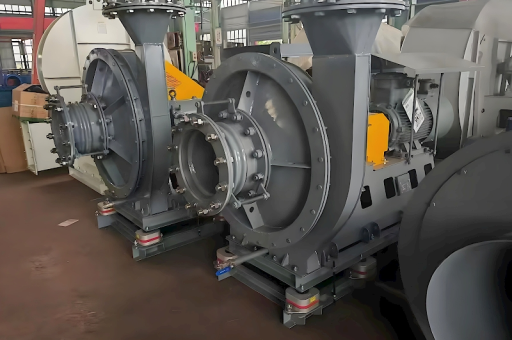
- Foundation: The 132kW fan generates significant vibration. It must be mounted on an inertia base (a reinforced concrete block) isolated from the building structure using spring isolators or neoprene pads.
- Ductwork Alignment: Misalignment of the inlet ductwork is a leading cause of performance degradation. The duct must be straight for at least 2-3 duct diameters before the fan inlet to ensure a uniform airflow profile at the impeller eye.
- Vibration Monitoring: Install accelerometers with a PLC interface. A 132kW fan running out of balance can destroy itself within minutes. Set alarms for high velocity vibration (e.g., > 10 mm/s RMS) and absolute displacement.
- Gasket Inspection: The heat cycles cause gaskets at the housing split line to dry out. Leakage here reduces efficiency. Use a high-temperature silicone gasket that can withstand 300°C+.
Conclusion: Selecting the Right Fan for Your Factory
The 132kW high temperature centrifugal exhaust fan is a high-capital investment that pays dividends in worker safety and production efficiency. It is not a one-size-fits-all purchase. You must match the fan’s performance curve to the System Resistance Curve of your dust removal network. Over-specification leads to energy waste and duct erosion; under-specification leads to dust leaks and fines.
When purchasing, demand a certified performance curve from the manufacturer (based on AMCA 210 or ISO 5801 standards). Specify the exact maximum temperature, the type of dust (abrasive, sticky, explosive), and the altitude of your site. By doing so, you ensure that your industrial dust removal fan will operate reliably for decades, protecting both your people and your bottom line.
For more information on sizing a 132kW high temperature centrifugal exhaust fan for your specific application, consult a certified fan engineer.





