
This article's table of contents introduction:
- Core Function & Process Context
- Critical Design Challenges
- Common Fan Types Used
- Material Selection is Critical
- Operational & Maintenance Considerations
- Summary Checklist for Purchasing/Designing
- Typical Supplier Examples (Global)
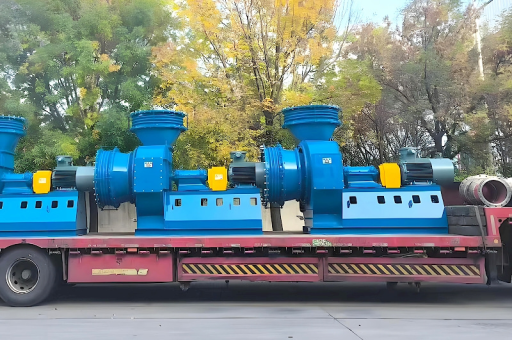
This is a highly specialized and critical piece of equipment. A Steel Plant Rotary Hearth Furnace (RHF) High Temperature Flue Gas Induced Draft (ID) Fan is not a standard industrial fan; it must withstand extreme thermal, abrasive, and corrosive conditions.
Here is a comprehensive breakdown of its function, design challenges, common types, materials, and operational considerations.
Core Function & Process Context
In a Rotary Hearth Furnace (used for DRI production, carburization, or heat treating), the fan's primary role is to:
- Maintain Negative Pressure (Draft): Pull combustion products (CO, CO₂, N₂, H₂O, SOx, dust) through the furnace, heat recovery system (e.g., recuperator), and pollution control equipment (baghouse/ESP).
- Control Atmosphere: In processes like DRI, precise draft control is critical to maintain the reducing atmosphere (CO/H₂) and prevent air ingress which would re-oxidize the product.
- Cooling: High-temperature (often >600°C / 1112°F) flue gas must be pulled away to prevent overheating furnace refractories and downstream equipment.
Critical Design Challenges
| Challenge | Why it's a Problem | Typical Solution |
|---|---|---|
| Extreme Temperature | Gas temps can reach 800-1050°C (1472-1922°F) at the fan inlet (even after a recuperator, temps are 250-450°C). Standard fans fail. | High-temperature alloy construction (Inconel, Hastelloy). Shaft cooling. High-temperature seals. |
| Thermal Expansion | Fan casing, impeller, and shaft expand at different rates leading to binding, rubbing, or imbalance. | Flexible expansion joints (inlet/outlet). Large, specific bearing clearances. Bell-mouth inlet design to allow impeller growth. |
| Abrasive Dust | RHF flue gas contains iron oxide dust, coke/coal fines, and sintered dust. Erodes impeller blades rapidly. | Hard-facing (Stellite, tungsten carbide) on blade leading edges. Thick wear plates on casing. "Airfoil" or "backward-curved" blades (less concave surface for dust buildup). |
| Corrosion | Sulfur from coal/coke forms H₂SO₄ at dew point. Alkali metals form corrosive compounds. | Corrosion-resistant alloys (e.g., 310S, 253MA). Operation above acid dew point. Coatings (ceramic, rubber – limited). |
| Vibration / Imbalance | Uneven dust buildup on blades creates catastrophic imbalance. | In-situ balancing ports. Automated washing systems (water or steam injection). Continuous vibration monitoring. |
| Shaft Sealing | Hot, toxic gases (CO) leaking around the shaft are lethal and cause bearing failure. | Air purged labyrinth seals. Carbon ring seals. High-temperature packing (e.g., PTFE + ceramic fiber). |
Common Fan Types Used
- Radial (Paddle Wheel): Simple, robust, handles heavy dust. Low efficiency but high durability.
- Backward-Inclined / Backward-Curved (BC): Most common for modern high-temp RHFs.
- Advantages: Non-overloading power curve, higher efficiency, self-cleaning blade design (fewer dust traps).
- Disadvantage: Larger, faster (requires more robust bearings).
- Airfoil: Highest efficiency (up to 85%+), but blades are hollow and prone to dust erosion/penetration. Rarely used in dirty RHF gas.
Material Selection is Critical
- Impeller:
- Typical: High strength low alloy steel (HSLA) up to ~400°C.
- Hot Gas (>400°C): 304H, 310S, 253 MA (1.4835) – stainless steels with good high-temp creep resistance.
- Extreme Temp/Corrosion (>750°C): Inconel 625, Hastelloy X – expensive but necessary for extreme conditions in zones with direct heat.
- Casing: Often dual-wall construction with internal insulating ceramic fiber blanket to reduce outer skin temperature and heat loss.
- Shaft: Usually alloy steel (AISI 4140 or 4340) with forced air or water cooling using a finned "cooling wheel" between the impeller hub and the bearing housing.
- Bearings: Spherical roller bearings with external forced circulation oil (lube oil system) . Pillow block housings with cooling fins or water jackets. High-temperature grease used for smaller units.
Operational & Maintenance Considerations
- VFD (Variable Frequency Drive): Mandatory for modern RHFs. Allows soft-start, precise draft control, and optimal energy consumption. Avoids damper control which wastes energy.
- Over-Speed Trip: The fan must be rated for minimum 115% of normal speed.
- Critical Speed Analysis: The rotor must be designed so that its 1st natural frequency does not coincide with operating speed range.
- Jacket Cooling: The shaft cooling wheel and bearing jacket cooling water flow must be interlocked with the fan start sequence.
- Downtime Causes:
- Blade Erosion (Front edge and near hub radius).
- Dust Accumulation (Leading to vibration trip).
- Shaft Seal Leakage (Hot gas causes bearing failure).
Summary Checklist for Purchasing/Designing
- Confirm Gas Temperature: Max continuous, max peak (emergency).
- Identify Dust Load: g/Nm³, particle size (0-50 micron, 50-200 micron), abrasiveness (SiO₂ content?).
- Analyze Gas Chemistry: CO, SOx, Cl, alkali metals (Na, K).
- Define Performance: Flow (Nm³/hr), static pressure (mmWC or kPa), density correction for temperature.
- Select Cooling Method: Shaft air/water cooling, bearing cooling required.
- Choose Material: Minimum 310S for impeller if temp >500°C. Consider HR120 or Inconel for very high temps.
- Specify Sealing: Carbon ring + air purge is typical for CO safety.
- Add Features: Vibration probes (accelerometers on X/Y axis), balancing ports, cleaning ports.
Typical Supplier Examples (Global)
- Howden (High-temp ID fans for steel/reheat)
- TLT-Babcock (Heavy duty fans)
- Siemens Process Industries / Flender (Drives)
- Robinson Fans (Custom engineered)
- Cincinnati Fan / New York Blower (Smaller units)
- Indigenous Chinese/Korean/Indian OEMs (e.g., Shanxi Fan Factory, Hyundai Rotem, Kirloskar Brothers)
⚠️ Note on Safety: Handling RHF flue gas is extremely dangerous due to CO poisoning risk. Work on these fans requires:
- Zero-energy isolation
- Lock-out / Tag-out
- Continuous CO monitoring (with alarm)
- Use of supplied-air respirators if leakage is suspected.
Would you like specific detail on impeller cleaning methods (e.g., steam washing cycles) or a bearing lubrication specification for high-temp operation?





