
This article's table of contents introduction:
- What does 13,000 Pa mean?
- Typical Applications
- Physical Characteristics (What to expect)
- Key Engineering Considerations
- How to Choose One
- Quick Calculation (Estimation)
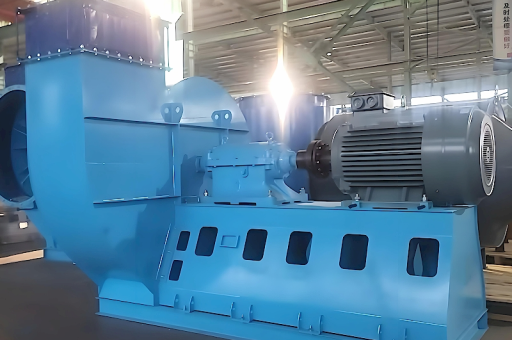
A 13,000 Pa (Pascal) centrifugal fan is a medium-to-high pressure industrial fan, often used in applications requiring significant static pressure (like overcoming duct resistance or pushing air through dense filters).
Here is a breakdown of what this specification means, typical applications, and key considerations.
What does 13,000 Pa mean?
- Pressure Classification: 13,000 Pa is equivalent to ~52.7 inches of water gauge (in. w.g.) or 3 meters of water column.
- Fan Type: This pressure range puts it squarely in the category of a Medium Pressure Fan (per ISO 13349) or the lower end of High Pressure Fan.
- Performance: It is not a standard HVAC fan (which typically operate at 250–750 Pa). It is a heavy-duty machine capable of moving air against significant resistance.
Typical Applications
A fan with this pressure capability is used in industrial processes where the air needs to be forced through restrictive systems:
- Pneumatic Conveying: Moving powders, granules, or fibers through pipes over long distances or high elevations.
- Dust Collection (High-Vacuum): Centralized dust extraction systems for woodworking, cement, or pharmaceutical plants.
- Fume Extraction: Pushing exhaust gases through tall chimneys or highly restrictive scrubbers.
- Drying Systems: Industrial dryers (e.g., for textiles, paper, or food) that require hot air to be forced through a product bed.
- Material Handling: Transporting light materials (e.g., paper scraps, cotton lint) through ductwork.
Physical Characteristics (What to expect)
A 13,000 Pa fan will look different from a standard ventilation fan:
- Blade Design: It will almost certainly be Backward-Curved (BC) or Backward-Inclined (BI) blades. Forward-curved blades (squirrel cage) cannot efficiently generate this high pressure.
- Housing: Thick, heavy-gauge steel or cast iron to withstand the pressure without deforming.
- Motor: High-powered (often 5.5 kW to 30+ kW), usually driven by a belt (pulley) system to allow for speed adjustment. It may be a direct drive if using a variable frequency drive (VFD).
- Size: The impeller diameter will be moderate (e.g., 400mm - 800mm), but the motor base and housing are built sturdy.
Key Engineering Considerations
If you are selecting or operating a 13,000 Pa fan, pay attention to these factors:
| Factor | Why it matters |
|---|---|
| Airflow (CFM/m³/h) | 13,000 Pa is a pressure spec, not a flow spec. You need the fan curve. A 13,000 Pa fan might move 500 m³/h or 50,000 m³/h depending on the model. Pressure alone does not define the fan. |
| Speed (RPM) | Fans generate pressure proportional to the square of the speed ($P \propto N^2$). A 13,000 Pa fan likely runs at 2900–3500 RPM (or higher). |
| Air Density | The fan's pressure output is directly proportional to air density. 13,000 Pa at 20°C will drop significantly at high altitudes (e.g., 3000m) or high temperatures (e.g., 200°C). |
| Silencer | At this pressure, the fan will be very loud (110-120 dB). You will almost certainly need an inlet/outlet silencer and vibration isolators. |
| Structural Support | The fan casings flex under high pressure. Proper mounting and support are critical to avoid fatigue failure, especially on the outlet duct. |
How to Choose One
To find the right fan, you need three numbers, not just one:
- Required Airflow (in m³/h or CFM).
- Required Static Pressure (13,000 Pa in this case).
- Air Density / Temperature.
Example Query for a manufacturer: “I need a centrifugal fan with backward curved blades. Duty: 10,000 m³/h @ 13,000 Pa. Air is clean at 30°C. Material: Mild steel. Maximum impeller diameter: 800mm. Please provide a fan curve and motor power requirement.”
Quick Calculation (Estimation)
For a rough idea of power required to achieve 13,000 Pa:
- Motor Power (kW) ≈ (Airflow (m³/s) × Pressure (Pa)) / (Fan Efficiency × Drive Efficiency)
- Example: For 5 m³/s (18,000 m³/h) @ 13,000 Pa with 75% fan efficiency and 95% drive efficiency:
- Power = (5 × 13000) / (0.75 × 0.95) = 91,228 Watts → ~92 kW motor.
Summary: A 13,000 Pa centrifugal fan is a specialized industrial machine. You need to match it with the correct airflow (CFM/m³/h) and ensure your ductwork can handle the high pressure.





