
This article's table of contents introduction:
- The Standard: The Radial Blade Fan (or "Paddle Wheel" Fan)
- Two Main Types for Industrial Boilers
- Critical Specifications to Request
- Top Manufacturers for Heavy-Duty Boiler Fans
- Example Model Line (for specification reference)
- Critical Accessories Needed
- Recommendation for Your Project
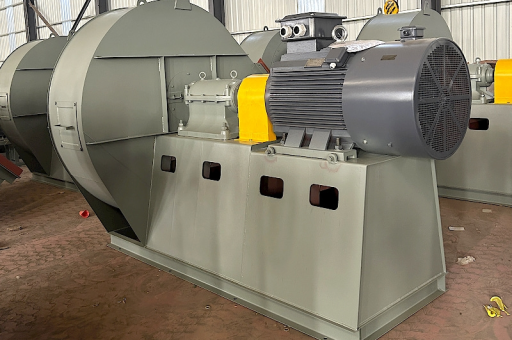
Based on your request for a Heavy-Duty Large Capacity Centrifugal Fan for Industrial Boilers, you are likely looking for a fan designed to handle high temperatures, abrasive particulates (fly ash), and high static pressures required for forced draft (FD), induced draft (ID), or primary air (PA) applications.
Here is a technical breakdown of the specific type of fan you need, key specifications, and leading manufacturers.
The Standard: The Radial Blade Fan (or "Paddle Wheel" Fan)
For heavy-duty boiler applications, the Radial Blade Centrifugal Fan is the industry workhorse. Unlike backward curved fans, radial blade fans are designed for durability in harsh environments.
Key Characteristics:
- High Pressure: Capable of generating very high static pressures (50+ inches w.g. / 12,000+ Pa) to overcome the resistance of ductwork, dampers, and the boiler itself.
- Abrasion Resistance: The flat, radial blades are less prone to clogging and are easier to weld on wear liners (e.g., chrome carbide or ceramic tiles) to handle fly ash.
- High Temperature: Constructed with heavy steel plate, expansion joints, and special bearing cooling to handle gas temperatures up to 400°C (750°F) for ID fans and up to 200°C (400°F) for FD fans.
- Self-Cleaning: The straight blade design prevents material buildup, which is critical for particulate-laden boiler exhaust.
Two Main Types for Industrial Boilers
| Feature | Forced Draft (FD) Fan | Induced Draft (ID) Fan |
|---|---|---|
| Location | Inlet of boiler (pushes air in) | Outlet of boiler (pulls exhaust out) |
| Medium | Clean, ambient air | Hot, dirty, corrosive flue gas |
| Blade Type | Airfoil or Backward Curved (for efficiency) | Radial Blade (for durability) |
| Key Issue | High volume, moderate pressure | High temperature, erosion, corrosion |
| Material | Standard carbon steel | Corten steel, wear liners, stainless steel |
For a true "Heavy-Duty" request, ID fans are the most demanding.
Critical Specifications to Request
When sourcing, you must provide these parameters:
- Flow Rate (CFM / m³/h): (e.g., 100,000 CFM / 170,000 m³/h)
- Static Pressure (in. w.g. / Pa): (e.g., 30" w.g. / 7,500 Pa)
- Gas Temperature (°F / °C): (e.g., 400°F / 204°C for ID)
- Gas Composition: Is it corrosive (sulfur)? Abrasive (fly ash)?
- Density: Altitude or specific gas density modification.
- Drive Type:
- Direct Drive (D): Heavy duty, no belt slippage, higher maintenance on high-temp bearings.
- Belt Drive (B): Allows RPM changes, isolates motor from heat (better for ID fans).
- Variable Frequency Drive (VFD): Highly recommended for modern boilers to save energy by adjusting fan speed.
Top Manufacturers for Heavy-Duty Boiler Fans
These companies specialize in the power generation and industrial boiler sector, not just standard HVAC.
- Greenheck (USA): Strong for smaller-to-mid industrial boilers.
- New York Blower (USA): Excellent for custom-engineered, high-temperature, dirty gas applications. Their "R-Series" radial blade fans are iconic.
- Howden (Global): A massive supplier for power plants. Very high-end, large capacity.
- Robinson Fans (USA): Specializes exclusively in heavy-duty industrial and power generation fans. Likely the best fit for "Heavy-Duty."
Example Model Line (for specification reference)
If you are writing a purchase order, a typical model for your request would look like:
Robinson Fans RSP (Radial, Self-Powered) or RBE (Radial Blade Exhauster)
- Type: Centrifugal, Radial Blade
- Application: Industrial Boiler ID Fan
- Wheel Diameter: 80" (2032 mm)
- Capacity: 150,000 CFM @ 25" w.g.
- Drive: Variable Speed via VFD on 800 HP Motor
- Features: Wear plates on blades, abrasion-resistant inlet cone, water-cooled bearing housing, shaft seal for negative pressure.
Critical Accessories Needed
- Inlet Box Dampers: To control flow.
- Expansion Joints: To handle thermal expansion of ductwork.
- Bearing Temperature Sensors: (RTDs) for early warning of failure.
- Vibration Monitoring: Probes to detect imbalance from erosion or ash buildup.
Recommendation for Your Project
- For a new boiler: Specify a Backward Curve Airfoil fan for FD (higher efficiency, saves energy) and a Radial Blade fan for ID (must handle debris and heat).
- For retrofitting an old boiler: A Radial Blade is the safest choice as it is most tolerant of variable conditions and ductwork issues.
- Must Ask: "Do you provide Finite Element Analysis (FEA) for the shaft and wheel?" This is essential to avoid resonant vibration in a heavy-duty fan.
Would you like a specific sizing calculation based on your boiler's heat input (BTU/hr) and draft requirements?





