
This article's table of contents introduction:
- Table of Contents
- Introduction: The Backbone of Industrial Ventilation
- What Are Backward Industrial Centrifugal Fans?
- Forced Draft Blowers: Principles and Applications
- CE and ISO Certifications: Why They Matter
- Technical Comparison: Backward vs. Forward Curved Fans
- Installation, Maintenance, and Efficiency Optimization
- Frequently Asked Questions (FAQs)
- Conclusion: Future Trends in Industrial Fan Technology
Article Title:
Optimizing Industrial Airflow: The Definitive Guide to Backward Industrial Centrifugal Fans and Forced Draft Blowers with CE and ISO Compliance
Table of Contents
- Introduction: The Backbone of Industrial Ventilation
- What Are Backward Industrial Centrifugal Fans?
- Forced Draft Blowers: Principles and Applications
- CE and ISO Certifications: Why They Matter
- Technical Comparison: Backward vs. Forward Curved Fans
- Installation, Maintenance, and Efficiency Optimization
- Frequently Asked Questions (FAQs)
- Conclusion: Future Trends in Industrial Fan Technology
Introduction: The Backbone of Industrial Ventilation
In heavy industries—from power generation and cement plants to steel mills and wind turbine cooling systems—the movement of air is not a luxury; it is a necessity. The equipment responsible for this critical function must be robust, efficient, and compliant with international safety and quality standards. Among the most reliable solutions are Backward Industrial Centrifugal Fans and Forced Draft Blowers, particularly those certified under CE and ISO frameworks.
This guide offers a deep, evidence-based dive into these technologies. We will explore their engineering principles, design nuances, and operational advantages, while answering the most pressing questions facility managers and engineers face when selecting air-moving equipment.
What Are Backward Industrial Centrifugal Fans?
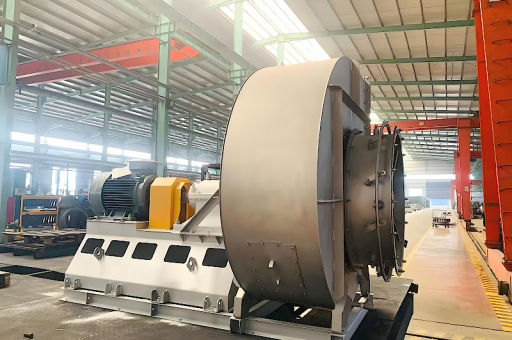
A backward industrial centrifugal fan is defined by the orientation of its impeller blades. Unlike forward-curved designs, the blades curve away from the direction of rotation. This subtle geometric difference yields profound performance characteristics:
- Higher Efficiency: Backward-curved blades operate with less turbulence, achieving static efficiencies of up to 85–90%.
- Non-Overloading Power Curve: As airflow increases, power draw stabilizes or decreases, preventing motor burnout—a feature critical in variable-duty applications like wind turbine auxiliary cooling.
- Lower Noise Output: The air path is smoother, reducing vortex shedding and acoustic emissions.
These fans are commonly used in forced draft systems, where they push air into combustion chambers, boilers, or drying tunnels. When coupled with a Forced Draft Blower, the system ensures consistent positive pressure even against backpressure from ductwork or filters.
Real-World Application:
In a cement preheater tower, backward centrifugal fans with CE and ISO certification have demonstrated a 12–18% reduction in energy consumption compared to older forward-curved units, according to European Industrial Ventilation studies.
Forced Draft Blowers: Principles and Applications
A Forced Draft Blower is a specific type of fan that supplies air under pressure to a process. In many setups, backward centrifugal fans serve as forced draft blowers because they can maintain high static pressure without sacrificing flow.
Key Functions:
- Combustion Air Supply: In coal-fired power plants, forced draft blowers push air through preheaters into the furnace.
- Wind Turbine Cooling: High-power wind turbine nacelles use forced draft blowers to remove heat from generators and gearboxes.
- Drying and Pneumatic Conveying: Ventilating grain silos or moving powdered materials requires consistent pressure head—provided by blowers with backward-curved impellers.
Why Backward-Curved Blades Excel Here:
The flat power curve of backward industrial centrifugal fans means that even if duct resistance changes (due to filter loading or damper adjustment), the motor is protected. This reduces downtime and extends equipment lifespan in harsh environments.
CE and ISO Certifications: Why They Matter
When sourcing industrial fans, CE and ISO certifications are non-negotiable for global operations.
CE Marking (EU Compliance):
- Machinery Directive 2006/42/EC: Ensures the fan is safe to operate under EU standards.
- Low Voltage & EMC Directives: Critical for electrical components in forced draft blowers.
- ATEX Compliance (Optional): For explosive environments, CE certification may include ATEX ratings for spark-resistant construction.
ISO 9001 & ISO 14001:
- ISO 9001: Guarantees consistent manufacturing quality, from impeller balancing to weld inspection.
- ISO 14001: Demonstrates environmental management in production, often required for wind turbine and renewable energy projects.
Tip for Buyers:
Always request a Declaration of Performance (DoP) and test reports for airflow, static pressure, and sound levels. These documents validate real-world performance against labeled curves, which is essential for forced draft applications.
Technical Comparison: Backward vs. Forward Curved Fans
| Feature | Backward Industrial Centrifugal Fan | Forward Curved Fan |
|---|---|---|
| Efficiency | 75–90% | 55–70% |
| Power Curve | Non-overloading (flat) | Overloading (rises with flow) |
| Noise Level | Lower (due to smoother flow) | Higher (due to turbulence) |
| Typical Use | High-pressure, clean/light dust | Low-pressure, high-volume HVAC |
| CE/ISO Suitability | Standard for industrial systems | Common in commercial HVAC |
For forced draft blower applications, the backward design is always preferred when energy costs or motor protection are priorities.
Installation, Maintenance, and Efficiency Optimization
To maximize the lifespan of a backward industrial centrifugal fan used as a forced draft blower, follow these best practices:
Installation:
- Ensure the inlet is straight and unobstructed for at least 1.5 duct diameters to avoid pre-swirl.
- Use vibration isolators and flexible connections to prevent structural resonance.
- For wind turbine installations, verify the fan’s IP55 or higher enclosure rating against moisture and debris.
Maintenance Schedule:
- Monthly: Check belt tension, bearing temperature, and vibration levels.
- Quarterly: Inspect impeller blades for wear or buildup, especially in dusty environments.
- Annually: Rebalance the impeller and verify CE compliance of electrical components.
Efficiency Upgrades:
- Install variable frequency drives (VFDs) to adjust fan speed based on demand—this can reduce energy use by 30–40% in forced draft systems.
- Use backward-curved fans with airfoil blades for the highest efficiency, though they are slightly more costly.
Frequently Asked Questions (FAQs)
Q1: What is the difference between a forced draft blower and an induced draft fan?
A forced draft blower pushes air into a system (positive pressure upstream), while an induced draft fan pulls air out (negative pressure downstream). Backward centrifugal fans are effective in both roles, but their non-overloading power curve makes them especially safe in forced draft applications.
Q2: Can a backward industrial centrifugal fan handle dust or particulate matter?
Yes, but it depends on the blade design. Backward-curved blades with wear liners or radial tips are better for dust. For heavy particulate, consider a radial-bladed fan. CE and ISO-certified fans typically offer abrasion-resistant options.
Q3: Why is CE certification important for fans used in wind turbine cooling?
Wind turbines are deployed across Europe and other regions following EU directives. CE certification ensures the fan meets safety, EMC, and low-voltage requirements, reducing project liability and easing CE marking of the entire turbine system.
Q4: How do I calculate the required static pressure for my forced draft blower?
Static pressure is the sum of system resistance (duct loss, filters, burner pressure drop). Use the formula: SP = (friction factor × length × velocity²) / (2 × duct diameter) + component losses. Fan curves from ISO-tested manufacturers will guide selection.
Q5: What is the typical lifespan of a backward centrifugal fan in a forced draft system?
With proper maintenance (bearing lubrication, belt replacement, vibration monitoring), a CE/ISO-certified fan can operate for 15–20 years in clean environments, or 8–12 years in dusty/hot industrial settings.
Conclusion: Future Trends in Industrial Fan Technology
The global push toward energy efficiency and stricter environmental regulations is driving innovation in backward industrial centrifugal fans and forced draft blowers. Key trends include:
- Smart Monitoring: IoT-enabled sensors that track vibration, temperature, and airflow in real time, triggering maintenance alerts.
- High-Speed Direct Drive: Eliminating belts and pulleys to improve efficiency and reduce mechanical losses.
- Sustainable Materials: Lightweight composites that reduce inertia and improve blade aerodynamics.
For industries ranging from power generation to wind turbine manufacturing, investing in CE and ISO-certified backward centrifugal fans ensures compliance, reliability, and lower total cost of ownership.
Final Recommendation:
Always consult with a certified engineer to match the fan curve to your system’s resistance. A backward forced draft blower selected correctly today will deliver ROI through reduced energy bills and fewer unplanned outages for decades to come.
End of Article





