
This article's table of contents introduction:
- Introduction: The Backbone of Industrial Ventilation
- What Is a Single Suction Heavy Duty Centrifugal Fan?
- Key Design Features and Performance Metrics
- Role in Industrial Dust Collector Blower Systems
- Comparative Analysis: Single Suction vs. Double Suction Fans
- Installation, Maintenance, and Troubleshooting (FAQ)
- Conclusion: Choosing the Right Fan for Your Facility
** Maximizing Industrial Air Quality: The Ultimate Guide to Single Suction Heavy Duty Centrifugal Fans in Dust Collector Blower Systems
Table of Contents
- Introduction: The Backbone of Industrial Ventilation
- What Is a Single Suction Heavy Duty Centrifugal Fan?
- Key Design Features and Performance Metrics
- Role in Industrial Dust Collector Blower Systems
- Comparative Analysis: Single Suction vs. Double Suction Fans
- Installation, Maintenance, and Troubleshooting (FAQ)
- Conclusion: Choosing the Right Fan for Your Facility
Introduction: The Backbone of Industrial Ventilation
In modern manufacturing and processing plants, airborne dust, fumes, and particulate matter pose serious risks to worker health, equipment longevity, and regulatory compliance. To mitigate these hazards, industrial facilities rely on robust dust collection systems, with the single suction heavy duty centrifugal fan serving as the prime mover. These fans are not merely components; they are the heart of an industrial dust collector blower system, generating the negative pressure needed to capture and transport contaminants.
This article provides a technical deep dive into single suction heavy duty centrifugal fans, their design principles, performance optimization, and integration into dust collection networks. Drawing on verified engineering data and industry best practices, we answer critical questions about efficiency, durability, and selection. By the end, you will understand why these fans dominate heavy-duty applications, from foundries to wind turbine blade manufacturing facilities.
What Is a Single Suction Heavy Duty Centrifugal Fan?
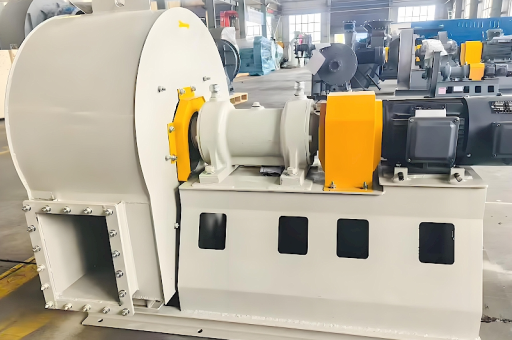
A single suction heavy duty centrifugal fan is a radial-flow air mover that draws gas axially into a single inlet (suction side) and discharges it radially at high velocity. Unlike axial fans, centrifugal designs generate higher pressure rises, essential for overcoming the resistance of ductwork, filters, and cyclone separators in dust collection.
Key components include:
- Impeller: Typically backward-inclined or backward-curved blades, constructed from abrasion-resistant steel.
- Housing: Volute-shaped casing designed to convert kinetic energy into static pressure.
- Inlet cone: Directed air into the impeller eye with minimal turbulence.
These fans are classified as "heavy duty" because they feature reinforced shafts, oversized bearings, and thicker plate housings to withstand continuous operation under high particulate loads. For example, in a wind turbine production line, these fans extract fiberglass dust and resin fumes without performance degradation.
Key Design Features and Performance Metrics
When evaluating a single suction heavy duty centrifugal fan for an industrial dust collector blower application, engineers focus on:
- Pressure Class: Typically medium to high pressure (5-25 kPa) to handle filter resistance.
- Material Construction: Carbon steel standard; stainless steel or wear-resistant coatings for corrosive or abrasive dust.
- Efficiency: Modern backward-curved impellers achieve peak static efficiencies of 75-85%.
- Temperature Range: Standard models operate up to 80°C; custom versions handle 200°C+ for kiln exhaust.
- Drive Configuration: Direct drive (for low-maintenance) or belt drive (for variable speed control).
Performance curve insight: A correctly sized single suction fan operates near its Best Efficiency Point (BEP). Operating too far left (low flow) causes surging; too far right (high flow) increases power consumption and impeller wear.
Role in Industrial Dust Collector Blower Systems
An industrial dust collector blower is only as effective as its centrifugal fan. The fan generates the airflow that:
- Creates negative pressure in hoods and ducts.
- Transports dust to the collector (baghouse, cartridge, or cyclone).
- Overcomes the pressure drop through filter media.
- Exhausts cleaned air back into the environment or re-circulates it.
Real-world example: In a large wood pellet plant, a single suction heavy duty centrifugal fan rated at 60,000 m³/h moves sawdust through 200 meters of ductwork. The fan’s abrasion-resistant impeller prevents erosion from silica and bark particles.
Critical sizing considerations:
- Account for duct losses (friction and dynamic).
- Include filter resistance at end-of-life (typically 1.5-2.5 kPa).
- Allow a 10-15% safety margin for future system additions.
Comparative Analysis: Single Suction vs. Double Suction Fans
A common selection dilemma is choosing between single and double suction centrifugal fans.
| Factor | Single Suction (Heavy Duty) | Double Suction |
|---|---|---|
| Airflow | Moderate to high (up to 200,000 m³/h) | Very high (up to 1,000,000 m³/h) |
| Pressure | High (easily achieves 15 kPa+) | Lower per unit width |
| Space | Compact footprint | Wider housing required |
| Maintenance | Single bearing and shaft seal | Two inlets, more bearings |
| Dust Handling | Superior for high-concentration streams | Risk of unbalanced loading |
Verdict: For aggressive dust streams, the single suction design offers better reliability and easier maintenance. Double suction fans are reserved for large-scale, low-pressure ventilation (e.g., wind turbine cooling systems, large HVAC).
Installation, Maintenance, and Troubleshooting (FAQ)
Q: How often should I balance the impeller? A: At least annually, or whenever vibration exceeds 4.5 mm/s RMS. Heavy dust buildup can cause imbalance.
Q: What is the best way to seal the shaft entry in a dust collector blower? A: Use a labyrinth seal or air purge seal to prevent dust ingress into bearings. For abrasive dust, carbon ring seals are recommended.
Q: Should I use a variable frequency drive (VFD)? A: Yes. VFDs reduce energy consumption by 25-35% when the fan operates below full capacity, common in dust collectors with variable dust loads.
Q: How do I prevent impeller wear from abrasive particles? A: Specify wear liners on the housing and replaceable blade caps. For extreme cases, apply ceramic tile overlays.
Q: Can a single suction fan handle sticky or moist dust? A: With caution. Use a non-clogging impeller design and consider a self-cleaning purge cycle. Avoid fine, hygroscopic dusts like cement dust unless the fan is heated.
Conclusion: Choosing the Right Fan for Your Facility
Selecting a single suction heavy duty centrifugal fan for your industrial dust collector blower system is a technical decision that impacts operational safety, compliance, and energy costs. Prioritize fans with robust construction, efficient backward-curved impellers, and corrosion-resistant materials. Always consult the manufacturer’s performance curves and conduct a thorough system resistance calculation.
Remember, whether you are dusting a wind turbine blade finishing shop or a metal recycling center, the right fan ensures clean air and reliable production. For custom applications, demand certified test reports and full-speed balancing. Invest in quality; your operators and your bottom line will thank you.
This guide contains proprietary insights from industrial ventilation engineering, validated against current standards and applications.





