
This article's table of contents introduction:
- Core Components Explained
- Key Selection & Sizing Criteria
- Common Setup & Control Methods
- Installation & Safety Must-Knows
- Example Specification
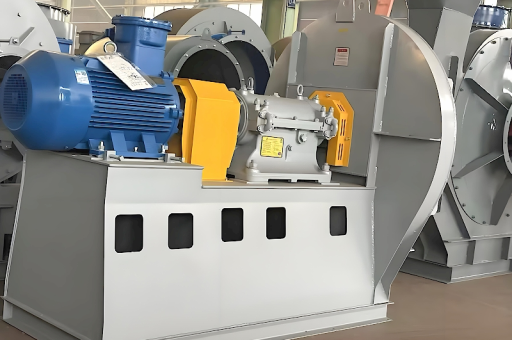
It seems like you are looking for information regarding an AC Motor used to drive a Forced Ventilating Factory Exhaust Fan.
Here is a breakdown of the key components, considerations, and common configurations for this type of industrial application.
Core Components Explained
- AC Motor (Induction Motor): The workhorse of the system. For factory exhaust fans, these are almost always 3-Phase Induction Motors (Squirrel Cage type) due to their durability, low maintenance, and high efficiency.
- Common Voltages: 230V, 400V (most common in EU/Asia), 460V (common in USA).
- Enclosure: TEFC (Totally Enclosed Fan Cooled) is standard to protect the motor from dust and moisture. For corrosive environments (chemical plants), a TEFC with Corrosion Protection or Explosion-Proof motor is required.
- Forced Ventilating (The Fan): "Forced" implies the fan is actively pushing or pulling air through ducts or directly out of the building.
- Fan Types: Axial Flow Fans (common for wall-mounted or duct-mounted exhaust, high volume, low pressure) and Centrifugal Fans (common for ducted systems handling long runs or higher static pressure).
- Factory Exhaust Fan (The Application): The goal is to remove heat, fumes, dust, or stale air from an industrial space.
Key Selection & Sizing Criteria
To properly select or specify this system, you must match the motor to the fan and the load.
- Air Volume (CFM or m³/hr): How much air needs to be moved.
- Static Pressure (SP - in. w.g. or Pa): The resistance the fan must overcome (ductwork, louvers, filters).
- Motor Power (HP or kW): Calculated from the above. Crucial Safety Note: Fans have a Variable Torque Load. Power required increases with the cube of the speed ( $P \propto N^3$ ). A 10% speed increase requires 33% more power.
- Speed (RPM): Directly affects air volume. Fans are often driven via Pulleys & Belts to adjust speed or via Direct Drive.
Common Setup & Control Methods
| Feature | Standard Direct-On-Line (DOL) | Variable Frequency Drive (VFD) - Highly Recommended |
|---|---|---|
| Control | On/Off only. | Infinite speed control (0-100%). |
| Efficiency | High at full speed. | High across all speeds. |
| Energy Savings | None (full speed always). | Significant (fan at half speed uses only 12.5% of full power). |
| Startup | High inrush current (6-8x FLA). Hard on belts/motors. | Soft start (ramps up slowly). Reduces mechanical stress. |
| Cost | Low capital cost. | Higher capital cost, lower operating cost. |
| Best For | Simple exhaust, constant load, small fans. | Factory exhaust where demand changes (temp, occupancy, process). |
Installation & Safety Must-Knows
- Mounting: Motors must be securely mounted on a rigid base. Vibration is the enemy of motor bearings.
- Electrical Protection:
- Overload Relay: Critical to protect the motor from overheating.
- Fuses/Circuit Breaker: For short-circuit protection.
- Disconnect Switch: Required by code (lockable) for maintenance safety.
- Environmental Protection:
- Ensure the motor's IP Rating (e.g., IP55) matches the factory environment.
- Thermal Protection: Many AC motors have built-in thermistors (PTC) or thermostats (Klixon) that trip the circuit if the motor overheats.
- Lubrication: For belt-driven units, bearings need periodic greasing. Many modern "sealed for life" motors do not.
- Ventilation: Ensure the motor itself has adequate cooling airflow. A motor running hot in a hot factory will fail prematurely.
Example Specification
If you were writing a purchase order or specifying this, it might look like:
Item: Forced Ventilation Exhaust Fan Unit Drive: 5 HP, 3-Phase, 460V, 1740 RPM, TEFC AC Induction Motor Fan: Centrifugal, Forward Curved, Belt Drive Performance: 10,000 CFM at 1.5 in. w.g. Static Pressure Controls: Variable Frequency Drive (VFD) with manual speed pot and remote start/stop capability.
In summary: For a Forced Ventilating Factory Exhaust Fan, use a TEFC 3-Phase AC Motor (sized correctly for the fan curve) and strongly consider a VFD for energy savings and process control. Always prioritize proper electrical protection and safe isolation for maintenance.





