
This article's table of contents introduction:
- What is it?
- Why "Stainless Steel"?
- Why "High Pressure" for Kilns?
- Key Design Features of This Fan
- Typical Applications
- Example Specification (For Quotation)
- Key Manufacturers (Who makes these?)
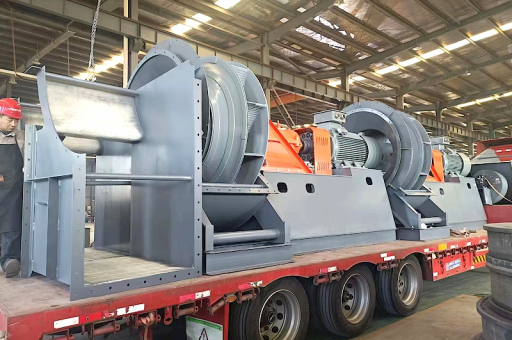
This is a highly specialized piece of equipment. A Stainless Steel High Pressure Centrifugal Fan for Kilns Cooling is designed to operate in one of the most demanding industrial environments.
Here is a detailed breakdown of what this equipment is, why specific materials and designs are used, and its key features.
What is it?
It is a centrifugal fan (also known as a blower or a radial fan) built to move a large volume of air (or process gas) at a high static pressure. Its specific function is to force cooling air through the shell of a rotary kiln, cooling the material inside (like clinker in a cement plant) or cooling the kiln shell itself to prevent thermal damage (a process called "forced air cooling").
Why "Stainless Steel"?
This is the most critical specification. Standard fans are carbon steel (mild steel). A Stainless Steel fan is chosen for three main reasons:
- Corrosion Resistance: Kiln cooling air is not "clean." It often contains:
- Acidic Gases: Sulfur dioxide (SO₂), nitrogen oxides (NOx), and chlorides can react with moisture to form acidic condensate.
- Moisture: High humidity can lead to significant rust on carbon steel.
- Abrasive Dust: If the fan draws air from the kiln hood or exit area, it contains fine, hot dust particles.
- High-Temperature Strength: Certain grades of stainless steel (like SS 310S or SS 309) have excellent high-temperature strength and oxidation resistance. They maintain their structural integrity better than carbon steel at elevated temperatures (300°C to 700°C+).
- Longevity & Hygiene: In applications where contamination of the cooling air is a concern (e.g., food-grade or pharmaceutical calcination), stainless steel prevents rust contamination and is easier to clean.
Common Stainless Steel Grades Used:
- SS 304: General corrosion resistance, moderate temperature (up to ~400°C / 750°F).
- SS 316 / 316L: Better resistance to chlorides and acidic gases. Often preferred for wet or highly corrosive environments.
- SS 310S / SS 309: High-temperature grades. Specifically for the "hot end" of the kiln where air temperatures can reach 600-800°C (1100-1500°F). These are essential for the fan housing and impeller.
Why "High Pressure" for Kilns?
A standard ventilation fan cannot overcome the resistance in a kiln cooling system. The fan must produce High Static Pressure to:
- Penetrate the Kiln Shell: The air must be forced through hundreds of small nozzles or slots around the kiln shell. This requires significant pressure to create a high-velocity air curtain.
- Overcome Ductwork Resistance: The fan moves air through long, complex ducting, dampers, and filters. Each component creates pressure loss.
- Maintain Velocity: High pressure is needed to achieve the required air velocity (often 30-50 m/s) at the nozzle exit to effectively strip away the hot boundary layer of air against the kiln shell.
Key Design Features of This Fan
| Feature | Why It Matters for Kiln Cooling |
|---|---|
| Impeller Type | Backward-Curved (BC) or Backward-Inclined (BI) blades are standard. They are efficient, non-overloading, and handle slightly dusty air better than forward-curved fans. |
| Housing | Heavy-gauge stainless steel, often with reinforced flanges and expansion joints to handle thermal expansion from the hot air. |
| Drive Arrangement | Direct Drive (fan wheel directly coupled to the motor) for reliability at high speeds. Belt Drive is used for speed adjustment (flow control) via variable pitch sheaves. |
| Shaft Seal | Air-purged labyrinth seals or mechanical seals to prevent hot, dusty air from leaking into the bearing housing and destroying the bearings. |
| Bearing Cooling | Features like oil-bath lubrication, fan-cooled housings, or even water-cooled bearing brackets are required to dissipate heat conducted down the shaft from the hot impeller. |
| Access Doors | Large, gasketed access doors allow for inspection and cleaning of the impeller without major disassembly. Kiln dust can build up and cause imbalance. |
Typical Applications
- Cement & Lime Kilns: Cooling the clinker cooler or the kiln shell.
- Metal Smelting (Copper, Zinc, etc.): Forced air cooling in rotary furnaces.
- Waste Incineration: Cooling rotary kilns used for thermal treatment.
- Mineral Processing: Calcining and drying kilns for gypsum, kaolin, etc.
Example Specification (For Quotation)
When requesting a quote for this fan, you should provide:
- Air Volume: (e.g., 50,000 m³/hr or 30,000 CFM)
- Static Pressure: (e.g., 4,000 Pa or 16" w.g.)
- Gas Temperature: (e.g., Normal: 250°C, Max: 400°C)
- Gas Composition: (e.g., "Air with acidic condensate and fine dust < 50mg/Nm³")
- Material: (e.g., "SS 316L Housing, Shaft, and Impeller")
- Mounting: (e.g., "Base-mounted with vibration isolators")
- Motor: (e.g., "50 HP, 1450 RPM, TEFC, VFD ready")
Key Manufacturers (Who makes these?)
- Howden
- Chicago Blower
- New York Blower (NYB)
- Cincinnati Fan
- Robinson Fans
- Kruger Ventilation
- Sodeca
Summary: This is a heavy-duty, corrosion-resistant, and thermally managed fan specifically designed to overcome high resistance in a hot, dirty environment. Its stainless steel construction is not a luxury—it is a necessity for reliable, long-term operation in kiln cooling service.





