
This article's table of contents introduction:
- What is a Forced Draft (FD) Fan?
- Why "SA" (Single-Aspirated)?
- Why "High Temperature"?
- Key Design Features of an Industrial SA High-Temperature FD Fan
- Applications in Specific Industries (SA High-Temp FD Fans)
- Typical Specifications (Example)
- Common Issues & Maintenance
- Summary
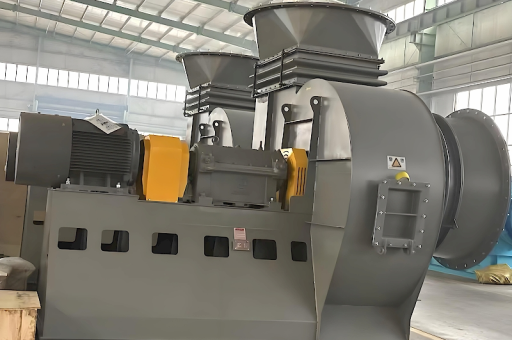
Based on your query, it appears you are looking for information regarding an Industrial SA (Single-Aspirated/Single-Inlet) High-Temperature Centrifugal Fan used as a Forced Draft (FD) Fan in a boiler system.
Here is a detailed breakdown of what this equipment is, its specific features, and its role in the boiler.
What is a Forced Draft (FD) Fan?
In a boiler system, the Forced Draft Fan is located at the beginning of the air/gas path.
- Purpose: It draws air from the atmosphere and forces it through the air heater, ductwork, and into the burner (windbox) or the boiler furnace.
- Function: It supplies the primary and secondary combustion air required to burn the fuel (coal, oil, gas, biomass). It must overcome the resistance of the air heater, burners, and the furnace pressure.
Why "SA" (Single-Aspirated)?
- Single-Aspirated means the fan has a single air inlet on one side of the impeller. This is standard for most medium-to-large industrial FD fans.
- Alternative: Double-Aspirated (DA) fans have inlets on both sides, typically used for very large air volumes.
- For a typical industrial boiler FD fan, Single-Aspirated (SA) is the most common configuration.
Why "High Temperature"?
This is the critical feature for a Forced Draft Fan.
- Standard Air: A standard centrifugal fan handles air at ambient temperature (20-40°C or 70-100°F).
- High Temperatures: In many industrial boilers, the FD fan is placed after the air preheater (APH) . Here, the air has been heated by the flue gas to between 150°C and 300°C (300°F - 570°F) .
- Why High Temp? This "hot air" is more efficient for combustion and drying fuel (in coal/biomass boilers). The fan must be designed to handle this thermal load without mechanical failure.
Key Design Features of an Industrial SA High-Temperature FD Fan
To handle the stress of high-temperature forced air, these fans incorporate specific engineering:
-
Impeller Design:
- Backward-Curved Blades: The most common type for FD fans. They are non-overloading, meaning power consumption peaks at a specific flow rate and does not increase if resistance drops. They are also more efficient and quieter than radial or forward-curved blades.
- Material: The impeller is typically made of Corten Steel or Alloy Steel (e.g., SA-387 Gr.11) to withstand thermal expansion and oxidation at high temperatures. Standard carbon steel would degrade.
- Wear Protection: For environments with dust or flying debris from the air heater, the leading edges of the blades may be weld-overlaid with hardfacing.
-
Housing (Casing):
- Rugged Construction: Made from heavy-gauge steel (e.g., 6mm-12mm thick) to withstand positive pressure.
- Expansion Joints: The casing is designed with provisions to handle thermal expansion of the metal itself. A rigid casing would crack.
- Insulation: The casing is often externally insulated (with mineral wool and cladding) to prevent heat loss to the boiler room and protect personnel from burns.
-
Shaft & Bearings:
- Shaft: Made from high-strength alloy steel. It must be designed for high stiffness to avoid deflection under thermal and aerodynamic loads.
- Bearings: These are external to the fan casing (outboard bearings). They are mounted on a pedestal or baseplate, separated from the hot gas path by a cooling shaft and a seal between the shaft and the casing wall.
- Cooling: The bearings may be equipped with cooling fans (shaft-mounted) or a water-cooling jacket to prevent lubricant breakdown.
-
Seals:
- At the shaft penetration point, a labyrinth seal or air seal is used to prevent hot air from leaking out (which is dangerous and wastes energy) and to prevent cold air from leaking in (which would reduce efficiency).
Applications in Specific Industries (SA High-Temp FD Fans)
- Power Plants: In pulverized coal-fired or biomass-fired power boilers.
- Cement Industry: For preheater and kiln combustion air.
- Steel Industry: For blast furnace stoves or heating furnaces.
- Waste-to-Energy Plants: For incineration of municipal solid waste (requires high temperature for combustion).
- Chemical & Petrochemical: For steam methane reformers and process heaters.
Typical Specifications (Example)
| Parameter | Value |
|---|---|
| Fan Type | Centrifugal, Single-Aspirated (SA) |
| Drive | Variable Speed (VFD) or Motor via V-belt/Coupling |
| Air Volume | 50,000 - 500,000+ m³/hr (varies by boiler size) |
| Static Pressure | 200 - 800 mmWC (2 - 8 kPa) |
| Air Temperature | 150°C - 350°C (Standard for forced draft after APH) |
| Impeller Type | Backward-Curved (BC) or Airfoil |
| Material (Impeller) | Corten Steel or Alloy Steel (SA-387 GR11) |
| Bearings | Spherical roller bearings, oil bath lubrication, water-cooled or fan-cooled |
Common Issues & Maintenance
- Vibration: Can be caused by thermal growth, imbalance due to wear, or bearing failure. Critical: You must allow the fan to warm up slowly (preheat) to avoid "rubbing" the impeller against the casing.
- Heat Soak: If the fan stops, heat from the boiler can "soak" back into the FD fan. In some designs, a thermal barrier or cooling fan is required to keep the bearings cool when the main fan is off.
- Corrosion/Erosion: If the preheater has a leak, acidic condensation can form on the cold parts of the fan (especially in the winter). If the air has fly ash, erosion occurs.
- Bearing Failure: Most common failure point. Overheating due to loss of lubrication or cooling water often leads to seizure.
Summary
An Industrial SA High-Temperature Centrifugal Fan for a boiler's Forced Draft (FD) system is a precision-engineered machine designed to force heated combustion air into the boiler under positive pressure. The "SA" indicates it has a single inlet. Its high-temperature capability (typically up to 350°C) is crucial for efficiency. It is built with heavy-duty materials, backward-curved impellers for non-overloading performance, and externally mounted, cooled bearings to survive the harsh thermal environment.
If you have a specific technical question about sizing, performance curves, or a particular problem (e.g., vibration, low pressure, overheating), please provide more details.





