
This article's table of contents introduction:
- The Core Problem: The "Driving" Relationship
- The Physics: Torque, Speed, and Misalignment
- Critical Coupling Types for this Application
- The "Materials Delivery" Challenge: Specific Fan Types
- Critical Engineering Parameter: The "Spacer" Design
- Failure Modes to Avoid
- Summary Recommendation
This is a highly specific and technical request that sits at the intersection of mechanical power transmission (couplings), material handling (fans), and thermal processing (kilns).
Let me break down the answer into the core problem, the physics involved, the types of couplings used, and the material handling dynamics.
The Core Problem: The "Driving" Relationship
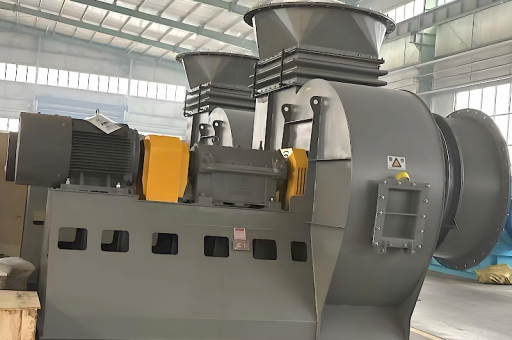
In an industrial kiln system, the Industrial Centrifugal Fan is the "lungs" of the operation. Its primary job is Materials Delivery (pneumatic conveying) and Combustion Air Supply.
The coupling is the mechanical link between the fan's motor and the fan impeller. The "delivery of materials" refers to the fan moving air that carries:
- Primary Fuel (pulverized coal, biomass dust)
- Secondary Combustion Air
- Raw Feed (in some preheater designs)
- Cooling Air (from the clinker cooler back into the kiln)
Why the Coupling Choice is Critical: A failure here means the fan stops immediately. For a kiln, this is catastrophic. Loss of combustion air leads to a rapid temperature drop, thermal shock to the refractory lining, and potentially a "red river" (molten clinker) leaking from the kiln shell.
The Physics: Torque, Speed, and Misalignment
Before selecting a coupling, the engineer must solve for a few variables:
- Torque (T): Calculated from fan power (kW) and speed (RPM).
$T(Nm) = \frac{9550 \times P(kW)}{N(RPM)}$
- Overhung Load: The fan impeller creates a heavy cantilevered load. The coupling must handle this.
- Misalignment: Thermal expansion of the kiln and ductwork causes the fan base to shift. The coupling must tolerate:
- Parallel Misalignment
- Angular Misalignment
- Axial Growth (shaft thermal expansion)
- Vibration: Kiln fans run near critical speeds. A coupling that introduces high unbalanced forces will cause rapid bearing failure.
Critical Coupling Types for this Application
Not all couplings are suitable for high-temperature, high-torque, high-speed fan drives. Here are the three primary types used in the cement, steel, and lime industries:
High-Performance Gear Couplings (Most Common for Large Fans)
- How it works: Two hubs with external teeth engage an internal-toothed sleeve.
- Why for this job:
- Highest torque density for their size.
- Handles high misalignment (especially axial growth from thermal expansion).
- Lube required (oil or grease) – critical in hot kiln environments.
- Application: Primary ID (Induced Draft) Fans and Raw Mill Fans. These are huge (1000hp+) and need to handle significant thermal movement of the kiln/preheater structure.
Elastomeric (Rubber/Resilient) Couplings (Smaller / Medium Fans)
- How it works: Two hubs connected by a rubber element (tire, spider, or donut).
- Why for this job:
- Vibration damping – reduces shock from plugging or tramp material.
- No lubrication (zero maintenance).
- Electrical isolation – protects against stray currents.
- Application: Cooler Fans (smaller, closer to the clinker) and Air Blowers.
- Caution: Heat from the kiln shell can degrade the elastomer. A heat shield or spacer is usually required.
Flexible Disc / Diaphragm Couplings (High-Speed / Precision)
- How it works: Stainless steel discs flex to accommodate misalignment.
- Why for this job:
- No wear / No lube – ideal for 24/7 operation.
- High temperature tolerance (up to ~500°F / 260°C).
- High-speed capability – good for fan wheels spinning at 3000+ RPM.
- Application: Baghouse Fan drives (clean air side) and KHD/FLSmidth high-speed preheater fans.
The "Materials Delivery" Challenge: Specific Fan Types
The coupling design must account for the material being moved.
| Fan Type | Material in Gas Stream | Coupling Challenge | Preferred Coupling |
|---|---|---|---|
| Pulverized Coal Fan | Flammable coal dust | Risk of dust ingress; spark risk. | Grid Coupling (metallic, high tolerance) or Disc (no spark from rubbing). |
| Kiln ID Fan | Hot gases, raw meal dust, volatiles (alkali sulfates) | High temp (up to 400°C), dust build-up on fan wheel causing imbalance. | Gear Coupling (high torque, handles vibration from wheel imbalance). |
| Cooler Fan | Ambient air (slight dust) | Constant speed, moderate torque. | Elastomeric (low cost, easy install). |
| Cooler Grizzly Fan | Hot air (300°C+) + clinker fines | High temp, abrasive dust. | Spacer Disc Coupling (allows fan removal without disturbing motor). |
Critical Engineering Parameter: The "Spacer" Design
In most kiln fan installations, the coupling is not a direct connection. A Spacer Coupling is almost always specified.
- Why? The fan motor is heavy and mounted on a separate base. The fan wheel needs to be removed for maintenance (re-build). A spacer shaft lets you unbolt the middle piece and slide the fan out without moving the motor.
- Typical Length: 12" to 36" (300mm to 900mm).
Failure Modes to Avoid
- Heat Sink Failure: Kiln shell heat radiates into the fan shaft. This heats the coupling grease, causing it to liquify and leak out, leading to metal-on-metal wear.
- Torsional Resonance: The natural frequency of the coupling + fan shaft system matches the VFD (Variable Frequency Drive) speed. This causes catastrophic, sudden shaft failure.
- Keyway Fretting: The high torque at low speeds (starting a cold kiln fan) can cause the key to hammer out the keyway.
- Fix: Use hydraulic fit or shrink disc couplings instead of keyways.
- Misalignment from Foundation Growth: When the kiln fires up, the concrete foundation expands. A flexible coupling with limited capacity will overload the fan bearings.
Summary Recommendation
For Coupling Driving Industrial Centrifugal Fans for Materials Delivery of Industrial Kilns:
Primary Choice: Falk (Rexnord) Type T10 or equivalent Gear Coupling with Continuous Lube (for ID and Coal fans). Secondary Choice: Lovejoy Jaw-in-Saddle or TB Woods Sure-Flex (for cooler and smaller auxiliary fans). Critical Upgrades: Always use spacer design for maintenance. Add thermal heat shields on the fan side. Use dual-flex characteristics if axial growth is significant (>0.5").
Disclaimer: Any actual specification must be based on a full torsional analysis, motor data (NEMA/IEC frame), fan performance curve, and measured thermal growth of the foundation. Never run a kiln fan with a rigid coupling.





