
This article's table of contents introduction:
- Why Stainless Steel is Mandatory
- The Core Applications (Where the Fan is Used)
- Key Specification Factors (You Must Check)
- Manufacturer / Supply Chain Considerations
- Common Issues to Avoid
- Summary Checklist for Your Inquiry
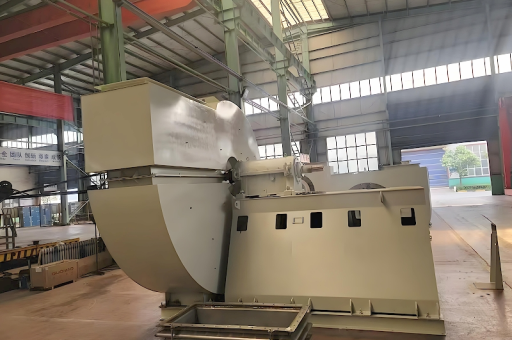
It appears you are looking for a stainless steel centrifugal blower (fan) specifically designed for use in a Garbage Incineration Power Plant.
These are highly specialized pieces of equipment. Unlike standard HVAC fans, they must withstand extreme heat, corrosive flue gases, and abrasive particulate matter (fly ash).
Here is a technical breakdown of what you need to know about this specific application, including key considerations and how to specify the correct unit.
Why Stainless Steel is Mandatory
In a waste-to-energy (WtE) plant, the flue gas is a cocktail of corrosive agents:
- Acids: Hydrochloric acid (HCl), Sulfuric acid (H2SO4), Hydrofluoric acid (HF), and Nitric acid (HNOx).
- Moisture: High humidity created by the combustion of organic waste.
- Temperature: Gas temperature can range from 180°C to 250°C (350°F to 480°F) and up to 950°C (1750°F) before cooling.
Material Recommendation:
- Standard Duplex (UNS S31803/S32205): Excellent for stress corrosion cracking. Good for IDs and Induced Draft fans.
- Super Duplex (UNS S32750): Higher strength and pitting resistance. Best for the most aggressive chemical environments near the scrubber.
- 904L (UNS N08904): Excellent resistance to sulfuric and phosphoric acids. Common in WtE plants.
- Hastelloy® C-276 (UNS N10276): Used for the most extreme acidic/high-chloride environments (e.g., after wet scrubbers). Very expensive.
The Core Applications (Where the Fan is Used)
There are typically three critical fan locations in a Garbage Incineration Power Plant:
| Application | Fan Type | Typical Temperature | Material Requirements | Key Challenge |
|---|---|---|---|---|
| Primary/Secondary Air Fan | Forward Curved or Radial | Ambient – 120°C | Standard Steel or 304L (SS) | Corrosion is low; main issue is wear. |
| Induced Draft (ID) Fan | Heavy-Duty Radial | 180°C – 250°C | SS Duplex / 904L | Corrosion + Erosion. The harshest fan duty. |
| Flue Gas Recirculation (FGR) | Radial | 150°C – 200°C | SS 316L / Duplex | Managing NOx emissions. |
| Cooling / Quench Air Fan | Axial or Centrifugal | Ambient | Standard Steel | Large volume, low pressure. |
The "Garbage Incineration Power Plant Fan" you mentioned is almost certainly either an ID Fan or an FGR Fan.
Key Specification Factors (You Must Check)
When ordering or specifying this blower, ensure these features are included:
A. Wheel (Impeller) Design
- Type: Radial (Paddle Wheel) is preferred over backward curved. Radial wheels are less susceptible to erosion and buildup.
- Wear Protection: Weld-on hard facing (e.g., Stellite® or Chromium Carbide) on the blades and backplate where ash impacts.
- Balance: ISO 1940 G2.5 balance grade minimum.
B. Shaft & Bearing Cooling
- Shaft: Must be double sealed with purge air to prevent hot gas from reaching the bearings.
- Bearings: Air cooled or water cooled bearing housings are mandatory. Grease can degrade in high heat.
C. Casing
- Split Housing (Horizontal or Vertical): Essential for maintenance. The fan must be easy to open to clean ash buildup.
- Drain Valve: A bottom drain to remove condensed acids during startup/shutdown.
- Thickness: Stainless steel casing is usually heavy gauge (10mm - 16mm) to resist vibration and erosion.
D. Drive System
- V-Belt or Direct Drive: Direct drive is preferred for high mechanical reliability.
- Motor: Must be IE3/IE4 efficiency, with a VFD (Variable Frequency Drive). The fan will need to modulate flow as the waste load changes.
- Variable Speed: Mandatory. Incineration plants fluctuate in heat output; fixed speed is insufficient.
E. Anti-Corrosion Features
- Passivation: The fan must be "pickled and passivated" after welding to restore the stainless steel's corrosion-resistant chromium oxide layer.
- No Galvanic Coupling: Ensure all fasteners (bolts) are made of the same or compatible stainless alloy.
Manufacturer / Supply Chain Considerations
Finding a used "standard" fan won't work. You need a Heavy-Duty Process Fan Manufacturer. Look for companies with specific "Waste-to-Energy" or "Incinerator" divisions.
Reputable Global OEMs (Original Equipment Manufacturers):
- Howden (U.S./UK) – Clear industry leaders.
- TLT-Babcock (U.S.) – Specialize in large power plant fans.
- Greenheck (U.S.) – Offer industrial centrifugal blowers (smaller sizes).
- Chicago Blower (U.S.) – Good for medium-duty.
- New York Blower (U.S.) – Strong in corrosive environments.
- Zhejiang Shangfeng (China) – Common for lower-cost Asian projects.
- Siemens Process Fans / FläktGroup (Europe) – High quality, high cost.
Common Issues to Avoid
- Ash Buildup: A radial fan with a "trickle clean" port is vital. If ash cakes on the impeller, the fan will vibrate and fail.
- Dew Point Corrosion: If the flue gas temperature drops below the acid dew point (approx. 140°C for HCl), acid condenses INSIDE the fan. The SS must be resistant to wet corrosion.
- No Bypass: If the fan runs while the boiler is cold, moisture can rust the SS surfaces. Ensure a pre-heat cycle.
Summary Checklist for Your Inquiry
If you are sourcing this fan, you need to provide this data to suppliers:
- Application: Garbage Incineration Power Plant (specify: Primary/ID/FGR).
- Flow (CFM / m³/h): [Required]
- Static Pressure (inches w.g. / kPa): [Required]
- Gas Temperature (Max / Normal / Min): [Required]
- Gas Composition: (High Chlorine? Sulfur? Fly ash concentration?)
- Material: SS 904L or Duplex 2205 (specify).
- Drive: Direct Drive with VFD.
- Standard: ISO 1940 Balance.
Conclusion: This is not a commodity fan. It is a high-cost, engineered piece of equipment. Expect lead times of 12–20 weeks. Do not use standard 304L stainless steel – it will fail within 6 months due to stress corrosion cracking from chlorides. Insist on Duplex or 904L.





