
This article's table of contents introduction:
- Core Function & Application
- Key Design Characteristics of "Heavy Duty" Fans
- Types of Heavy Duty Centrifugal Fans for Dust Collection
- How They Work in a Dust Collection System
- Critical Selection Parameters
- Maintenance & Common Issues
- Top Manufacturers (Examples)
- Summary
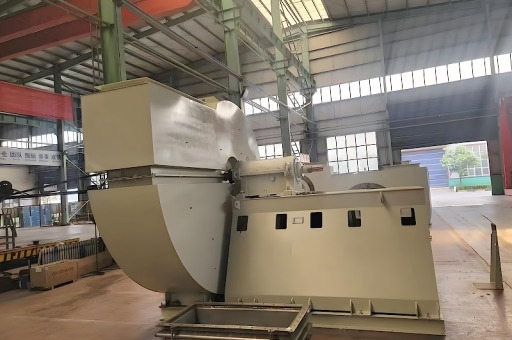
Here is a comprehensive overview of Large Flow Heavy Duty Centrifugal Fans used for Waste Gas and Dust Collecting.
These fans are the "lungs" of industrial air pollution control systems. They are specifically engineered to move massive volumes of contaminated air (waste gas) laden with particulate matter (dust) against the significant resistance (static pressure) created by ductwork, filters, scrubbers, and baghouses.
Core Function & Application
- Primary Function: To create the negative pressure (suction) required to capture fugitive dust and fumes at the source and convey them through a dust collection system to a filter or scrubber, then discharge clean air.
- Key Industries:
- Cement & Mining: Crushing, grinding, conveying, kiln exhaust.
- Steel & Metalworking: Arc furnaces, blast furnaces, grinding, welding fume extraction.
- Power Generation: Coal-fired boiler flue gas (often with FGD scrubbers), fly ash handling.
- Woodworking: Large-scale facilities with cyclones and baghouses.
- Chemical Processing: Corrosive fume exhaust, powder conveying.
- Pharmaceuticals & Food: Dust control for bulk material handling.
Key Design Characteristics of "Heavy Duty" Fans
Not all centrifugal fans are created equal. Heavy-duty models are built for 24/7 operation and harsh conditions.
-
Rugged Construction:
- Material: Typically heavy-gauge carbon steel, Corten steel (for abrasion), or stainless steel (for corrosion/heat).
- Housing: Designed for high static pressures (e.g., 10" to 40"+ w.g.). Often features split housing for easier maintenance.
- Shaft & Bearings: Large diameter shafts with heavy-duty, self-aligning, pillow-block bearings often with vibration monitoring and grease/ oil lubrication systems.
-
Wheel (Impeller) Design:
- This is the most critical component. The choice depends on the dust type.
- Backward Inclined (BI) / Backward Curved (BC): Most common for dust collection. High efficiency, non-overloading power curve (prevents motor burnout). Suitable for moderate dust loading.
- Radial Blade (Paddle Wheel) / Radial Tip: For extremely heavy dust loads or sticky material. Self-cleaning design, but less efficient and noisier.
- Airfoil (AF): Highest efficiency, but prone to dust build-up. Usually used on the clean air side of the filter.
-
High Flow Rate (Volume):
- Large impeller diameters (e.g., 48" to 100"+).
- High inlet/outlet duct sizes (e.g., 24" to 60" diameter or more).
- Capable of moving tens of thousands to hundreds of thousands of CFM (Cubic Feet per Minute).
-
Wear Protection (Abrasion Resistance):
- Wear Liners: Replaceable steel or ceramic liners inside the housing, especially on the cut-off and impeller blades.
- Hard Facing: Welding a hard metal alloy onto leading edges of blades.
- Corten Steel: Forms a protective oxide layer to resist wear.
-
Temperature & Corrosion Resistance:
- High-Temperature Designs: For kilns or dryers (up to 800°F+). Uses special alloys, water-cooled bearings, and shaft cooling discs.
- Corrosive Gas Handling: Constructed from 316L stainless steel, Hastelloy, or other exotic metals. May include external coatings (e.g., epoxy, rubber lining).
Types of Heavy Duty Centrifugal Fans for Dust Collection
| Fan Type | Best For | Pros | Cons |
|---|---|---|---|
| Housing | |||
| Inlet Box | High temperature, high pressure | Allows for efficient gas flow control (dampers). | More complex, higher cost. |
| Plug Fan | Baghouses, clean air side | Compact, direct drive (no belts), low maintenance. | Lower pressure capability. |
| Arrangement | |||
| Arr. 1 (SWSI) | General dust collection | Simple, cost-effective for moderate sizes. | Higher overhung load on the shaft. |
| Arr. 3 (DWD) | Very high volume, large fans | Excellent shaft stability, less deflection. | Two bearings (can be harder to align). |
| Arr. 4 (Direct Drive) | Clean air, high speed | No belts to break or slip, constant speed. | Requires a VFD for speed control, limited speed range. |
| Arr. 8 (Belt Drive) | Variable speed requirements | Easy speed change via sheaves, isolates motor from dust. | Belts & bearings require regular maintenance. |
How They Work in a Dust Collection System
- Capture: The fan creates a vacuum at hoods, shrouds, or machine inlets.
- Transport: The high-velocity airflow entrains dust and fumes and carries them through ductwork.
- Separation: The air enters the dust collector (e.g., baghouse, cartridge filter, cyclone, or wet scrubber). The fan is often placed after the collector ("clean air side" or "pull-through") to protect the fan from the heaviest dust.
- Pull-Through (Most Common for Heavy Dust): Fan is downstream of filter. Handles cleaner air. Longer filter life, less fan wear.
- Push-Through (Less Common): Fan is upstream. Used for sticky or very hot gases. The fan handles all the dust, requiring heavy-duty abrasion protection.
- Exhaust: The cleaned air is exhausted to the atmosphere or recirculated.
Critical Selection Parameters
- Air Volume (CFM): The total desired airflow.
- Static Pressure (SP, in w.g.): The total pressure drop of the entire system (ducts, hoods, filter, silencer).
- Air Density & Temperature: Affects motor power and material selection.
- Particulate Characteristics: Size, shape (abrasiveness), concentration, stickiness, explosiveness (ATEX/NEC compliance).
- Cleaning Method: Is the filter pulse-jet, reverse air, or mechanical shaker? This affects the SP profile.
- Motor & Drive: Typically oversized motors (Service Factor 1.15) with VFDs for energy savings and soft-starting.
Maintenance & Common Issues
- Erosion/Wear (Most Common): Leading cause of failure. Regular inspection of wear liners and blades is critical. Uneven wear can cause dynamic imbalance.
- Imbalance: Caused by uneven dust build-up on blades (especially BI or AF wheels) or erosion. Leads to vibration, bearing failure, and shaft cracks.
- Bearing Failure: From contamination, misalignment, or vibration.
- Corrosion: From acidic gases (SOx, NOx, HCl).
- Plugging: Sticky materials can build up on the wheel, severely reducing performance and causing imbalance.
- Vibration Monitoring: Essential for predictive maintenance. Use accelerometers on bearing housings.
Top Manufacturers (Examples)
- Howden
- New York Blower (NYB)
- Greenheck
- Chicago Blower
- Cincinnati Fan
- Robinson Fans (Heavy-duty, especially for power)
- TLT-Turbo (Formerly Babcock & Wilcox)
- DCL (UK-based, heavy industrial)
Summary
A Large Flow Heavy Duty Centrifugal Fan is a specialized piece of rotating equipment. Its success depends on matching the impeller type (backward inclined vs. radial) to the dust characteristics and using robust materials (abrasion-resistant steels or coatings). Properly specified, these fans are the reliable workhorses of industrial air pollution control, operating flawlessly for decades with minimal downtime. When they fail, it is almost always due to abrasive wear or dynamic imbalance from dust buildup.
Would you like a more detailed analysis on a specific application (e.g., cement kiln exhaust vs. woodworking baghouse) or the calculations for sizing a motor?





