
This article's table of contents introduction:
- Table of Contents
- Introduction: Why Heavy Duty Centrifugal Fans Are Critical for Industry
- What Is a Durable Heavy Duty Centrifugal Fan Blower?
- Key Features That Define Durability and Performance
- Industrial Applications: Where These Fans Shine
- How to Select the Right Centrifugal Fan for Your Facility
- Maintenance Tips to Extend Operational Life
- Frequently Asked Questions (FAQ)
- Conclusion: Investing in Quality for Long-Term ROI
The Comprehensive Guide to Durable Heavy Duty Centrifugal Fan Blower for Industrial Use
Table of Contents
- Introduction: Why Heavy Duty Centrifugal Fans Are Critical for Industry
- What Is a Durable Heavy Duty Centrifugal Fan Blower?
- Key Features That Define Durability and Performance
- Industrial Applications: Where These Fans Shine
- How to Select the Right Centrifugal Fan for Your Facility
- Maintenance Tips to Extend Operational Life
- Frequently Asked Questions (FAQ)
- Conclusion: Investing in Quality for Long-Term ROI
Introduction: Why Heavy Duty Centrifugal Fans Are Critical for Industry
In modern industrial environments, managing airflow is not a luxury—it is a necessity. Facilities such as chemical plants, steel mills, cement factories, power generation stations, and wind turbine manufacturing units require consistent, high-volume air movement to maintain safety, regulate temperature, and remove hazardous fumes or dust. This is precisely where a durable heavy duty centrifugal fan blower becomes an indispensable asset.
Unlike standard axial fans, which move air parallel to the blade axis, a centrifugal fan uses a rotating impeller to increase air pressure and volume, making it far more effective for industrial tasks involving long ductwork, high static pressure, or particulate-laden air. However, not all centrifugal fans are built alike. A true "heavy duty" unit is engineered with robust materials, oversized bearings, reinforced housings, and high-torque motors to withstand continuous operation under extreme conditions.
This guide synthesizes insights from leading engineering sources, maintenance manuals, and industry case studies to provide you with a definitive resource. Whether you are a plant manager, a procurement specialist, or an HVAC engineer, understanding the nuances of a durable heavy duty centrifugal fan blower will help you make a smarter, more cost-effective investment.
What Is a Durable Heavy Duty Centrifugal Fan Blower?
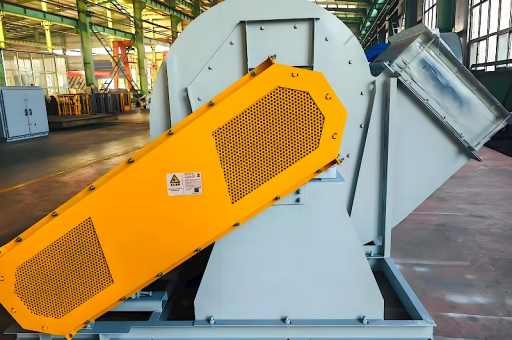
A durable heavy duty centrifugal fan blower is a mechanical device designed to convert rotational kinetic energy into airflow with increased pressure. It consists of three primary components: a motor, an impeller (or wheel), and a housing (scroll or volute). The air enters the fan axially through the inlet, is caught by the rotating impeller blades, and is then expelled radially at a 90-degree angle through the outlet.
The term "heavy duty" refers to the fan's ability to operate continuously—often 24/7—in harsh conditions without premature failure. This means the fan must handle:
- High ambient temperatures (up to 200°C or more)
- Corrosive or abrasive gas streams
- High static pressure (up to several thousand Pascals)
- Dust, moisture, or chemical vapors
To achieve this, manufacturers reinforce the impeller with thicker steel or even stainless steel alloys, use cast iron or welded steel housings, and incorporate Class F or H insulation in the motor. Sealed bearings with grease fittings, vibration monitoring ports, and replaceable wear liners are also common in high-end models.
One important distinction: these fans are often paired with variable frequency drives (VFDs) to control airflow precisely. In wind turbine manufacturing, for instance, heavy duty centrifugal fans are used to ventilate nacelles and cool generators, where reliability is paramount.
Key Features That Define Durability and Performance
When evaluating a durable heavy duty centrifugal fan blower, look beyond the nameplate. The following features separate a premium unit from a standard one:
Impeller Design and Material
- Backward-curved blades are preferred for high efficiency and self-cleaning properties.
- Forward-curved blades offer higher volume at lower pressure, useful in clean air applications.
- Radial or paddle-blade impellers are used for dusty or sticky materials due to their simple geometry.
- Materials range from mild steel (economical) to 304/316 stainless steel (corrosion resistance) and aluminum (lightweight).
Housing Construction
- Heavy duty fans feature 6–12 mm thick steel housing, often welded and reinforced with external ribbing.
- Split housings are available for easier maintenance access.
- Internal wear liners (e.g., ceramic tiles or hardened steel) protect against abrasive erosion.
Bearing and Shaft Assembly
- Double-row spherical roller bearings are standard for handling radial and axial loads.
- Labyrinth seals or contact seals prevent dust ingress.
- Oversized shafts reduce deflection, extending bearing life.
Motor and Drive Options
- Direct drive (motor directly coupled to fan) vs. belt drive (pulley system) – belt drives allow speed adjustment but require more maintenance.
- Motors should be IE3 or IE4 efficiency class for energy savings.
- For explosion-proof environments, ATEX-certified motors are mandatory.
Vibration and Noise Control
- Factory balancing of impellers to ISO 1940 G6.3 or better.
- Vibration sensors can be integrated into predictive maintenance systems.
- Acoustic enclosures or silencers reduce noise to OSHA-compliant levels.
Industrial Applications: Where These Fans Shine
A durable heavy duty centrifugal fan blower is not a one-size-fits-all product. Different industries require tailored configurations:
Cement and Mining
These fans handle extremely abrasive raw materials. They often use radial blade impellers with hardened wear plates. Air volumes can exceed 500,000 m³/h at pressures over 5,000 Pa. Example: kiln exhaust fans or baghouse fan systems.
Chemical and Petrochemical
Corrosive gases (e.g., HCl, SO₂, or volatile organic compounds) demand stainless steel or FRP (fiberglass-reinforced plastic) construction. Fans must comply with API 673 or ISO 13709 standards for reliability.
Power Generation and Wind Turbine Cooling
In thermal power plants, centrifugal fans supply combustion air and cool generators. For wind turbine installations, compact yet powerful fans extract heat from nacelle components. These fans must be lightweight but robust, often using aluminum impellers and IP55-rated motors.
Pharmaceutical and Food Processing
Cleanroom environments require hygienic design: no crevices for bacteria growth, easy disassembly, and FDA-approved coatings. Fans are often constructed from 316L stainless steel with polished surfaces.
Wastewater Treatment
Biological aeration relies on low-pressure high-volume centrifugal blowers. Durability against moisture and hydrogen sulfide is critical.
How to Select the Right Centrifugal Fan for Your Facility
Follow this step-by-step process to ensure you choose a durable heavy duty centrifugal fan blower that matches your operational needs:
-
Define Airflow and Pressure Requirements
- Determine CFM or m³/h and total static pressure (including duct losses).
- Use a fan selection software or consult a manufacturer's performance curve.
-
Assess Air Composition
- Is the air clean, dusty, moist, or corrosive?
- For temperatures above 80°C, order a high-temperature fan with appropriate seals.
-
Choose Impeller Type
- Backward-curved for efficiency in clean, moderate pressure applications.
- Radial for heavy dust; forward-curved for high volume, low pressure.
-
Evaluate Environmental Class
- Indoor or outdoor installation? Use weatherproof housing and corrosion-resistant fasteners.
- For hazardous locations, select ATEX or IECEx certified fans.
-
Consider Power and Drive
- Match motor kW to the fan's brake horsepower at the design point.
- For variable loads, invest in a VFD; for constant speed, direct drive is simpler.
-
Check Maintainability
Prefer fans with removable bearing cartridges, access doors, and reversible impellers.
Maintenance Tips to Extend Operational Life
Even the most durable heavy duty centrifugal fan blower will fail prematurely if neglected. Implement these practices:
-
Weekly: Visual Inspection
Check for unusual noise, vibration, or leakage. Inspect belts (if belt-driven) for tension and wear. -
Monthly: Bearing Lubrication
Use the correct grease type (e.g., lithium-based) and quantity. Over-greasing can cause overheating. -
Quarterly: Impeller Cleaning
Remove dust buildup to avoid imbalance. In abrasive environments, check wear liner thickness. -
Annually: Full Overhaul
Replace seals, bearings, and gaskets. Re-balance the impeller if necessary.
Pro tip: Set up a vibration trending program using portable analyzers. This can detect bearing degradation weeks before a catastrophic failure.
Frequently Asked Questions (FAQ)
Q1: How long does a heavy duty centrifugal fan last?
With proper maintenance, a quality fan can operate for 15–20 years or longer. Key factors include operating temperature, dust load, and lubrication regimen.
Q2: Can I use a standard fan for wind turbine applications?
Not recommended. Conditions inside a wind turbine nacelle include temperature extremes, high vibration, and limited access. A heavy duty fan with sealed bearings, reinforced housing, and compliant motor rating is essential.
Q3: What is the difference between a fan and a blower?
In industrial terminology, a "blower" typically operates at higher pressure (over 1,000 Pa) than a "fan." However, the terms are often used interchangeably. A centrifugal blower is designed for high static pressure applications.
Q4: How do I reduce noise from my centrifugal fan?
Install an inlet and outlet silencer, use vibration isolators, and consider a fan with backward-curved blades (quieter than forward-curved designs). Additionally, placing the fan in a sound-attenuated enclosure can reduce noise by 10–20 dB.
Q5: Do I need a VFD for my fan?
VFDs offer significant benefits: energy savings (up to 30% at partial loads), soft-start to reduce electrical stress, and precise flow control. If your process requires variable airflow, a VFD is a wise investment.
Q6: Are there specific certifications I should look for?
Yes. For general industrial use, look for ISO 9001 manufacturing quality. For safety, CE or UL certification. For explosive atmospheres, ATEX (Zone 1 or 2) is mandatory. For energy efficiency, the motor should meet IE3 standards.
Q7: Can a heavy duty fan handle high-vibration environments like wind turbine nacelles?
Absolutely. However, you must specify the fan with reinforced steel housing, high-grade bearings, and vibration-resistant mounting brackets. Many manufacturers offer customized designs for marine or wind turbine applications.
Q8: What’s the typical lead time for a custom heavy duty fan?
Standard models ship in 4–8 weeks. Custom engineered fans (with exotic materials or special coatings) can take 12–20 weeks depending on complexity.
Conclusion: Investing in Quality for Long-Term ROI
Choosing the right durable heavy duty centrifugal fan blower is not merely a technical decision—it is a financial one. A high-quality unit may have a higher upfront cost, but it pays dividends through reduced downtime, lower energy consumption, and longer service intervals. In industries like wind turbine manufacturing, chemical processing, and mining, failure of a ventilation fan can halt an entire production line, costing thousands per hour.
By prioritizing features such as heavy-gauge construction, premium bearings, appropriate impeller material, and compliance with industry standards, you ensure that your facility operates safely and efficiently. Use the selection guidelines and maintenance tips provided in this article to make an informed purchase.
Remember: the best fan is the one that you never think about—running quietly, reliably, and consistently in the background. That is the hallmark of true heavy duty engineering.





