
This article's table of contents introduction:
- Introduction: Why Grate Cooler Cooling Matters
- Understanding the Grate Cooler: Thermal Exchange Dynamics
- The Power Behind the Cooler: High Pressure Centrifugal Fans
- Stainless Steel Construction: Durability in Harsh Environments
- System Integration: Fan Selection and Performance Metrics
- Frequently Asked Questions (FAQ)
- Conclusion: Future Trends in Cooling Technology
** Optimizing Industrial Cooling Efficiency: The Critical Role of Grate Cooler Systems with Stainless Steel High Pressure Centrifugal Blowers
Table of Contents
- Introduction: Why Grate Cooler Cooling Matters
- Understanding the Grate Cooler: Thermal Exchange Dynamics
- The Power Behind the Cooler: High Pressure Centrifugal Fans
- Stainless Steel Construction: Durability in Harsh Environments
- System Integration: Fan Selection and Performance Metrics
- Frequently Asked Questions (FAQ)
- Conclusion: Future Trends in Cooling Technology
Introduction: Why Grate Cooler Cooling Matters
In heavy industries such as cement manufacturing, steel production, and mineral processing, the grate cooler is a cornerstone of thermal management. Its primary function is to rapidly cool hot clinker (often reaching 1,200–1,400 °C) by forcing ambient air through a moving bed of material. This process recovers heat, improves product quality, and protects downstream equipment. However, the efficiency of a grate cooler depends overwhelmingly on its air supply system—specifically, the high pressure centrifugal fan that delivers cooling air. Without a reliable, corrosion-resistant fan, the entire cooling cycle fails. This article examines how a stainless steel blower, engineered for high pressure and continuous duty, optimizes grate cooler cooling performance and extends equipment lifespan.
Understanding the Grate Cooler: Thermal Exchange Dynamics
A grate cooler consists of a series of moving plates (grates) that transport hot clinker while allowing air to pass upward through the material bed. The air performs two roles: convective cooling of the clinker and quenching to stabilize mineral phases. Key factors in this process include:
- Pressure Drop: The clinker bed creates significant resistance, often requiring 6–10 kPa (kilopascals) of static pressure.
- Air Distribution: Uneven airflow leads to “red rivers” (uncooled hotspots) and excessive wear.
- Temperature Gradients: Inlet air at ambient temperature must displace superheated gases without causing thermal shock to the fan.
A high pressure centrifugal fan is uniquely suited here because its impeller design generates the necessary static pressure while maintaining stable volumetric flow. Unlike axial fans, centrifugal models handle high resistance without stalling.
The Power Behind the Cooler: High Pressure Centrifugal Fans
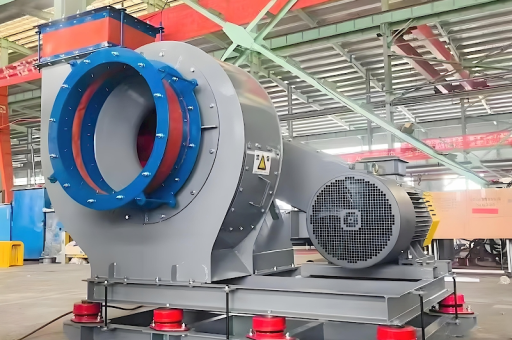
The term high pressure centrifugal fan refers to a rotating machine where air enters axially and is discharged radially at higher pressure. For grate cooler applications, these fans must meet three demanding criteria:
- High Static Pressure: Typically 8,000–15,000 Pa, depending on bed depth and material porosity.
- Consistent Airflow: Fluctuations in clinker feed or moisture content require a fan with a steep pressure curve (i.e., minimal flow drop under varying resistance).
- Variable Speed Capability: Modern systems use VFDs (Variable Frequency Drives) to match fan output to cooler demand, reducing energy waste.
A properly selected high pressure centrifugal fan improves cooling speed, reduces clinker temperature from 1,200 °C to under 100 °C within minutes, and recovers up to 30% of input heat for preheating combustion air.
Stainless Steel Construction: Durability in Harsh Environments
Why is a stainless steel blower the preferred choice for grate cooler cooling? The environment inside a grate cooler is extremely aggressive:
- High Humidity: Water spray cooling creates saturated air that corrodes carbon steel.
- Abrasive Dust: Clinker particles erode fan impellers and housings.
- Thermal Cycling: Fans start and stop frequently, inducing stress on weld joints.
Stainless steel (grades 304L or 316L) offers:
- Corrosion Resistance: Chromium oxide layer prevents rust in condensing steam.
- Erosion Resistance: Higher hardness than carbon steel reduces blade wear.
- Temperature Tolerance: Stainless steel maintains structural integrity up to 400 °C without embrittlement.
In practice, a stainless steel high pressure centrifugal fan can last 3–5 times longer than a carbon steel equivalent in the same service, justifying its higher initial cost.
System Integration: Fan Selection and Performance Metrics
When integrating a grate cooler cooling stainless steel blower, engineers must calculate:
- Required Air Volume (m³/h): Based on clinker throughput and specific heat capacity.
- System Resistance (Pa): Sum of bed pressure drop, duct losses, and dampers.
- Fan Efficiency (%): Preferably above 80% at the design point.
Selection Checklist:
- Impeller type: Backward-curved blades for high efficiency; radial blades for heavy dust.
- Drive arrangement: Direct drive (no belt losses) or belt drive (speed flexibility).
- Inlet and outlet cones: Designed to minimize turbulence.
Case studies show that upgrading to a high pressure centrifugal fan with a stainless steel impeller reduces annual maintenance downtime by 50% and lowers energy consumption by 8–12% compared to older, undersized units.
Frequently Asked Questions (FAQ)
Q1: What is the main difference between a grate cooler fan and a standard ventilation fan?
A1: A grate cooler fan must generate high static pressure (often >8 kPa) to overcome clinker bed resistance, while a standard ventilation fan operates at low pressure (<1 kPa). Also, grate cooler fans require robust construction to handle abrasive dust and thermal shock.
Q2: Why is stainless steel necessary for a grate cooler cooling blower?
A2: The combination of moisture, high temperature, and abrasive particles accelerates corrosion and erosion. Stainless steel’s chromium content forms a protective layer that resists rust and maintains blade strength, significantly extending service life.
Q3: Can a high pressure centrifugal fan be retrofitted into an existing grate cooler?
A3: Yes, but careful duct sizing and motor power calculations are required. A retrofit usually involves replacing the fan wheel and housing while reusing the motor and VFD if capacity allows. Always consult a specialized OEM.
Q4: How does fan speed affect cooling performance?
A4: Reducing fan speed by 20% cuts airflow by 20% but decreases power consumption by nearly 50% (per fan affinity laws). However, too low a speed may cause clinker overheating and grate damage. VFDs allow precise speed control.
Q5: What maintenance is required for a stainless steel blower in this application?
A5: Regular inspections for blade erosion (every 6 months), bearing lubrication (monthly), and vibration analysis (continuous). Stainless steel reduces internal cleaning frequency because dust adheres less to its smooth surface.
Conclusion: Future Trends in Cooling Technology
The combination of a grate cooler cooling system with a stainless steel high pressure centrifugal fan represents a mature yet evolving technology. Current innovations include aerodynamic impeller profiles that reduce noise by 15 dB, coatings like tungsten carbide applied to stainless blades for extreme abrasion resistance, and smart sensor integration that predicts fan failure via real-time vibration data.
For industries aiming to reduce carbon footprint, optimizing the grate cooler fan is a low-hanging fruit: better cooling efficiency directly lowers clinker temperature, enabling higher alternative fuel usage and reducing kiln heat loss. As global environmental regulations tighten, the demand for durable, energy-efficient high pressure centrifugal fans—particularly in stainless steel construction—will only increase. Whether you are designing a new plant or retrofitting an existing line, selecting the right blower is not just a mechanical decision: it is an investment in reliability, safety, and long-term cost savings.





