
This article's table of contents introduction:
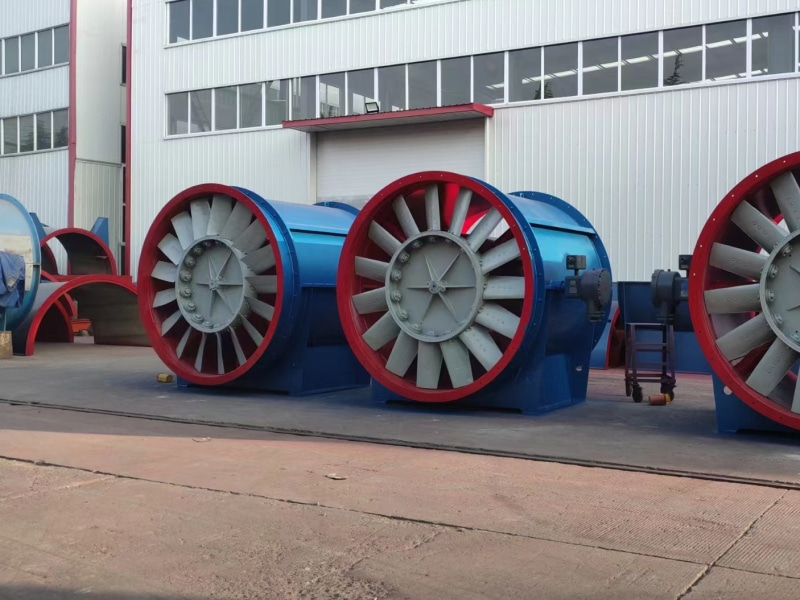
This specific model number, FBCDZ-10-No38, refers to a particular type of industrial fan used exclusively in underground coal mining. Let's break down what each part of the name means, followed by a technical overview of the fan type.
Nomenclature Breakdown
F – Fan
B – Explosion-proof (防爆, Fángbào)
C – Coal Mine (煤矿, Méikuàng)
DZ – Contra-rotating / Counter-rotating Axial Flow (对旋轴流式, Duì Xuán Zhóu Liú Shì)
10 – Design Sequence Number (Series 10)
No38 – Impeller Diameter in decimeters (38 dm = 3800 mm or 8 meters)
Full Translation
FBCDZ-10-No38 = Explosion-Proof, Coal Mine, Counter-Rotating, Axial Flow Fan, Series 10, 3.8m Diameter
Technical Description
Counter-Rotating (DZ) Design
This is the defining feature of the fan.
Two stages of impellers are mounted on the same axis but rotate in opposite directions.
First stage (Rotor 1): Acts as the main impeller, accelerating the air and imparting swirl.
Second stage (Rotor 2): Rotates opposite to the first stage. It acts as a stator and a rotor simultaneously. It removes the swirl from the first stage and converts it into additional static pressure, recovering energy that would otherwise be lost.
Result: High efficiency (up to 85%), high pressure (for a mine fan), and a compact axial length compared to a conventional axial fan with guide vanes.
Explosion-Proof (B) Construction
Since the fan handles potentially explosive mine air (methane gas mixtures), safety is paramount:
Materials: The impellers and casing are typically made of non-sparking materials (e.g., aluminum alloy for blades, steel for the hub) or have copper/nickel inserts to prevent frictional sparks.
Motor: The motors (usually two separate explosion-proof motors, one for each rotor) are certified Exd (Flameproof enclosure) or Exe (Increased safety) for use in underground coal mines.
Sealing: The shaft seals are designed to prevent the escape of hot gases or sparks into the mine atmosphere.
"No38" (3800 mm Diameter)
A 3.8-meter diameter is a large industrial fan, typically used for main mine ventilation (as opposed to auxiliary or local fans).
Airflow Range: Likely between 150 m³/s to over 400 m³/s (depending on blade angle setting).
Static Pressure: Likely between 1,500 Pa to 4,500 Pa.
Power: The motors driving this fan would be in the range of 800 kW to over 2,000 kW total (two motors combined).
Operating & Control
Blade Pitch: The fan is likely equipped with adjustable blades (on both stages). You can change the blade angle while the fan is stationary to alter the performance curve to match mine ventilation requirements.
Reverse Ventilation: A key feature of mine fans. To reverse airflow (for emergency situations in case of a fire underground), the counter-rotating fan can simply reverse the rotation direction of both impellers. This is much faster and more efficient than using mechanical dampers or reversing doors (though reversing doors are often still installed for redundancy).
Variable Speed: Modern drives (High Voltage VFDs) are sometimes used, but the standard control is via blade angle adjustment.
Summary Table
| Feature | Detail |
|---|---|
| Type | Counter-rotating, axial flow |
| Application | Primary (Main) mine ventilation (exhaust) |
| Diameter | 8 m (3800 mm) |
| Safety | Explosion-proof (Exd / Exe) |
| Key Advantage | High efficiency, compact size, fast reverse airflow |
| Typical Flow | ~150–400 m³/s |
| Typical Pressure | ~1,500–4,500 Pa |
| Drive | Two independent explosion-proof motors |
Common Use Case
This fan would be installed at the surface exhaust shaft of a large, modern underground coal mine. It pulls air out of the mine (exhaust), creating negative pressure that draws fresh air into the intake shafts and through the workings.
If you have a specific question about installation, a common fault, or performance curve data for this model, please feel free to ask.





