
This article's table of contents introduction:
- The Core Fan Type: Backward Centrifugal Fan
- The Application: Induced Draft (ID)
- The Material: Stainless Steel
- The Motor: Three-Phase
- How They ALL Work Together: The Complete System
- Typical Applications
- Common Problems & Considerations
It sounds like you are describing a specific type of industrial fan. Let me break down what each of those terms means and how they combine to form a high-performance piece of equipment.
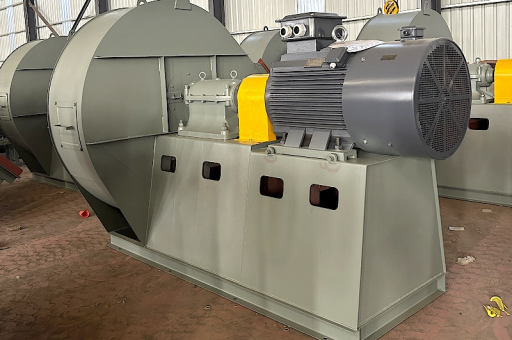
Here is a detailed breakdown of the Stainless Steel Induced Draft Fan (Backward Centrifugal, Three-Phase) .
The Core Fan Type: Backward Centrifugal Fan
- Centrifugal Fan: Air enters the fan axially (along the shaft) and is expelled radially (outward, 90 degrees from the inlet) by a rotating impeller.
- Backward Curved/Inclined Blades: The blades of the impeller curve away from the direction of rotation.
- Key Characteristics:
- High Efficiency: This is the most efficient type of centrifugal fan.
- Non-Overloading Power Curve: The motor will not burn out if the duct system is blocked. Power consumption peaks at a certain point and then drops.
- Higher Speed: Operates at higher RPMs than forward-curved fans.
- Cleaner Air: The blade shape is less prone to dirt buildup.
The Application: Induced Draft (ID)
- Function: This fan is located after the process (e.g., a boiler, furnace, or kiln). It pulls (sucks) air or exhaust gases out of the system, creating a negative pressure (vacuum) inside the process equipment.
- Contrast: A Forced Draft (FD) fan pushes air into the system.
- The Challenge: ID fans move hot, often corrosive, dirty, and moisture-laden air. This is the most demanding application for a fan.
The Material: Stainless Steel
This is the critical material selection for an ID fan. Standard carbon steel would rapidly corrode or erode, especially with hot exhaust gases.
-
Why Stainless Steel?
- Corrosion Resistance: Essential when handling acidic flue gases (e.g., from burning sulfur-containing fuels), chemical vapors, or salty air.
- Heat Resistance: Some grades (like 310S or 316H) can withstand very high temperatures (600°C / 1112°F and above).
- Hygiene: Smooth, non-porous surface is easy to clean for food, pharmaceutical, or cleanroom applications.
-
Common Grades Used:
- SS304 (1.4301): General-purpose corrosion resistance. Good for food, mild chemicals, and moderate temperature.
- SS316/L (1.4401/1.4404): Excellent resistance to chlorides (salt, bleach) and acids. The standard for marine or chemical environments.
- SS310/S (1.4845): High-temperature service (up to 1150°C / 2100°F). Used for extreme ID applications like steel furnaces.
The Motor: Three-Phase
- Why Three-Phase? This is the industrial standard. Three-phase motors are more efficient, more reliable, and more powerful than single-phase motors of the same size.
- Advantages:
- Smooth Operation: Constant torque, no vibration from starting.
- Higher Power: Can easily handle large fans (e.g., 5 HP, 50 HP, 500 HP).
- Variable Speed: Easily controlled with a Variable Frequency Drive (VFD) for precise airflow control (dampening).
- Reversibility: Can be wired to run in either direction.
How They ALL Work Together: The Complete System
- Application: A furnace burns fuel to heat a fluid or create steam.
- Gas Flow: Hot exhaust gas (250°C - 800°C, containing SOx, NOx, ash, and moisture) is created.
- The Fan's Role: The Stainless Steel Induced Draft Fan is placed in the exhaust stack. It pulls the hot, corrosive gas through the furnace, heat exchangers, filters (baghouse), and scrubbers.
- The Fan Construction:
- Impeller: Made of SS316 or SS310, with backward curved blades for highest efficiency and self-cleaning properties.
- Housing: Made of the same stainless steel to prevent rust from the corrosive condensates that form when the gas cools.
- Shaft & Bearings: Heavy-duty bearings (often with external cooling) to handle the heat and load.
- Motor: A large three-phase induction motor (e.g., 50 HP, 1480 RPM) connected directly or via belts to spin the fan at high speed.
- Result: The system maintains negative pressure, preventing dangerous fumes from leaking out, and safely moves the gas to the stack for discharge.
Typical Applications
- Power Plants: Boiler ID fans.
- Cement Plants: Kiln exhaust gas handling.
- Chemical Industry: Fume extractors, scrubber exhaust.
- Waste Incineration: Moving hot, acidic, and particulate-filled gas.
- Food Processing: Oven exhaust, fryer ventilation.
- Pharmaceuticals: Fume hoods, pollution control.
Common Problems & Considerations
- Temperature: The fan must be rated for the maximum possible gas temperature. Cooling wheels (shaft coolers) are often needed.
- Erosion: Soot and fly ash can erode the blades quickly. Hard-facing or thicker stainless steel is sometimes required.
- Corrosion: Condensation is a major issue. Acid "dew point" corrosion occurs if the gas cools below a certain temperature before exiting the fan. Insulation and drain holes are critical.
- Vibration: High-speed operation and potential imbalance from dust buildup require robust monitoring and balancing.
In short: You are describing a heavy-duty, high-efficiency, corrosion-resistant fan designed for the most demanding job in industrial ventilation: pulling hot, nasty exhaust gas out of a process.





