
This article's table of contents introduction:
- Introduction: The Unsung Hero of Combustion Efficiency
- Understanding the Forced Draft Fan System
- The Drying Function: Why Material Moisture Matters
- How Power Generation Is Impacted by Fan Performance
- Key Components and Design Considerations
- Common Operational Challenges and Solutions
- Q&A: Expert Answers to Frequent Fan-Related Questions
- Maintenance Best Practices for Longevity
- Conclusion: Optimizing the Drying-Power-Fan Triad
** The Critical Role of Materials Drying Power Forced Draft Fan in Thermal Power Plant Operations
Table of Contents
- Introduction: The Unsung Hero of Combustion Efficiency
- Understanding the Forced Draft Fan System
- The Drying Function: Why Material Moisture Matters
- How Power Generation Is Impacted by Fan Performance
- Key Components and Design Considerations
- Common Operational Challenges and Solutions
- Q&A: Expert Answers to Frequent Fan-Related Questions
- Maintenance Best Practices for Longevity
- Conclusion: Optimizing the Drying-Power-Fan Triad
Introduction: The Unsung Hero of Combustion Efficiency
In a thermal power plant, every kilowatt of electricity begins with heat. That heat comes from burning fuel—coal, biomass, or other materials. But before combustion can occur efficiently, the fuel must be dry. Excess moisture reduces calorific value, increases emissions, and can even damage equipment. This is where the Materials Drying Power Forced Draft Fan enters the stage. This fan is not just any blower; it is a specialized unit designed to supply heated, forced air to dry solid fuels before they enter the boiler. Without it, thermal efficiency drops, and operational costs soar.
This article dives deep into the function, engineering, and optimization of forced draft fans in the context of materials drying for power generation. We will explore how these fans interact with the drying system, what happens when they fail, and how plant engineers can maximize performance.
Understanding the Forced Draft Fan System
A forced draft (FD) fan is located at the beginning of the air-gas path in a thermal power plant. Its primary job is to push ambient air into the furnace or, in the case of drying, into a pre-combustion dryer. Unlike induced draft fans that pull air out, FD fans operate under positive pressure.
For materials drying, the FD fan often works in tandem with an air heater. The fan draws in outside air, which passes through steam coils or heat exchangers, raising its temperature to 150–250°C. This hot air is then directed into a mill or dryer where wet fuel—such as lignite or high-moisture biomass—is tumbled and dried. The fan must deliver a consistent, high-volume airflow at a pressure sufficient to overcome duct resistance and lift the fuel particles.
Key parameters:
- Flow rate: Typically 50–150 m³/s depending on plant size
- Pressure rise: 1–3 kPa
- Power consumption: 300 kW to 2 MW
The Drying Function: Why Material Moisture Matters
Moisture in fuel is the enemy of thermal efficiency. For example, lignite coal can contain 30–60% water by weight. Burning such wet fuel directly would waste energy evaporating water instead of generating steam. A dedicated drying system using a forced draft fan pre-treats the fuel, reducing moisture to 10–15%.
The process works as follows:
- Wet fuel enters a hammer mill or rotary drum dryer.
- Hot air from the FD fan flows through the dryer, absorbing moisture.
- The dried fuel is then pneumatically conveyed into the boiler.
- Exhaust air, now laden with water vapor, is treated or vented.
Without this forced draft fan, drying would be slow, incomplete, and energy-intensive. The fan ensures that the heat transfer between air and fuel is rapid and uniform.
How Power Generation Is Impacted by Fan Performance
The forced draft fan directly influences the plant’s net power output. If the fan underperforms, fuel remains wet, leading to:
- Lower boiler temperature
- Increased slagging and fouling
- Higher auxiliary power consumption (the fan itself uses electricity)
- Reduced steam generation and hence lower megawatt output
Conversely, an oversized fan wastes energy and may over-dry fuel, causing dust explosions in extreme cases. The sweet spot is a fan that matches the drying curve of the specific fuel. Modern plants use variable frequency drives (VFDs) to modulate fan speed based on real-time moisture sensors. This approach can save 15–25% of fan energy costs while maintaining optimal drying.
Key Components and Design Considerations
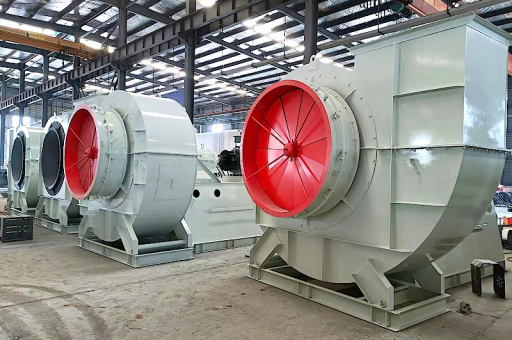
A typical Materials Drying Power Forced Draft Fan in a thermal power plant consists of:
- Impeller: Backward-curved blades for high efficiency and low noise.
- Housing: Heavy-gauge steel with erosion-resistant linings (since dried fuel particles can be abrasive).
- Shaft and Bearings: Designed for continuous operation at high temperatures (ambient + heater output).
- Inlet Box: Often equipped with guide vanes for flow control.
- Drive System: Motor, coupling, and optionally a gearbox.
Designers must account for:
- Material handling: The fan must tolerate occasional carryover of fine fuel dust.
- Temperature excursions: If the air heater fails, cold air can condense moisture inside the fan, leading to corrosion.
- Sealing: Air leaks reduce drying efficiency; labyrinth seals or purge air systems are common.
Common Operational Challenges and Solutions
| Challenge | Cause | Solution |
|---|---|---|
| Vibration | Imbalance from dust buildup | Regular cleaning & dynamic balancing |
| Reduced airflow | Clogged inlet filter or duct | Install differential pressure sensors |
| Bearing overheating | High ambient temp or grease failure | Use high-temp grease & external cooling |
| Erosion of blades | Abrasive fuel particles | Apply ceramic coating or replace with hardened alloys |
| Motor overload | Density change in hot air | Use VFD to match motor load to actual demand |
One real-world case: A 500 MW plant in India saw a 4% drop in boiler efficiency because its FD fan for the lignite dryer was running at fixed speed. After installing a VFD and a moisture analyzer, efficiency recovered fully within three months.
Q&A: Expert Answers to Frequent Fan-Related Questions
Q: Can a forced draft fan be used for both drying and combustion air?
A: It is possible but not recommended. Drying air and combustion air have different temperature, pressure, and cleanliness requirements. Separate fans allow independent optimization.
Q: What happens if the forced draft fan fails during operation?
A: The drying process stops immediately. Wet fuel will enter the boiler, causing flame instability and rapid slagging. Most plants have a standby fan that starts automatically within seconds.
Q: How do I calculate the required power for a drying FD fan?
A: Use the formula:
Power (kW) = (Flow m³/s × Pressure kPa) / (Fan Efficiency × Motor Efficiency)
Typical efficiency for a modern backward-curved fan is 82–88%.
Q: Is there a difference between an FD fan for coal vs. biomass drying?
A: Yes. Biomass fibers can clog the fan, so a larger inlet and self-cleaning impeller are needed. Coal dust is abrasive but less sticky.
Q: What is the typical lifespan of such a fan?
A: With proper maintenance, 15–20 years. Blade replacement may be needed every 5–8 years depending on erosion.
Maintenance Best Practices for Longevity
To keep your Materials Drying Power Forced Draft Fan running at peak performance:
- Monitor vibration weekly – Use ISO 10816-3 standards. Unusual spikes indicate imbalance or bearing wear.
- Inspect internals quarterly – Look for erosion on blades and corrosion in the housing.
- Lubricate bearings per OEM specs – Over-greasing is as harmful as under-greasing.
- Check air heater tubes – A leaky heater sends cold, wet air into the fan, causing condensation.
- Calibrate sensors monthly – Flow, pressure, and temperature readings must be accurate for VFD control.
- Keep spare parts on site – Critical spares include bearings, shaft seals, and a complete impeller.
Implementing predictive maintenance using trend analysis can reduce unplanned downtime by up to 40%. Many plants now use IoT-based sensors that feed data into a central control system.
Conclusion: Optimizing the Drying-Power-Fan Triad
The Materials Drying Power Forced Draft Fan is a linchpin in modern thermal power plants. It does more than move air—it directly enables fuel drying, which in turn drives combustion efficiency, emissions control, and overall plant profitability. From lignite-fired stations in Germany to biomass plants in Brazil, engineers rely on these fans to balance airflow, temperature, and pressure against the ever-changing moisture content of fuel.
As the energy industry shifts toward variable renewable sources, thermal plants must run with maximum flexibility and minimum cost. Investing in high-efficiency forced draft fans with intelligent controls is not optional—it is a strategic necessity. Whether you are designing a new plant or upgrading an existing one, remember: dry fuel is happy fuel, and a happy fan makes dry fuel possible.





