
This article's table of contents introduction:
- Component Breakdown
- Key Design & Engineering Factors
- Common Applications
- Advantages of Overhang Type for This Application
- Potential Weaknesses to Manage
- Procurement Checklist
- Conclusion
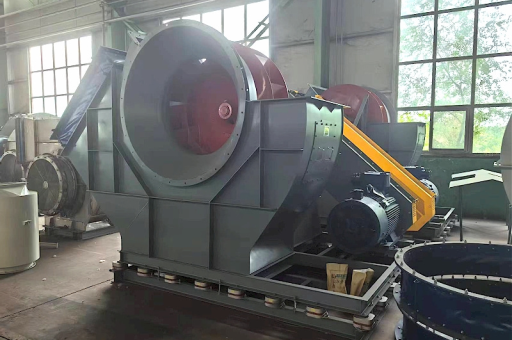
It appears you are describing a High Wear Resistance, Overhang Type (Overhung) Flue Gas Fan, likely constructed from Q345 steel for heavy-duty industrial applications.
Here is a breakdown of what this specification typically means, its common applications, and key design considerations for procurement or maintenance.
Component Breakdown
- Heavy Duty: Designed for continuous operation under harsh conditions (high temperature, dust, corrosive gases). Typically features thicker material, reinforced bearings, and robust shafts.
- Q345 (Material): A Chinese standard low-alloy high-strength structural steel (similar to ASTM A572 Grade 50 or S355JR). It offers good weldability and strength, but standard Q345 is NOT inherently corrosion or wear resistant.
- Critical Note: If high wear resistance is required, the fan blades and housing are usually lined with a wear-resistant layer (e.g., Hardox steel, ceramic tiles, or carbide coatings) or the material is upgraded to Q345R with a hard-facing overlay.
- Flue Gas Fan: Used to move exhaust gases from boilers, furnaces, or kilns. Gases often contain abrasive fly ash and corrosive sulfur compounds (SOx).
- Overhang Type (Overhung): The impeller is mounted on the end of the shaft, "overhanging" the bearing supports. This allows the fan housing to be directly connected to the ductwork without the shaft passing through the housing (reducing leakage), but it puts more bending stress on the shaft and bearing.
- High Wear Resistance: This is the key performance requirement. The fan must resist erosion from solid particles (fly ash, dust) present in the flue gas.
Key Design & Engineering Factors
To ensure the fan meets the "High Wear Resistance" claim, you should verify these features:
| Feature | Specification / Standard |
|---|---|
| Blade Material | Not just Q345. Typically uses NM400/NM500 (wear-resistant steel) or Q345 with a hard-facing welding overlay (e.g., tungsten carbide or chromium carbide). |
| Housing Lining | Internal lining of ceramic tiles (alumina, 92%+) or a replaceable wear plate made of wear-resistant steel. |
| Impeller Design | Forward-curved or radial blades. Radial blades are best for high dust loads. Blades should have a thick leading edge (e.g., 10-20mm) to withstand impact. |
| Shaft & Bearing | Overhung type requires a heavy-duty bearing pedestal with spherical roller bearings. The shaft must be large diameter (e.g., 100-150mm+ for large fans) and made of 40Cr or 45# steel. |
| Speed & Balance | Usually operates at 1450 RPM or 960 RPM. Must be dynamically balanced to G2.5 grade or better to prevent vibration from wear. |
| Temperature | Flue gas fans often require a cooling shaft or cooling impeller (backward curved) if temperatures exceed 250°C. Q345 loses strength above 300°C. |
Common Applications
- Power Plants: Induced Draft (ID) fans for coal-fired boilers.
- Cement Plants: Kiln exhaust fans handling hot, abrasive dust.
- Steel Mills: Sintering plant fans or blast furnace gas fans.
- Chemical Plants: Handling exhaust from dryers or calciners.
Advantages of Overhang Type for This Application
- Leak Reduction: No shaft penetration through the housing, which is critical for containing hot, toxic, or acidic flue gases.
- Simpler Maintenance: The impeller can be accessed from the front (inlet side) for inspection and repair, often without removing the entire fan housing. The bearing pedestal is outside the gas stream, reducing heat damage to bearings.
- Lower Cost: Less complex housing design than double-suction or double-bearing arrangements.
Potential Weaknesses to Manage
- Shaft Fatigue: The overhung load creates a cantilever moment. Shaft bending fatigue is the #1 failure mode in these fans. Crucial: Use a shaft diameter with a safety factor of >2.0.
- Bearing Overload: Misalignment or high imbalance from uneven wear can quickly destroy bearings. Must use a split-pillow block bearing housing with a vibration sensor.
- Inlet Erosion: The "eye" of the impeller and the leading edges of the blades suffer the most erosion. Must have a replaceable inlet cone (wear ring) made of high-chrome iron.
Procurement Checklist
If you are sourcing this fan, request the following specifications from the manufacturer:
- Impeller Blade Thickness: Minimum 12mm (Q345 base) + 6mm hard-facing overlay.
- Housing Lining: Ceramic tiles (Al₂O₃ >92%) glued and riveted, minimum 10mm thick in the wear zone.
- Shaft: 40Cr steel, heat treated, balanced to G2.5.
- Bearings: SKF/FAG spherical roller bearings (223 series or similar) with grease lubrication and a vibration sensor.
- Speed: Maximum 1450 RPM (for diameters >1.5m, 960 RPM or lower is preferred).
- Inspection Ports: You need access panels to check the thickness of the wear lining.
Conclusion
A Heavy Duty Q345 Flue Gas Fan Overhang Type with High Wear Resistance is a robust industrial fan designed for abrasive, hot, and corrosive environments. Q345 alone is insufficient for high wear resistance. You must ensure the impeller and housing are either made of a higher-grade wear-resistant steel (NM500) or are effectively lined with ceramic or hard-facing alloys. The overhang design is excellent for serviceability and leak prevention but demands high shaft quality and bearing support.





