
This article's table of contents introduction:
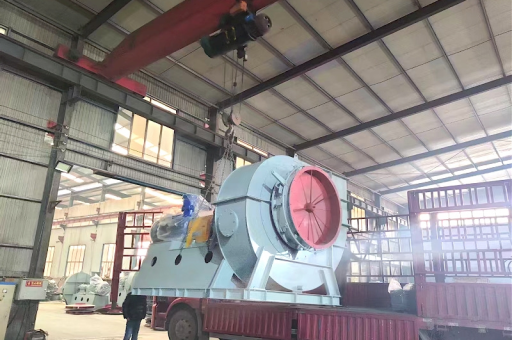
- What is it?
- Key Design Features for Flue Gas & High Heat
- Who Uses This Fan? (Applications)
- Operating Principle & Performance
- How to Select the Correct Fan (Key Parameters)
- Advantages of a Single Inlet Centrifugal for This Duty
- Disadvantages / Considerations
- Summary Table
This is a detailed specification for a Heat Dissipation Flue Gas Fan, specifically a Single Inlet Centrifugal Blower. This type of fan is a critical piece of industrial equipment designed to handle high-temperature, potentially corrosive, and particulate-laden exhaust gases.
Below is a breakdown of what this fan is, its key design features, typical applications, and operating considerations.
What is it?
A Single Inlet Centrifugal Blower uses a rotating impeller to increase the velocity and pressure of a gas. The gas enters axially through a single inlet on one side of the fan housing and is discharged radially (at 90 degrees) into a scroll-shaped casing.
When configured for Heat Dissipation and Flue Gas, the fan is engineered to withstand the harsh conditions of an exhaust stream from a combustion process (boiler, furnace, incinerator, etc.). It is often referred to as an ID Fan (Induced Draft Fan).
Key Design Features for Flue Gas & High Heat
-
High-Temperature Construction:
- Materials: The impeller, shaft, and housing are typically made from carbon steel (for lower temps, ~200°C / 400°F), corten steel (for higher temps), or stainless steel (for corrosive gases + heat).
- Shaft Cooling: A fan handling hot gases must prevent heat from traveling down the shaft to the motor bearings. This is achieved via:
- Cooling Fan (Ventilator): A small auxiliary fan mounted on the shaft in between the housing and the bearing.
- Radiation Disc (Heat Slinger): A disc mounted on the shaft that radiates heat away.
- Water-Cooled Bearings: For extreme temperatures (>300°C / 570°F).
-
Rugged Impeller Design:
- Blade Type: Backward Curved (BC) or Backward Inclined (BI) blades are most common. They are non-overloading (motor won't burn out if system pressure drops), efficient, and handle dust better than forward-curved blades.
- Rugged Construction: Blades are often welded to heavy-duty side plates and a hub, rather than riveted.
- Wear Protection: May include replaceable wear plates or hard-facing on the blades if the flue gas contains abrasive fly ash.
-
Housing Design:
- Single Inlet: Standard, cost-effective design.
- Reinforced Casing: Heavy-gauge steel to handle positive or negative pressures.
- Access Doors: Crucial for inspection and cleaning of ash buildup.
-
Motor and Drive:
- Belt Drive or Direct Drive: Belt drive allows for speed changes (and thus flow/pressure changes) easily. Direct drive is more efficient for a fixed speed.
- Variable Frequency Drive (VFD): The standard for modern energy-efficient systems, allowing precise control of fan speed and flow.
- Motor Type: Typically a TEFC (Totally Enclosed Fan Cooled) motor, or a higher-grade motor for harsh environments.
Who Uses This Fan? (Applications)
- Power Plants: Induced Draft fans pulling flue gas through boilers, baghouses, and scrubbers.
- Industrial Boilers: For steam generation in factories, refineries, and chemical plants.
- Cement Plants: Exhaust from kilns and clinker coolers.
- Steel Mills: Exhaust from furnaces and fume extraction systems.
- Incinerators: For waste-to-energy plants, pulling gas through the combustion chamber and pollution control equipment.
- Glass Manufacturing: Hot exhaust from glass furnaces.
Operating Principle & Performance
- Function: It creates a negative pressure (suction) on the inlet side, pulling hot flue gas through the system. It then creates positive pressure on the discharge side to push the gas up a stack or into a scrubber/baghose.
- Pressure: Typically classified as Medium Pressure (20-80 inches w.g. / 5-20 kPa) or Heavy Duty Medium Pressure.
- Efficiency: Backward curved designs offer good efficiency (70-85%) across a wide operating range.
How to Select the Correct Fan (Key Parameters)
If you are looking to purchase or specify this fan, you will need to provide:
- Gas Volume: (CFM or m³/hr) - at actual operating conditions (hot).
- Static Pressure: (Inches W.G. or Pa) - Total system resistance.
- Gas Temperature: (Normal, Maximum, and Minimum) - Crucial for material selection and cooling design.
- Gas Composition:
- Is it corrosive? (e.g., SOx, HCl)
- Is it abrasive? (e.g., fly ash, sand)
- Is it explosive? (e.g., combustible dust)
- Altitude: Affects air density and motor power.
- Location: Indoor or outdoor? Ambient temperature?
Advantages of a Single Inlet Centrifugal for This Duty
- Higher Efficiency: More efficient than axial fans for this pressure range.
- Stable Performance: Non-overloading power curve prevents motor overload.
- Handles Particulates: Better at handling dust and debris than many other fan types.
- Durable: Robust design for continuous industrial operation.
Disadvantages / Considerations
- Space: Larger footprint than axial fans.
- Cost: More expensive than simple axial fans due to heavy construction.
- Maintenance: Bearings and belts (if used) require periodic maintenance.
- Heat Management: Special cooling measures are mandatory, adding cost and complexity.
Summary Table
| Feature | Typical Specification for Heat Dissipation Flue Gas Fan |
|---|---|
| Type | Single Inlet, Centrifugal |
| Blade Style | Backward Curved / Backward Inclined |
| Duty | Heavy Duty, Continuous |
| Temperature | Up to 450°C (850°F) with special cooling |
| Drive | Belt or Direct Drive (with VFD preferred) |
| Construction | Heavy Gauge Steel, Stainless, or Corten |
| Key Feature | Heat Slinger / Cooling Fan on Shaft |
| Primary Use | Induced Draft (ID) Fan |
In conclusion, this fan is a rugged, high-performance workhorse for any process that needs to move large volumes of hot, dirty air or gas safely and efficiently. Proper selection based on your exact gas conditions is critical to its longevity and safe operation.





