
This article's table of contents introduction:
- What it is: The Core Function
- Key Design Features (What makes it "Large" & "Centrifugal")
- Applications (Where you find this fan)
- Critical Considerations for Selection & Operation
- Summary Table: Characteristics
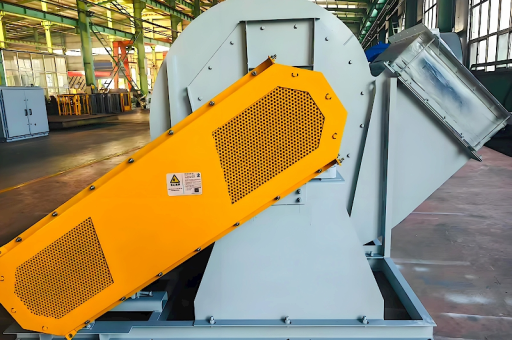
This is a highly specific and industrial piece of equipment. You are describing a heavy-duty, induced draft (ID) fan used in boiler systems for emission control, specifically for moving large volumes of hot, particulate-laden flue gas through a dust collector (like a baghouse or electrostatic precipitator).
Here is a breakdown of what this fan is, its key design features, common applications, and critical considerations.
What it is: The Core Function
This fan is the "vacuum cleaner" of an industrial boiler system. It sits after the boiler and the dust collection system (typically a baghouse or ESP).
- Primary Role: To create negative pressure (draft) in the boiler, pulling combustion gases (flue gas) through the boiler, economizer, air heater, and finally through the dust collector before exhausting it up the stack.
- The Challenge: It must handle extremely large volumes of hot, abrasive, and often corrosive gas containing fly ash and other particulates.
Key Design Features (What makes it "Large" & "Centrifugal")
-
Centrifugal Design: These fans use a rotating impeller (wheel) to accelerate the gas outward by centrifugal force. This design is ideal for:
- High Pressure: Overcoming the significant pressure drop across the boiler, ductwork, and the dust collector (often 10-40 inches w.g. or more).
- High Volume: Moving hundreds of thousands of cubic feet per minute (CFM) of gas.
- Durability: More robust and resistant to abrasion from fly ash than axial fans.
-
Heavy-Duty Construction:
- Housing: Heavy-gauge carbon steel, often lined with abrasion-resistant materials (e.g., ceramic tile, hard-facing, or replaceable wear plates).
- Impeller: Typically backward-inclined or radial-tip blades. These are designed to be self-cleaning (to prevent ash buildup) and are often made from abrasion-resistant steel.
- Shaft & Bearings: Large, stout shaft supported by oversized, heavy-duty bearings (often spherical roller bearings) in split pillow blocks for easy maintenance. The bearings are usually located outside the gas stream (on the pedestal) to keep them cool and clean.
- Drive System: Powerful electric motor (often 500 hp to several thousand hp), connected via a massive V-belt drive or a direct-drive coupling. Variable Frequency Drives (VFDs) are now common for energy savings and precise control of boiler draft.
-
Temperature & Corrosion Resistance:
- Hot Gas Handling: Designed for continuous operation at 300–500°F (150–260°C), with possible excursions up to 800°F (425°C) for bypass or startup.
- Shaft Cooling: A cooling fan (shaft-mounted) or a cooling shroud is often used to keep the bearings from overheating due to radiant heat from the hot shaft.
- High-Temperature Seals: Special labyrinth or carbon ring seals prevent hot gas and dust from leaking out along the shaft.
Applications (Where you find this fan)
- Coal-Fired Power Plants: The classic application. ID fans handle massive volumes of hot flue gas after the baghouse or ESP.
- Biomass Power Plants: Burning wood, agricultural waste, or refuse-derived fuel. These produce particularly abrasive and corrosive ash (especially with high chlorine/potassium content).
- Industrial Boilers: Used in paper mills (recovery boilers), chemical plants, refineries, and steel mills.
- Waste-to-Energy Plants: Handling flue gas from municipal solid waste incineration, which is highly corrosive and requires specialized alloys or coatings.
- Cement Kilns: Handling hot gas from the preheater tower.
Critical Considerations for Selection & Operation
- Abrasion: Fly ash is like sandpaper. The fan must be designed for hard-facing of blades and housing. The wear rate dictates maintenance schedules and fan lifespan.
- Corrosion: If the boiler burns high-sulfur fuel or the flue gas temperature drops below the acid dew point (typically 200-300°F for sulfuric acid), severe corrosion will occur. Insulation, heaters, and corrosion-resistant materials (like Corten steel or 316 stainless) might be needed.
- Vibration Monitoring: Due to imbalance from fly ash buildup or degradation, these giant fans are often equipped with continuous vibration monitoring systems to prevent catastrophic failure.
- Variable Frequency Drive (VFD): Almost mandatory for modern installations. A VFD allows precise control of fan speed to match boiler load, saving immense amounts of energy compared to inlet vanes or dampers. It also provides a soft start for the massive motor.
- Fan Laws: Performance scales predictably with speed. Fan flow is proportional to speed (RPM), pressure is proportional to RPM², and power is proportional to RPM³. This is crucial for understanding the impact of speed changes.
Summary Table: Characteristics
| Feature | Typical Characteristic | Why it's critical |
|---|---|---|
| Type | Centrifugal, Single or Double Inlet | Handles high volume & pressure |
| Service | Induced Draft (ID) | Pulls gas from boiler & dust collector |
| Gas Temp | 250°F - 400°F (121°C - 204°C) | Prevents condensation & acid attack |
| Wheel Blades | Radial or Backward Inclined | Self-cleaning, high efficiency, robust |
| Material | Abrasion-resistant steel, wear liners | Combats fly ash erosion |
| Drive | VFD + Motor (direct or belt) | Energy savings, precise control, soft start |
| Mounting | Isolation base, heavy steel frame | Reduces vibration transmission to structure |
In short, you're looking at a critical, high-maintenance, and high-value asset in any large industrial combustion system. Its proper design, operation, and maintenance are essential for meeting environmental emission standards and ensuring the boiler runs reliably.





