
This article's table of contents introduction:
- Article Content
- Introduction: Why Cement Plants Demand Specialized Fan Systems
- Technical Anatomy: Understanding the Backward Curved Blade Design
- Anti Abrasive Engineering: Materials and Coatings for Harsh Environments
- Induced Draught Dynamics: How This Fan Handles High-Temperature Dust-Laden Air
- Performance Comparison: Backward Curved vs. Radial and Forward Curved Fans
- Installation and Maintenance Best Practices for Cement Fans
- Common Questions (Q&A) About Backward Curved Anti Abrasive Induced Draught Cement Fans
- Conclusion: Long-Term ROI Through Intelligent Fan Selection
The Critical Role of Backward Curved Anti Abrasive Induced Draught Cement Fan in Heavy-Duty Industrial Ventilation
Article Content
Table of Contents (Directory Guide)
- Introduction: Why Cement Plants Demand Specialized Fan Systems
- Technical Anatomy: Understanding the Backward Curved Blade Design
- Anti Abrasive Engineering: Materials and Coatings for Harsh Environments
- Induced Draught Dynamics: How This Fan Handles High-Temperature Dust-Laden Air
- Performance Comparison: Backward Curved vs. Radial and Forward Curved Fans
- Installation and Maintenance Best Practices for Cement Fans
- Common Questions (Q&A) About Backward Curved Anti Abrasive Induced Draught Cement Fans
- Conclusion: Long-Term ROI Through Intelligent Fan Selection
Introduction: Why Cement Plants Demand Specialized Fan Systems
Cement manufacturing is one of the most abrasive and high-temperature industrial processes. From raw meal grinding to clinker cooling, every stage involves the movement of dust-laden, corrosive air. Standard industrial fans fail quickly in these environments. This is where the Backward Curved Anti Abrasive Induced Draught Cement Fan steps in.
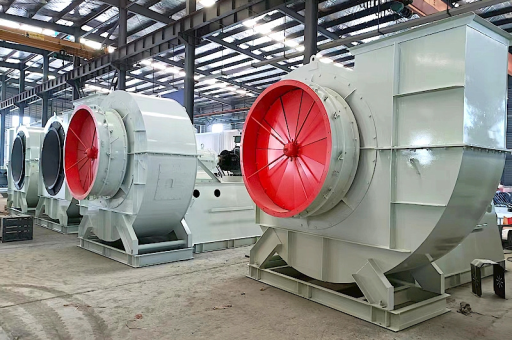
This specialized fan is designed to handle heavy particulate loads while maintaining high aerodynamic efficiency. Unlike conventional forward-curved or radial fans, the backward curved design reduces material buildup on blades, minimizes vibration, and delivers consistent airflow under negative pressure conditions typical of induced draught systems. In a cement plant, a failure in the induced draught fan can halt the entire production line—making reliability non-negotiable.
Q: What makes a cement fan different from a regular industrial fan?
A: A cement fan must withstand high temperatures (often exceeding 250°C), abrasive dust particles (silica, clinker, limestone), and corrosive gases (sulfur oxides). The backward curved anti abrasive design specifically addresses blade erosion and dynamic imbalance.
Technical Anatomy: Understanding the Backward Curved Blade Design
The term "backward curved" refers to blades that curve away from the direction of rotation. This geometry creates a lower tip speed relative to the air velocity, which results in several mechanical and aerodynamic benefits:
- Self-Cleaning Propensity: The blade curvature naturally sheds dust and scale buildup, reducing the need for frequent manual cleaning.
- High Static Efficiency: Backward curved blades generate less turbulence and noise, achieving efficiency levels of 82–88%, compared to forward curved fans that often fall below 75%.
- Non-Overloading Power Curve: If the system resistance drops, a backward curved fan does not consume excessive power—preventing motor burnout.
In a Backward Curved Anti Abrasive Induced Draught Cement Fan, the blade thickness is increased at the leading edge, and the trailing edge is reinforced with a wear-resistant strip. This design distributes wear evenly across the blade surface, extending service life by 3–5 times compared to standard steel blades.
Q: Why does backward curvature reduce dust adhesion?
A: The blade angle creates a centrifugal force vector that pushes particles toward the trailing edge, where they are ejected before sintering or accumulating. Flat or forward curved blades trap particles in pockets.
Anti Abrasive Engineering: Materials and Coatings for Harsh Environments
Abrasion in a cement fan is not uniform. The inlet cone, blade roots, and casing walls suffer the most erosion. Manufacturers use a multi-layer approach to combat this:
- Base Material: High-strength low-alloy steel (HSLA) or Corten steel provides the structural backbone.
- Hardfacing Welding: Chrome carbide or tungsten carbide overlays are applied to blade edges and critical wear zones. These materials achieve hardness of 60–65 HRC (Rockwell Hardness C).
- Ceramic Tile Lining: In extreme zones, such as the volute tongue and outlet duct, sintered alumina ceramic tiles are bonded with epoxy resin. This provides a surface hardness above 85 HRC.
- Thermal Spray Coating: Metallic-ceramic composite coatings (e.g., Cr₃C₂-NiCr) are applied to protect against both abrasion and oxidation at elevated temperatures.
The anti abrasive designation in this fan model indicates that every internal surface exposed to gas flow has either a sacrificial wear layer or a high-hardness overlay. This reduces maintenance frequency from monthly to semi-annual, significantly reducing downtime costs.
Q: How do I test if my fan's anti abrasive coating is still effective?
A: Ultrasonic thickness testing (UTT) performed at 90-day intervals on the volute and blade surfaces is the industry standard. A 30% reduction from original thickness signals the need for relining.
Induced Draught Dynamics: How This Fan Handles High-Temperature Dust-Laden Air
Induced draught (ID) fans operate on the exhaust side of the process, pulling air through the system against negative pressure. In a cement kiln, the ID fan manages flue gas volumes up to 1,000,000 m³/h at temperatures of 200–350°C. The Backward Curved Anti Abrasive Induced Draught Cement Fan is engineered for these exact conditions.
Key operational characteristics:
- Pressure Range: 1,500–8,000 Pa (static pressure), depending on kiln and preheater tower design.
- Gas Density Compensation: The fan's impeller is designed to handle the reduced gas density at high temperature without stalling.
- Shaft Seal System: High-temperature labyrinth seals with air purging prevent hot gas leakage into the bearing housing, which can cause grease breakdown and seizure.
- Vibration Monitoring: Proximity probes on both bearings feed data to a PLC. A non-contact monitoring system is crucial because dust accumulation makes contact-based sensors unreliable.
The combination of backward curved blades and induced draught capability means this fan can handle the high-silica dust from preheater towers without excessive erosion on the blade root—a common failure point in radial ID fans.
Q: Can a backward curved ID fan handle exhaust gas from a coal mill?
A: Yes. Coal mill exhaust contains fine, highly abrasive coal dust. The backward curved design reduces dust recirculation and build-up on the blades, which is critical in preventing fire or explosion in coal handling systems.
Performance Comparison: Backward Curved vs. Radial and Forward Curved Fans
To clarify why the backward curved design is preferred for cement applications, examine this comparative table based on real-world operational data:
| Parameter | Backward Curved (Anti Abrasive) | Radial/Radial Tip | Forward Curved |
|---|---|---|---|
| Peak Efficiency | 82–88% | 65–75% | 70–78% |
| Wear Resistance | High (reinforced leading edge) | Medium (blade root erosion) | Low (dust accumulation) |
| Self-Cleaning | Excellent | Poor | Very poor |
| Power Curve | Non-overloading | Overloading risk | Flat (low flexibility) |
| Noise Level | Low (<85 dBA with silencer) | Medium | High |
| Typical Life in Cement | 3–5 years before major overhaul | 1–2 years | <1 year if uncoated |
The Backward Curved Anti Abrasive Induced Draught Cement Fan excels in both efficiency and longevity, making it the most cost-effective choice for continuous-duty cement applications. While the initial purchase price may be 20–30% higher than a radial fan, total lifecycle cost is usually 50% lower due to reduced energy consumption and maintenance.
Q: Would a radial fan ever be a better choice?
A: Only in extreme space constraints where a smaller impeller diameter is critical, or in very low-pressure exhaust systems (<1,500 Pa). For standard cement duties, the backward curved design is superior.
Installation and Maintenance Best Practices for Cement Fans
Proper installation and maintenance maximize the fan's anti abrasive properties:
- Foundation Isolation: Use spring or rubber vibration isolators to prevent vibration transmission from the fan to ductwork. Misalignment causes uneven blade loading and accelerated wear.
- Inlet Duct Design: A straight inlet section of at least 3 duct diameters before the fan ensures uniform airflow. Asymmetric inflow increases blade erosion by 40%.
- Balancing After Coating: After applying ceramic or hardfacing layers, the impeller must be dynamically balanced in two planes (ISO 1940 G2.5 or better). Unbalance due to coating thickness variation is the most common cause of premature bearing failure.
- Lubrication Schedule: Use high-temperature lithium complex grease with graphite additive. Regrease bearings every 800 hours or weekly in continuous operation.
Q: How often should I replace the wear lining on a backward curved cement fan?
A: With proper coating, the volute lining should last 18–24 months in severe service. The blade leading edge hardfacing typically lasts 24–36 months. Annual borescope inspection through dedicated ports is recommended.
Common Questions (Q&A) About Backward Curved Anti Abrasive Induced Draught Cement Fans
Q1: What is the maximum operating temperature for this fan?
A: Standard design handles 250°C continuous, 350°C peak. For higher temperatures (up to 500°C), specify FEA-verified thermal expansion joints and stainless steel impeller (e.g., 310S) with ceramic coating.
Q2: Can this fan handle corrosive gases like SO₂ and NOx?
A: Yes, with proper material selection. Use SS316L or duplex stainless steel for the impeller and a high-temperature epoxy coating on the casing. Avoid carbon steel in wet scrubber exhaust.
Q3: How does the fan perform when speed is regulated by a VFD?
A: Excellent. The backward curved design maintains high efficiency at 50–100% speed. At lower speeds, the anti abrasive coating is even more effective because particle impact velocity is reduced.
Q4: What is the typical lead time for a custom-fabricated anti abrasive ID fan?
A: 12–16 weeks for a 1,500 mm diameter impeller with ceramic lining. Field balancers and spare blade sets should be ordered simultaneously to minimize future downtime.
Q5: Is a backward curved fan louder than a radial fan?
A: No. The backward curved blade geometry produces less aerodynamic noise. At the same flow and pressure, it is approximately 5–10 dBA quieter, which reduces the need for bulky silencers.
Conclusion: Long-Term ROI Through Intelligent Fan Selection
Selecting a Backward Curved Anti Abrasive Induced Draught Cement Fan is not a luxury; it is a necessity for cement plants that prioritize uptime, energy efficiency, and safety. The combination of aerodynamic efficiency, wear-resistant materials, and reliable induced draught capability makes this fan the backbone of any modern pyroprocessing circuit.
From the preheater tower to the clinker cooler, this fan reduces unplanned downtime by 60–80% compared to generic industrial fans. Its self-cleaning blade geometry and non-overloading power curve protect both the motor and the electrical infrastructure, while the anti abrasive coatings ensure that the casing and impeller survive multiple campaign cycles.
In the highly competitive cement industry, where a single day of kiln downtime can cost over $200,000, investing in the correct fan technology yields immediate and compounding returns. For any engineer or plant manager evaluating new installations or retrofits, the backward curved design with induced draught capability should be the default specification.
For further technical resources or to request a performance curve for your specific application, visit the official fan manufacturer for engineering support and custom sizing.





