
This article's table of contents introduction:
- Table of Contents – Article Guide
- Introduction: The Unsung Hero of Steam Generation
- System Anatomy: Understanding the Medium Pressure Steam Boiler
- Core Component: The High Temperature Centrifugal Fan Blower
- How They Work Together: Airflow, Combustion & Heat Transfer
- Technical Specifications: What to Look For in a Fan Blower
- Applications Across Industries
- Common Problems & Troubleshooting Q&A
- Maintenance Best Practices for Longevity
- Future Trends: Energy Efficiency & Smart Controls
- Conclusion: Why Your Boiler Needs a Quality Fan Blower
*The Critical Role of the Medium Pressure Steam Boiler High Temperature Centrifugal Fan Blower in Industrial Efficiency*
Table of Contents – Article Guide
- Introduction: The Unsung Hero of Steam Generation
- System Anatomy: Understanding the Medium Pressure Steam Boiler
- Core Component: The High Temperature Centrifugal Fan Blower
- How They Work Together: Airflow, Combustion & Heat Transfer
- Technical Specifications: What to Look For in a Fan Blower
- Applications Across Industries
- Common Problems & Troubleshooting Q&A
- Maintenance Best Practices for Longevity
- Future Trends: Energy Efficiency & Smart Controls
- Conclusion: Why Your Boiler Needs a Quality Fan Blower
Introduction: The Unsung Hero of Steam Generation
When we think of a steam boiler, we often picture the furnace, the water tubes, or the pressure vessel. Yet, without the high temperature centrifugal fan blower, the entire combustion process would stall. In a medium pressure steam boiler—typically operating between 15 and 150 psi (1 to 10 bar)—this fan is not an accessory; it is the lungs of the system. It forces preheated air into the burner, ensures complete fuel combustion, and extracts hot flue gases through the heat exchange surfaces. This article dives deep into how this fan blower works, why it is critical for efficiency, and how to select or maintain one for maximum uptime.
System Anatomy: Understanding the Medium Pressure Steam Boiler
A medium pressure steam boiler is commonly used in process industries, hospitals, and food production. It generates steam for heating, sterilization, or driving turbines. Key components include:
- Furnace & Burner – where fuel (gas, oil, or biomass) is ignited.
- Heat Exchanger (Water Tubes or Fire Tubes) – transfers heat from combustion to water.
- Steam Drum – separates steam from water.
- Draft System – includes the high temperature centrifugal fan blower for forced or induced draft.
The boiler operates at pressures high enough to require certified safety valves and ASME code compliance. At these pressures, even a 5% drop in combustion efficiency can cause fuel waste and emissions penalties.
Q: What pressure range defines a medium pressure steam boiler?
A: Typically 15–150 psi (1–10 bar). These systems are less complex than high-pressure units (over 150 psi) but more robust than low-pressure residential boilers.
Core Component: The High Temperature Centrifugal Fan Blower
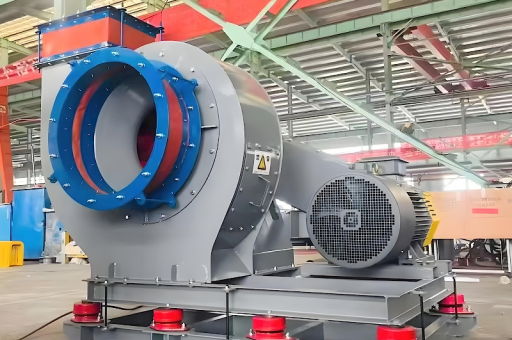
The high temperature centrifugal fan blower is designed to withstand continuous exposure to gases ranging from 150°C to over 400°C. Unlike standard fans, this blower uses:
- Heat-resistant alloy impellers (e.g., stainless steel 310S or Inconel).
- Shaft cooling systems (often a separate cooling fan or water jacket).
- High-temperature bearings and seals that prevent lubricant breakdown.
Its centrifugal design—where air enters axially and exits radially—provides high pressure rise at moderate flow rates, ideal for overcoming the resistance of boiler tubes, dampers, and ducts.
Q: Why can’t I use a standard ventilation fan for boiler draft?
A: Standard fans lack thermal tolerance. At 300°C, mild steel impellers warp, bearings seize, and seals fail, leading to vibration, fire hazard, and lost efficiency.
How They Work Together: Airflow, Combustion & Heat Transfer
The fan blower serves two primary roles in the boiler:
- Forced Draft (FD Fan): Pushes combustion air into the burner at controlled pressure. This ensures the fuel-air ratio stays within optimal range (typically 1.1 to 1.2 times stoichiometric air).
- Induced Draft (ID Fan): Pulls hot flue gases through the boiler, maintaining negative pressure in the furnace to prevent backflow of flames.
In a medium pressure steam boiler, the high temperature centrifugal fan blower often operates as an ID fan, drawing exhaust at up to 350°C. The pressure differential across the fan must match the boiler’s draft loss—typically 2–8 inches of water gauge.
Example: A 10-ton boiler burning natural gas requires about 12,000 CFM of combustion air. Without the fan blower, natural draft would only provide 30% of that flow, resulting in incomplete combustion, soot buildup, and CO formation.
Q: How do I calculate the required fan static pressure?
A: Sum the draft losses from the burner, heat exchanger tubes, economizer, ductwork, and chimney. Add 20% margin. A common value is 6–10 inches WG for a medium pressure boiler.
Technical Specifications: What to Look For in a Fan Blower
When selecting a high temperature centrifugal fan blower, consider:
| Parameter | Typical Range / Requirement |
|---|---|
| Max continuous temperature | 350°C (standard); 450°C+ (custom) |
| Impeller material | SS 310S, Hastelloy, or ceramic-coated |
| Flow rate | 5,000 – 50,000 CFM |
| Static pressure | 4 – 12 inches WG |
| Motor power | 15 – 150 HP (VFD compatible) |
| Bearing type | High-temp grease or oil mist |
| Cooling method | Shaft cooling fan or external cooling fins |
Also check for AMCA certification for aerodynamic performance and ISO 1940 balance grades to avoid vibration.
Q: What is the difference between forward-curved and backward-curved blades for boiler fans?
A: Forward-curved blades are compact and suitable for low-pressure high-flow. Backward-curved blades are more efficient, handle higher temperatures, and are standard for ID fans in medium pressure boilers.
Applications Across Industries
- Chemical & Petrochemical: Steam for reactors and distillation columns.
- Food & Beverage: Sterilization, cooking, and canning lines.
- Pulp & Paper: Drying cylinders and steam cogeneration.
- Hospitals: Central steam plants for sterilization and HVAC humidification.
- Textile Mills: Steam for dyeing and finishing.
In each industry, a failed fan blower can shut down the entire plant. That is why many facilities maintain a redundant fan unit or a VFD-controlled blower that can automatically adjust speed to match load.
Common Problems & Troubleshooting Q&A
Q: The fan blower is vibrating excessively. What could be wrong?
A: Common causes:
- Impeller imbalance due to dust buildup or erosion.
- Worn bearings (check for high-frequency noise).
- Loose foundation bolts or misaligned shaft.
- Thermal distortion if the fan was allowed to run without cooling.
Q: The motor is tripping on overcurrent. Why?
A:
- Damper closed too far – the fan works against high resistance.
- Impeller interference (debris hitting blades).
- Motor voltage drop or single phasing.
- High gas temperature causing thermal overload.
Q: How often should I replace the fan bearings?
A: In continuous operation at 300°C, grease-lubricated bearings should be replaced every 6–12 months. Oil-mist systems can last 2–3 years. Always monitor vibration and temperature.
Maintenance Best Practices for Longevity
- Visual inspection weekly: Check for cracks, corrosion, and soot accumulation on the impeller.
- Vibration analysis monthly: On-bearing housing, axial and radial.
- Bearing temperature monitoring: Keep below 90°C if greased; above indicates failure.
- Clean the impeller every quarter: Use compressed air or soft brushes – never water on hot surfaces.
- Lubrication schedule: Follow manufacturer’s intervals; do not over-grease.
- Align motor and fan: Use laser alignment after every bearing change.
Future Trends: Energy Efficiency & Smart Controls
Modern high temperature centrifugal fan blowers are being integrated with IoT sensors. A smart fan blower can:
- Adjust speed via VFD to match boiler load, saving 20–30% electricity.
- Predict bearing failure using machine learning.
- Optimize combustion in real-time, reducing NOx and CO emissions.
For medium pressure steam boilers moving toward decarbonization, these fan blowers will play a role in hydrogen combustion, where air volume and temperature stability are even more critical.
Conclusion: Why Your Boiler Needs a Quality Fan Blower
The medium pressure steam boiler high temperature centrifugal fan blower is not a commodity part—it is a precision machine that directly impacts energy costs, safety, and plant uptime. Investing in a fan with proper materials, thermal management, and vibration control reduces the total cost of ownership over a boiler’s 20+ year lifespan. Whether you are designing a new system or replacing a failed unit, prioritize fan specifications that match your actual flue gas temperature and pressure profile. A well-chosen fan blower, combined with regular maintenance, ensures your boiler runs clean, hot, and efficient.
Q: What is the single most important factor for reliable fan blower operation?
A: Matching the material and cooling method to the actual maximum operating temperature. Never oversize or undersize the fan on temperature alone.





