
This article's table of contents introduction:
- Decoding the Terms
- Recommended General Specification (Based on Standard FD Fan Design)
- Why "16Mn" and "Coupling Driven" is a Good Choice
- Typical Performance Parameters (Example for a Medium Industrial Boiler)
- Key Design Considerations for a Boiler FD Fan
- Summary of Request
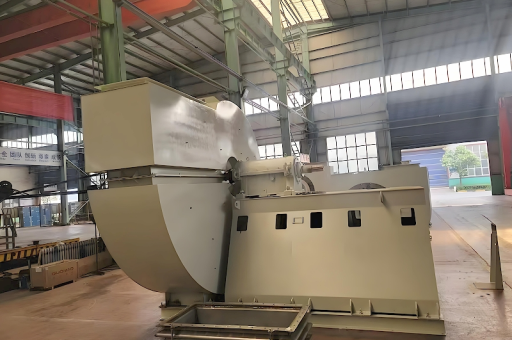
This is a technical specification requesting a specific type of industrial fan. Let me break down what these terms mean and provide a general specification for this equipment.
Decoding the Terms
- 16Mn: This refers to a specific steel grade (Chinese standard GB/T 1591). It's a low-alloy, high-strength structural steel with good weldability and toughness.
- In context: The impeller (wheel) or possibly the housing of the fan is made of 16Mn steel. This is common for applications requiring higher strength than standard Q235 carbon steel, often to handle thicker materials or higher stresses.
- Coupling Driven: This describes the drive arrangement.
- In context: The fan shaft is not directly mounted on the motor shaft. Instead, a flexible coupling is used to connect the motor to the fan shaft. Both the motor and fan have their own bearings and baseplate. This is standard for larger, high-power industrial FD fans.
- Boiler Fan: This indicates the application.
- In context: The fan is designed for a boiler system (power plant, industrial boiler, etc.).
- Centrifugal FD Fan: This is the type and function.
- Centrifugal: Air enters axially (along the shaft) and is discharged radially (at 90 degrees) by the spinning impeller. It creates high pressure.
- FD (Forced Draft) Fan: This fan is located on the front end of the boiler. It pushes ambient air into the boiler furnace to provide oxygen for combustion. It works against the resistance of the air preheater, windbox, and burner.
- In Boiler: Redundant confirmation of the application.
Recommended General Specification (Based on Standard FD Fan Design)
Here is a typical specification sheet for a 16Mn Coupling Driven Centrifugal FD Fan.
| Parameter | Specification | Notes / Typical Values for a Medium Boiler |
|---|---|---|
| Fan Type | Centrifugal, Single Inlet (SI) or Double Inlet (DI) | DI is common for very high volumes. |
| Blade Type | Backward Inclined (Airfoil or Single Thickness) | Most efficient for FD fans. Handles clean air. |
| Drive Arrangement | Arrangement D (or F) with Flexible Coupling | Motor has its own shaft; Fan has its own shaft. |
| Impeller Material | 16Mn (Q345B equivalent) | High strength, good for larger diameters or higher tip speeds. |
| Casing Material | Q235B Carbon Steel (Standard) or 16Mn (if casing is part of pressure boundary) | Casing is usually standard steel unless specified. |
| Shaft Material | 45# Steel (Medium Carbon Steel) or 40Cr (Alloy Steel) | Standard for industrial fans. |
| Bearing Type | Spherical Roller Bearings (Pillow Block) | Designed to handle both radial and axial thrust loads. |
| Coupling | Flexible (e.g., Grid, Gear, or Tire) | Allows for slight misalignment and absorbs shock. A coupling guard is mandatory. |
| Inlet Damper | Radial Louver Type (or Inlet Vane Control) | For volume control / turndown. |
| Discharge Position | Variable (e.g., 0°, 45°, 90°, etc.) | Specified based on ductwork layout. |
Why "16Mn" and "Coupling Driven" is a Good Choice
- 16Mn Advantages:
- Higher Yield Strength: >345 MPa (vs. ~235 MPa for standard Q235). This allows for a thinner, lighter, or stronger impeller.
- Better Weldability: It's easier to weld reliably than higher-carbon steels.
- Wear Resistance: Slightly better in erosive environments (though FD fan air is usually filtered, any debris is slightly less damaging).
- Coupling Driven Advantages:
- Speed Optimization: Allows the fan to run at its optimal aerodynamic speed (e.g., 980 RPM) while the motor runs at a standard 4-pole speed (1480 RPM) or via a VFD.
- Simplified Maintenance: The motor can be replaced or serviced without disturbing the fan rotor and bearings.
- Reduced Motor Stress: The fan's starting inertia doesn't directly shock the motor shaft.
Typical Performance Parameters (Example for a Medium Industrial Boiler)
These are indicative for a boiler around 50-100 tons per hour.
| Parameter | Value |
|---|---|
| Flow Rate | 50,000 - 150,000 m³/h (29,400 - 88,300 CFM) |
| Static Pressure | 3,000 - 8,000 Pa (12 - 32 in. w.g.) |
| Operating Temp | 20°C - 50°C (Ambient air, preheater inlet) |
| Power | 75 kW - 500 kW (Induction motor) |
| Speed | 740 - 1480 RPM (Depends on drive ratio) |
Key Design Considerations for a Boiler FD Fan
- Vibration Monitoring: Must have ports for accelerometers. Balance grade should be G6.3 or better.
- Lubrication: Grease-lubricated bearings for smaller units; Oil-lubricated (splash or forced) for larger, high-speed units.
- Access Doors: For cleaning and impeller inspection.
- Drainage: Drain plugs at the bottom of the casing (for condensation in humid climates).
- Shaft Seal: A labyrinth or carbon ring seal is needed where the shaft passes through the casing to prevent air leakage.
Summary of Request
You are looking for a heavy-duty, high-pressure centrifugal fan built with a stronger steel impeller (16Mn) and a separate motor-driven design (Coupling Driven) to push clean combustion air into a boiler furnace.
Next Step: Would you like a selection sheet to fill out with exact flow and pressure requirements to size a specific unit?





