
This article's table of contents introduction:
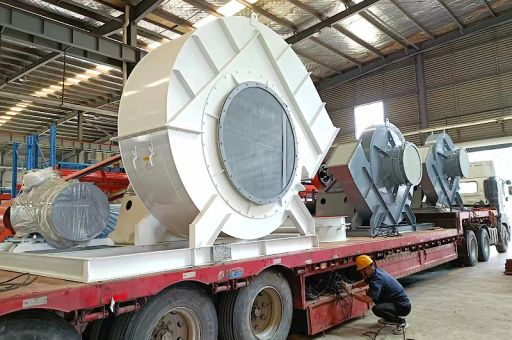
- Key Technical Specifications (Typical)
- The "Anticorrosion" Aspect (Critical for CFB)
- Typical Construction (Materials & Features)
- Application in CFB Boiler
- Advantages of a Single Inlet Design for CFB
- Potential Challenges & Solutions
- Common Models / Standards
- Example Specification for a Procurement Inquiry
- Recommendations for Purchase
Based on the keywords you provided, here is a detailed breakdown of the specifications, common features, and considerations for an Industrial Single Inlet Centrifugal (CFB Boiler) Blower Fan operating at 2900 r/min with Anticorrosion properties.
This type of fan is a critical component in a Circulating Fluidized Bed (CFB) Boiler system, typically serving as the Primary Air (PA) Fan or Secondary Air (SA) Fan.
Key Technical Specifications (Typical)
- Type: Single Inlet, Centrifugal (Forward Curved or Backward Inclined/Curved).
- Backward Curved (e.g., 9-19, 9-26 series): More common for high-pressure CFB applications. More efficient, non-overloading power curve.
- Forward Curved: Used for lower pressure, higher volume applications (e.g., draft fans).
- Speed: 2900 r/min (Standard 2-pole motor speed at 50Hz).
- Flow Rate: Varies widely (e.g., 10,000 – 200,000 m³/h).
- Pressure: High static pressure (e.g., 6000 – 15,000 Pa) to overcome the deep bed resistance in a CFB boiler.
- Impeller: Single inlet, often with wear-resistant lining or hard-faced blades (due to fly ash erosion) in addition to anticorrosion coating.
The "Anticorrosion" Aspect (Critical for CFB)
The environment inside a CFB boiler flue gas path is highly corrosive due to:
- SOx, NOx, HCl gases.
- Acidic condensation when the fan is operating at lower temperatures (e.g., during startup or after wet flue gas desulfurization - WFGD).
- High humidity (especially if used as an Induced Draft - ID - fan downstream of scrubbers).
Typical Anticorrosion Solutions:
- Material Selection:
- Impeller: Stainless Steel (e.g., 304, 316L, or Duplex 2205) or Corten Steel with epoxy/polymer coating.
- Housing: Lined with FRP (Fiber Reinforced Plastic), Rubber, or Stainless Steel cladding.
- Coatings:
- Heavy-duty Epoxy (e.g., based on Novolac epoxy) – High chemical resistance, good for dry to mildly wet acids.
- Vinyl Ester – Superior resistance to both acidic and alkaline environments.
- PTFE (Teflon) lining – For extreme chemical resistance (more expensive).
- Design Modifications:
- Drain holes in the scroll casing to prevent acid accumulation.
- Shaft sealing with purge air to prevent corrosive gases from reaching bearings.
- Stainless steel hardware (bolts, nuts).
Typical Construction (Materials & Features)
| Component | Standard Material | Anticorrosion Upgrade |
|---|---|---|
| Impeller | Q235 (Mild Steel) | 304/316L Stainless Steel or Hardox with Epoxy coating |
| Shaft | #45 Steel (Carbon) | 2Cr13 Stainless Steel |
| Casing | Q235 (Mild Steel) | Carbon Steel with FRP lining or Vinylester coating |
| Bearing Housing | Cast Iron | Cast Iron with labyrinth seals |
| Bearing | SKF / NSK / FAG (Grease-lubricated) | Same, but with high-temperature grease (if near boiler) |
| Shaft Seal | Packing seal | Mechanical seal or purge air labyrinth seal |
Application in CFB Boiler
This specific fan is most likely used as:
- Primary Air Fan (PA Fan): Supplies the air to fluidize the bed material (sand/ash). Needs high pressure (to lift the bed) and anticorrosion (to handle preheated air or flue gas recirculation).
- Secondary Air Fan (SA Fan): Provides over-fire air to complete combustion. Lower pressure, higher volume.
- Induced Draft Fan (ID Fan): Draws flue gas out of the boiler. Highly susceptible to corrosion (acid dew point). Often requires the most aggressive anticorrosion lining.
Alternative: Fluidizing Air Fan (for limestone or coal feeding systems): Needs anticorrosion if handling damp fuel.
Advantages of a Single Inlet Design for CFB
- Compactness: Smaller footprint than double inlet (since CFB boiler houses have limited space).
- Efficiency: Higher static pressure efficiency (up to 85%) compared to double inlet.
- Lower Cost: Simpler manufacturing, less material than a double inlet fan of equivalent capacity (though double inlet can handle higher flow).
- Easy Maintenance: Single shaft, single bearing set.
Potential Challenges & Solutions
| Challenge | Solution |
|---|---|
| Abrasive wear from fly ash | Use Ming Dynasty / Hardox 500 steel blades; install wear plates at inlet cone and volute tongue. |
| Vibration at 2900 rpm | Ensure dynamic balancing (Grade 6.3 or 2.5); use a heavy-duty baseframe with vibration isolators. |
| Acidic condensation (ID fan) | Automate steam tracing or electric heaters for the casing; install a drain valve at the bottom. |
| High temperature (if PA fan) | Use stainless steel impeller (up to 250°C/482°F) or alloy steel (up to 400°C/752°F). |
Common Models / Standards
- Standard: JB/T 8689-2016 (Centrifugal Fans for Ventilation) – but modified for corrosion.
- Typical Models: 9-19 (High Pressure), 9-26 (Medium Pressure), G4-73 (Draft Fan).
- Mounting: Coupling drive (2-pole motor + flexible coupling) or direct drive.
Example Specification for a Procurement Inquiry
Item: Single Inlet CFB Boiler Primary Air Blower Fan
- Speed: 2900 r/min
- Flow: 50,000 m³/h
- Pressure: 8,000 Pa
- Impeller: 304 Stainless Steel, backward curved
- Casing: Q235 + 2mm Epoxy coating (Novolac)
- Shaft seal: Purge air + labyrinth
- Motor: 160 kW, 2-pole, IP55, F-class insulation
- Accessories: Inlet box (with adjustable damper), vibration sensors, manometer ports.
Recommendations for Purchase
- Confirm the location (PA, SA, or ID fan): ID fans need the most anticorrosion.
- Request a "Material Certificate" for the anticorrosion coating (e.g., ISO 12944).
- Ask for a "Vibration Report" after balancing (especially at 2900 rpm).
- Check the "Spark-proof" design if handling coal-rich air.
- Ensure the brand has CFB boiler experience (e.g., Shandong Tianren, Yilun Fan, or European brands like FläktGroup / Woods).
Summary: This fan is a high-speed, high-pressure industrial blower specifically designed to handle corrosive flue gases and abrasive fly ash in a CFB boiler. The 2900 rpm speed gives it a compact footprint but requires robust dynamic balancing and wear-resistant materials.





