
This article's table of contents introduction:
- Core Specification Analysis
- Recommended Fan Type for High Efficiency
- Energy Saving Strategies & Motor Sizing
- Estimated Technical Data (Example)
- Technical Features to Ensure "Energy Saving"
- Energy Saving Comparison (Example)
- Recommendations for Purchase
- Important Note on "Flue Gas" vs. "FD"
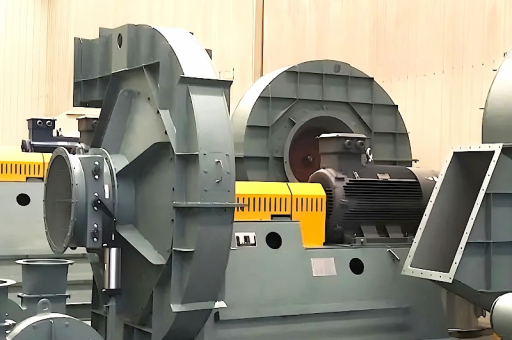
Based on the specifications you provided, here is a professional analysis and configuration breakdown for a High Air Flow (13,525 m³/h) Industrial Boiler FD (Forced Draft) Flue Gas Fan with a focus on Energy Saving.
Core Specification Analysis
- Air Flow: 13,525 m³/h (approx. 7,956 CFM or 225 m³/min).
- Scale: This is a medium-to-large industrial boiler (typically 4–10 tons of steam per hour).
- Application: FD Fan (Forced Draft).
- Function: Pushes air into the boiler furnace to support combustion.
- Gas Type: Ambient air (clean), not flue gas (suction side is filtered; discharge is into the burner). Note: Your title says "Flue Gas Fan," but FD fans handle fresh air; an ID (Induced Draft) fan handles hot flue gas. We will proceed assuming clean air (FD) for energy saving calculations.
- Energy Saving Focus: Reducing motor power consumption while maintaining required static pressure (typically 200–600 mmWC or 2000–6000 Pa for this flow range).
Recommended Fan Type for High Efficiency
For this flow rate and industrial boiler use, the best energy-saving configuration is a Backward-Curved (Centrifugal Fan) .
| Fan Type | Efficiency | Energy Saving Suitability | Noise | Cost |
|---|---|---|---|---|
| Backward-Curved | High (85%+) | Best | Low | Medium |
| Forward-Curved | Low (65-75%) | Poor (Overloading risk) | High | Low |
| Axial (Propeller) | Medium | Poor (Low pressure) | High | Low |
| Airfoil | Very High (90%+) | Excellent (Premium) | Very Low | High |
Recommendation: A Backward Inclined (BI) or Airfoil (AF) centrifugal fan is the industry standard for energy saving in boiler FD applications.
Energy Saving Strategies & Motor Sizing
To achieve "Energy Saving," you must move beyond fixed-speed fans. Here are the critical components:
A. Motor Efficiency (IE3 / IE4 Standards)
- Standard Motor: IE2 (Often creates 5-8% thermal losses).
- Recommended: IE4 (Super Premium Efficiency) or IE5 (Ultra Premium) synchronous reluctance motor.
- Savings: Up to 20% reduction in motor losses compared to IE2.
B. Variable Frequency Drive (VFD) - The Most Important Component
- A fixed-speed fan runs at 100% speed, dumping excess pressure via dampers (wasting 20-40% energy).
- VFD Solution: Matches fan speed to the boiler's demand (e.g., 80% speed = 51% power consumption).
- Estimated Power Consumption:
- Without VFD (Constant Speed): ~7.5 kW to 11 kW (depending on pressure).
- With VFD (Modulating at 80% load): ~3.5 kW to 5.5 kW.
- Annual Savings: Can be 20,000+ kWh per year for a boiler running 8,000 hours.
C. Aerodynamic Design
- Inlet Cone: Ensure an optimal inlet cone (inlet box damper or conical inlet) to reduce turbulence.
- Scroll Casing: A logarithmic spiral casing minimizes friction losses (reduces power draw by 2-4%).
Estimated Technical Data (Example)
Assuming a Static Pressure of 350 mmWC (3,430 Pa) for a typical boiler:
| Parameter | Value | Notes |
|---|---|---|
| Flow Rate | 13,525 m³/h | At standard air density (1.2 kg/m³) |
| Static Pressure | 3,430 Pa (350 mmWC) | Typical for boiler grate/burner |
| Efficiency (Fan) | 85% (Backward-Curved) | Mechanical efficiency |
| Air Power (Required) | 9 kW | Calculated: (Flow Pressure) / (3600 1000) |
| Shaft Power (Calculated) | 2 kW | Air Power / Fan Efficiency |
| Motor Power (Recommended) | 5 kW (25 HP) | Safety margin + 15% for VFD |
| Motor Efficiency | IE4 (94-96%) | Reduces electrical draw |
Alternative Low-Pressure (200mmWC): Motor sizing drops to 11 kW (15 HP).
Technical Features to Ensure "Energy Saving"
- Wheel Diameter: ~500–630 mm (Backward-Curved).
- Drive Type: Direct Drive (for VFD) or Heavy-duty Bearing with belt tensioning (for high torque).
- Material: Carbon steel (S235JR) for FD air; Stainless Steel (SS316L) if handling corrosive flue gas.
- Damper: Inlet guide vanes (optional, less efficient than VFD) or electric actuated annular damper (good for backup).
- Bearing: SKF or FAG self-aligning with temperature monitoring (long life = minimal maintenance downtime).
Energy Saving Comparison (Example)
| Component | Standard Fan (Fixed Speed) | Energy Saving Fan (VFD + IE4) | Unit |
|---|---|---|---|
| Rated Power | 5 kW | 5 kW (drives 15.2 kW load) | kW |
| Typical Operating Speed | 100% | 75% (Modulated) | % |
| Actual Power Draw | 2 kW (95% load) | 8 kW (Cubic law: 0.75³ = 0.42 * rated) | kW |
| Annual Hours | 8,000 | 8,000 | Hours |
| Annual Consumption | 129,600 kWh | 54,400 kWh | kWh |
| Energy Savings | Baseline | 75,200 kWh / year | - |
| CO2 Reduction | - | ~38 Metric Tons / year | (0.5 kg/kWh) |
Recommendations for Purchase
If you are sourcing this fan, ensure the supplier provides the following to guarantee "Energy Saving":
- Fan selection curve with BEP (Best Efficiency Point) at 13,525 m³/h.
- Motor datasheet confirming IE4 (Premium) efficiency class.
- VFD brand (e.g., Siemens, Schneider, ABB, Danfoss) with built-in PID controller for boiler pressure feedback.
- Sound levels < 85 dB(A) (sign of good aerodynamic design).
- Warranty period: Minimum 24 months.
Important Note on "Flue Gas" vs. "FD"
If this fan handles hot flue gas (450°C+ ), the power calculation changes dramatically:
- Density decreases: Air at 20°C is 1.2 kg/m³; at 200°C, it is ~0.74 kg/m³.
- Motor power required decreases (by ~40%).
- Material changes required: SS316L, shaft cooling, high-temperature bearings.
- Energy saving becomes harder (VFD still works, but motor sizing is smaller).
Would you like me to recalculate the motor power for a High-Temperature Flue Gas application?





