
This article's table of contents introduction:
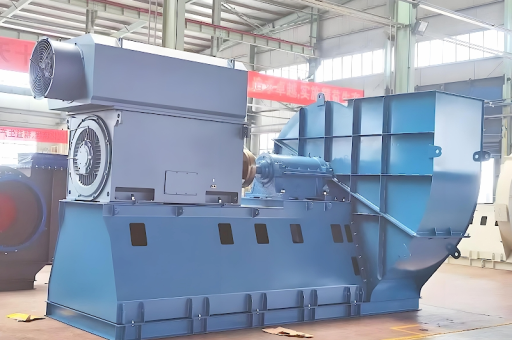
- Fan Type: Backward Curved Centrifugal Fan
- Key Performance Parameters (Estimation)
- Standard Design Specifications for CFB Boiler Service
- Why Backward Curved for CFB?
- Important System Considerations
- Drafting a Query for Suppliers
- Summary of Standard Model (Example)
This is a request for a high-volume, backward-curved centrifugal fan designed for a Circulating Fluidized Bed (CFB) boiler.
The specific flow range you provided (17,463 to 63,305 m³/h) indicates a medium-to-large industrial fan, likely serving as a Primary Air (PA) fan, Secondary Air (SA) fan, or an Induced Draft (ID) fan for a CFB boiler of significant size (often in the 30-100 MWth range).
Here is a detailed technical analysis and specification outline for a fan meeting these criteria.
Fan Type: Backward Curved Centrifugal Fan
- Blade Geometry: The blades curve away from the direction of rotation.
- Efficiency: High (typically 82-88%).
- Pressure Characteristics: Stable, non-overloading power curve (power peaks near the design point and drops off at higher flows).
- Application Synergy with CFB: Tolerant to particulate-laden gas (erosion resistant coatings possible), handles high static pressures required for fluidization (PA) or overcoming flue gas treatment systems (ID).
Key Performance Parameters (Estimation)
You provided the volume range. To specify the fan, you need the pressure. For a CFB boiler, typical values are:
- Primary Air (PA) Fan:
- Flow: 63,305 m³/h (at the high end of your range, for the fluidizing air grid).
- Static Pressure: 20,000 – 30,000 Pa (2,000 – 3,000 mmWC). CFB fluidization requires high pressure to overcome the bed material weight.
- Induced Draft (ID) Fan:
- Flow: 63,305 m³/h (plus seal air and excess air).
- Static Pressure: 6,000 – 10,000 Pa (600 – 1,000 mmWC). Lower, as it pulls suction from the furnace, economizer, baghouse/ESP.
- Secondary Air (SA) Fan:
- Flow: 17,463 – 30,000 m³/h (lower range, for staging combustion).
- Static Pressure: 8,000 – 15,000 Pa (800 – 1,500 mmWC).
Standard Design Specifications for CFB Boiler Service
Given the application, the fan must be robust. Here is a typical bill of specifications:
| Parameter | Design Recommendation |
|---|---|
| Impeller | Backward curved, hollow airfoil or single-thickness plate blades. Steel (Q345/Q355) or Hardox for erosion resistance. |
| Housing | Heavy-gauge steel (6-10mm minimum), split housing for maintenance access (mandatory for a fan this size). |
| Outlet Orientation | Top horizontal, bottom horizontal, or rotation defined per layout. |
| Drive System | Dual-drive preferred: V-belt for large speed adjustments during commissioning OR Direct drive (flexible coupling) with a High-Efficiency Motor + VFD. |
| Speed | 1,500 RPM (4-pole) or 1,000 RPM (6-pole) for lower noise. |
| Motor | TEFC or IC 411. Power: 90 kW – 250 kW (depending on pressure req.). |
| Bearings | Outboard pedestal bearings (for high temperature). “Housing temperature alarm” included. |
| Inlet Damper | Variable Inlet Vane (VIV) control for turndown (more efficient than discharge dampers for CFB). |
| Temperature | Max continuous: 150°C (ID fans: 180°C with cooling shaft). |
| Erosion Protection | Weld-on tungsten carbide tiles at leading edge of blades (for PA/ID fans). Ceramic-lined casing at tongue. |
Why Backward Curved for CFB?
- Non-Overloading Power Curve: If the CFB bed empties (unlikely but possible) and flow increases, a backward curve fan will not burn out the motor, unlike a forward curve fan.
- Efficiency: CFB boilers run for 8,000+ hours/year. A 2-3% efficiency gain from backward airfoil blades vs. radial blades saves significant electricity costs.
- Low Noise: Lower tip speed than radial fans for the same pressure.
Important System Considerations
- Variable Frequency Drive (VFD): Highly recommended. CFB boilers require precise turndown (from 60% to 100% load). A VFD on a backward curved fan saves 30-50% power compared to damper control at low load.
- Erosion: The “Achilles heel” of ID and PA fans in CFBs.
- Solution: Use thicker blades (10-12mm) , replaceable wear liners on the housing, and hard-faced (Stellite or Tungsten Carbide) leading edges.
- Vibration Monitoring: CFB fans are often mounted high up on steel structures. Must include vibration sensors (4-20mA) connected to DCS.
- Shaft Sealing: For PA fans handling hot air with fly ash, use a labyrinth seal with purge air to prevent ash ingress into bearings.
Drafting a Query for Suppliers
If you are purchasing this fan, use this technical data sheet:
Subject: RFQ for CFB Boiler Backward Curved Centrifugal Fan
- Type: Backward Centrifugal (Suitable for CFB Boiler)
- Flow: 63,305 m³/h (Max), 17,463 m³/h (Min)
- Static Pressure: _ Pa (You need to complete this. Ask your boiler designer.)
- Media: Air / Flue Gas / Primary Air (Be specific. Temperature: °C. Dust load: g/Nm³)
- Installation: Indoor / Outdoor
- Motor Drive: VFD ready (Yes/No)
- Accessories: Inlet Box, Expansion Joint (Inlet/Outlet), Inlet Damper, Vibration Sensors.
- Erosion Protection: Required (Specific to CFB duty).
Summary of Standard Model (Example)
- Power: 160 kW / 180 kW
- Speed: 1480 RPM
- Class: 300°C (but operating at 140°C)
- Material: Impeller: Corten Steel (Cor-Ten) / Blade thickness: 8mm
- Control: Guide Vane Control + VFD
To proceed:
- Confirm the static pressure required for your boiler grid (PA) or stack draft (ID).
- Confirm the gas temperature at the fan inlet (hot air vs. flue gas).
- Choose between Plate blade (cheaper, slightly less efficient) or Airfoil blade (more expensive, 87%+ efficiency).





