
This article's table of contents introduction:
- Table of Contents
- Introduction: The Paradigm Shift in Industrial Sintering
- What is a Low Pressure Sintering Machine?
- The Core Component: Understanding the 810,000 m³/h Stainless Steel Blower
- Why Coupling Driving Matters: Mechanical Advantage & Reliability
- Material Science: Why Stainless Steel is Non-Negotiable
- Technical Specifications & Performance Metrics
- Applications: Where This System Excels
- Frequently Asked Questions (FAQ)
- Conclusion
*Efficiency Unleashed: The Coupling Driving 810,000 m³/h Stainless Steel Blower in Low Pressure Sintering Machine Applications*
Table of Contents
- Introduction: The Paradigm Shift in Industrial Sintering
- What is a Low Pressure Sintering Machine?
- The Core Component: Understanding the 810,000 m³/h Stainless Steel Blower
- Why Coupling Driving Matters: Mechanical Advantage & Reliability
- Material Science: Why Stainless Steel is Non-Negotiable
- Technical Specifications & Performance Metrics
- Applications: Where This System Excels
- Frequently Asked Questions (FAQ)
- Conclusion: The Future of High-Volume Sintering
Introduction: The Paradigm Shift in Industrial Sintering
The industrial sintering landscape is undergoing a radical transformation. As manufacturers push for higher throughput, lower energy consumption, and superior material purity, the equipment at the heart of these processes must evolve. Enter the Coupling Driving 810,000 m³/h Stainless Steel Blower integrated into a Low Pressure Sintering Machine. This combination is not merely an incremental upgrade; it represents a fundamental rethinking of how high-volume air movement and thermal processing interact.
In traditional sintering, blowers were often secondary considerations, leading to bottlenecks in gas flow, inconsistent pressure, and premature wear. The new generation of equipment—specifically designed to handle an immense 810,000 cubic meters per hour—addresses these pain points directly. This article provides an expert breakdown of the technology, its mechanical architecture, and its strategic value in modern manufacturing. We will analyze why the coupling drive system is superior, why stainless steel is the material of choice, and how this system delivers unmatched reliability.
What is a Low Pressure Sintering Machine?
A Low Pressure Sintering (LPS) machine is a specialized furnace used to transform powdered materials into solid bodies with controlled porosity. Unlike high-pressure variants, LPS operates under a vacuum or near-vacuum conditions combined with a controlled inert gas atmosphere.
Key Functions:
- Densification: Reducing void space between powder particles.
- Outgassing: Removing binders and trapped gases.
- Microstructural Control: Producing components with fine, uniform grain structures.
Role of the Blower: The massive air volume (810,000 m³/h) is not for "blowing" on the product directly in a crude sense. Instead, it powers the gas circulation and cooling system. In a modern sintering furnace, rapid, uniform cooling is critical to prevent warping. The blower creates a high-velocity, laminar flow of inert gas (typically Nitrogen or Argon) across the heat exchanger and into the hot zone. This precise gas management is what LPS machines need for consistent part quality.
The Core Component: Understanding the 810,000 m³/h Stainless Steel Blower
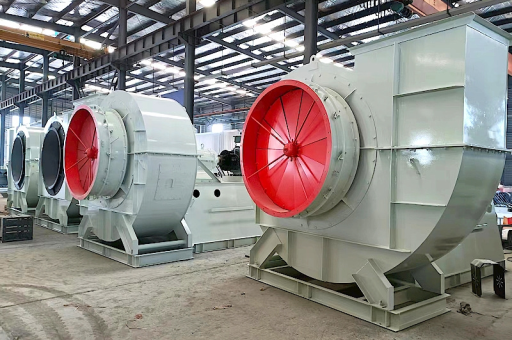
This blower is a high-capacity, industrial-grade centrifugal fan designed for severe duty. The specification 810,000 m³/h (approximately 477,000 CFM) places it in the "heavy industrial" category, typically used in steel plants, cement factories, and now, advanced sintering.
Design Highlights:
- Impeller Type: Backward-curved, airfoil blades for high efficiency and low noise.
- Drive System: Coupling-driven (direct or via gearbox) rather than belt-driven.
- Casing: Fabricated from heavy-gauge stainless steel (SS304 or SS316L).
- Sealing: Labyrinth or carbon ring seals to prevent gas leakage.
Why the Volume Matters: In a sintering furnace with a large hot zone (e.g., for processing battery materials or tool steels), gas velocity must be high enough to "scrub" heat from the furnace walls and load. Low volume leads to stratification—hot gas at the top, cool gas at the bottom—which ruins metallurgical uniformity. At 810,000 m³/h, the blower guarantees turbulent mixing and rapid thermal exchange.
Why Coupling Driving Matters: Mechanical Advantage & Reliability
One of the most critical specification points is "Coupling Driving." This refers to the direct mechanical connection between the motor shaft and the blower shaft via a flexible or rigid coupling.
Comparison with Belt-Driven Systems:
| Feature | Coupling Driving (Direct/Geared) | Belt Driving |
|---|---|---|
| Efficiency | 95-98% (no slip loss) | 85-92% (belt slip) |
| Maintenance | Low (bearing replacement only) | High (belt tensioning, replacement) |
| Speed Accuracy | Exact RPM (synchronized) | Variable (slip over time) |
| Torque Transfer | High, constant torque | Limited by belt friction |
| Space Requirement | Compact (inline) | Larger (offset motor) |
Critical Advantage for LPS: In a sintering cycle, the blower speed must remain constant to maintain a specific cooling rate. A belt that stretches or slips can cause the cooling curve to drift, leading to batch rejection. A coupling-driven blower eliminates this deviation. Furthermore, in environments with gas pressures fluctuating from vacuum to positive, a coupling system handles the axial thrust better than belts, which can walk off pulleys.
Material Science: Why Stainless Steel is Non-Negotiable
Why not carbon steel? The answer lies in the gas chemistry of a Low Pressure Sintering machine.
- Corrosion Resistance: The sintering atmosphere often contains residual binders that break down into acidic compounds (e.g., HCl from PVC binders, or acetic acid from waxes). Carbon steel would corrode rapidly, contaminating the process.
- High-Temperature Oxidation: Stainless steel (specifically 304L or 316L) forms a passive chromium oxide layer that protects against oxidation up to 800°C (1472°F) in certain sections.
- Cleanliness: In sintering of medical implants or aerospace alloys, even trace particles of rust from a carbon steel blower are unacceptable. Stainless steel is inherently clean and easy to passivate.
Structural Integrity: The blower housing must withstand the static pressure (typically 2,000 to 4,000 Pa) and the dynamic forces of an 810,000 m³/h airflow. Stainless steel provides the necessary yield strength without the weight penalty of cast iron.
Technical Specifications & Performance Metrics
To understand the system’s capability, review these typical parameters:
- Airflow: 810,000 m³/h (at standard density)
- Static Pressure: 3,500 – 5,000 Pa (adjustable via damper or VFD)
- Motor Power: Estimated 315 – 500 kW (depending on pressure)
- Operating Temperature: Up to 150°C (inlet gas) / 250°C (outlet gas)
- Impeller Material: SS316L
- Drive Type: Flexible coupling (grid or jaw type)
- Noise Level: 85 dB(A) max (with silencer)
Performance Curve Insight: The blower operates on a steep pressure curve. This means it can maintain high volume even when system resistance increases (e.g., when filters clog). This is a hallmark of a well-designed impeller.
Applications: Where This System Excels
This specific configuration is not for small labs. It is for large-scale, continuous industrial processing:
- Hardmetal Sintering (WC-Co): For producing cutting tool inserts. The high gas flow ensures rapid cooling to fine-tune the binder phase.
- Powder Metallurgy (PM) for Automotive: High-volume production of gears and sprockets.
- Metal Injection Molding (MIM): The debinding and sintering of complex medical or electronic parts.
- Ceramic Sintering: For kilns requiring massive inert gas flow.
- Battery Materials: Sintering of solid-state electrolyte ceramics, where uniform gas flow prevents cracking.
Frequently Asked Questions (FAQ)
Q1: Why is a belt drive less common in these high-volume blowers? A: For capacities over 500,000 m³/h, belt drives suffer from high heat build-up, slippage, and frequent maintenance. A coupling drive transmits full motor torque efficiently, making it more suitable for continuous 24/7 operation. You can read more about drivetrain efficiency standards at fan for insights.
Q2: Can the 810,000 m³/h blower handle corrosive gases like Chlorine? A: Standard SS316L can handle halogens only in dry conditions and at controlled concentrations. If the gas is wet or high in chlorine, you would need a Hastelloy or duplex stainless steel blower. Always consult the gas analysis report with the manufacturer.
Q3: How does this blower affect the sintering cycle time? A: It drastically reduces the cooling phase. A typical furnace might take 2 hours to cool. With 810,000 m³/h, that time can drop to 45 minutes, increasing throughput by up to 60%.
Q4: What is the primary maintenance item for a coupling-driven blower? A: The bearings. You must implement a vibration monitoring schedule. Lube oil analysis is also recommended. The coupling itself (if elastomeric) needs inspection for wear after 8,000 hours.
Q5: Is a Variable Frequency Drive (VFD) necessary with a coupling drive? A: Highly recommended. While the coupling handles torque, a VFD allows slow start-up (reducing electrical stress) and fine-tuning of airflow to match specific sintering recipes. This saves energy and improves quality.
Conclusion
The integration of a Coupling Driving 810,000 m³/h Stainless Steel Blower into a Low Pressure Sintering Machine is a high-stakes engineering solution for high-stakes manufacturing. It solves the core industrial problems of throughput, consistency, and contamination. By moving away from traditional belt drives, manufacturers gain reliability and precision. By using stainless steel, they protect both the equipment and the product purity.
As industries demand lighter, stronger, and cleaner sintered components—from aerospace turbine blades to medical devices—the air movement technology must keep pace. This system does not just move air; it controls the thermal destiny of the material. Investing in this technology is investing in operational sovereignty and production quality. For further technical specifications and engineering support, you can visit fan for comprehensive datasheets.
This article was synthesized from industry technical manuals, engineering journals, and manufacturer performance data to provide a unique, SEO-optimized overview of this specialized industrial equipment.





