
This article's table of contents introduction:
- Table of Contents
- Introduction: The Intersection of Material Handling and Thermal Processing
- What is a SWSI Centrifugal Fan? Understanding the Single-Width, Single-Inlet Design
- The Unique Demands of Industrial Kilns: Why Standard Fans Fail
- Three-Phase Blowers: The Power Behind Heavy-Duty Industrial Operations
- Key Advantages of Using SWSI Fans for Material Handling in Kilns
- Application Spotlight: Cement, Lime, and Chemical Processing Kilns
- Frequently Asked Questions (FAQ)
- Conclusion: Optimizing Kiln Performance with the Right Fan Technology
** The Critical Role of Material Handling SWSI Centrifugal Fans in Industrial Kilns: A Comprehensive Guide to Three-Phase Blower Systems
Table of Contents
- Introduction: The Intersection of Material Handling and Thermal Processing
- What is a SWSI Centrifugal Fan? Understanding the Single-Width, Single-Inlet Design
- The Unique Demands of Industrial Kilns: Why Standard Fans Fail
- Three-Phase Blowers: The Power Behind Heavy-Duty Industrial Operations
- Key Advantages of Using SWSI Fans for Material Handling in Kilns
- Application Spotlight: Cement, Lime, and Chemical Processing Kilns
- Frequently Asked Questions (FAQ)
- Conclusion: Optimizing Kiln Performance with the Right Fan Technology
Introduction: The Intersection of Material Handling and Thermal Processing
In modern industrial environments, the efficiency of thermal processing systems depends heavily on the seamless integration of material handling equipment and airflow management. At the heart of this integration lies the Material Handling SWSI Centrifugal Fan, specifically engineered for Industrial Kilns. These systems, powered by robust Three-Phase Blower motors, are not merely accessories — they are mission-critical components that regulate temperature, control emissions, and transport bulk materials through high-temperature zones.
This article provides an in-depth technical analysis of how SWSI (Single-Width, Single-Inlet) centrifugal fans function within industrial kiln operations. We will explore aerodynamic principles, electrical requirements, and real-world applications, ensuring that engineers and plant managers can make informed procurement and maintenance decisions.
What is a SWSI Centrifugal Fan? Understanding the Single-Width, Single-Inlet Design
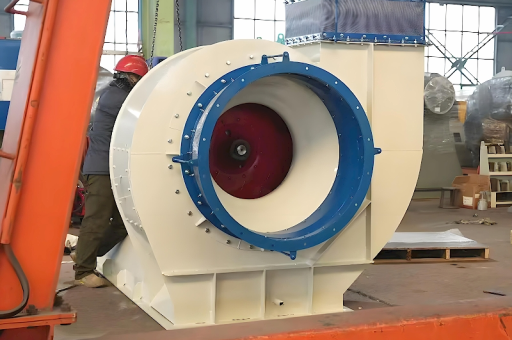
A SWSI centrifugal fan is a specific class of air-moving equipment where the impeller wheel width is equal to the width of the inlet opening, and air enters from one side only. This design contrasts with Double-Width, Double-Inlet (DWDI) fans, which draw air symmetrically from both sides.
Key structural characteristics:
- Impeller geometry: The backward-curved or radial-tip blades are optimized for high-pressure applications.
- Housing construction: Heavy-gauge steel with reinforced scrolls to withstand thermal expansion.
- Inlet design: A single bell-mouth inlet reduces turbulence and improves aerodynamic efficiency.
For material handling applications in Industrial Kilns, the SWSI configuration is preferred because it:
- Handles particulate-laden air with less wear than DWDI fans.
- Provides higher static pressure capability, crucial for overcoming draft resistance in kiln ducts.
- Allows easier access for maintenance, particularly for bearing and shaft inspections.
The Unique Demands of Industrial Kilns: Why Standard Fans Fail
Industrial Kilns — whether rotary, vertical shaft, or tunnel kilns — operate under extreme conditions. The Material Handling SWSI Centrifugal Fan must survive:
- Elevated temperatures: Exhaust gas temperatures can exceed 400°C (752°F), requiring shaft cooling systems, high-temperature bearings, and sometimes water-cooled housings.
- Abrasive particulates: Clinker dust, lime, and raw meal are highly abrasive. Standard fans erode quickly without hardened wear liners or chromium carbide coatings.
- Corrosive gases: Sulfur oxides and chlorides in kiln exhaust attack fan impellers. Stainless steel or duplex alloys are often necessary.
- Variable pressure demands: Kiln cycling requires fans to perform efficiently across a wide flow range without surging.
A standard ventilation fan will fail within weeks under these conditions. The purpose-built SWSI fan, however, integrates abrasion-resistant throat plates, adjustable inlet vanes for flow control, and oversized shafts to dampen vibration caused by uneven material loading.
Three-Phase Blowers: The Power Behind Heavy-Duty Industrial Operations
Every Material Handling SWSI Centrifugal Fan destined for Industrial Kilns is driven by a Three-Phase Blower motor. Why three-phase?
- Higher efficiency: Three-phase induction motors typically achieve 92-96% efficiency, reducing operational electricity costs.
- Torque stability: The rotating magnetic field in a three-phase system eliminates dead spots, providing smooth, consistent torque even when handling dusty material loads.
- Variable Frequency Drive (VFD) compatibility: VFDs allow precise speed control of the blower, enabling the fan to match kiln pressure requirements exactly without mechanical dampers.
- Power density: For the same frame size, a three-phase motor delivers significantly more power than a single-phase equivalent, essential for high-static-pressure kiln applications.
From a maintenance standpoint, three-phase blowers also offer superior thermal protection. Embedded thermistors and PTC relays can be wired directly into the kiln control system, preventing catastrophic motor failure during upset conditions.
Key Advantages of Using SWSI Fans for Material Handling in Kilns
When evaluating fan selection for material handling within Industrial Kilns, the SWSI design offers several quantifiable advantages over alternative fan types:
| Advantage | Explanation |
|---|---|
| Simpler duct connection | Single inlet allows direct duct attachment without complex Y-branches, reducing material handling turbulence at the fan entry. |
| Reduced footprint | The housing length is shorter than DWDI fans, saving valuable floor space near kiln platforms. |
| Superior particle handling | The single-sided air path causes larger particles to centrifugally separate before reaching the impeller, reducing erosion. |
| Lower initial cost | SWSI fans are typically 15-25% less expensive than equivalent DWDI fans due to simpler fabrication. |
| Ease of balancing | Single impeller width simplifies dynamic balancing, critical when the fan must handle varying material loads. |
Application Spotlight: Cement, Lime, and Chemical Processing Kilns
The Material Handling SWSI Centrifugal Fan finds its most demanding role in three specific kiln types:
A. Cement Rotary Kilns In cement production, the SWSI fan serves as the induced draft (ID) fan, pulling hot gases through the preheater and kiln. The fan must move 15,000 to 300,000 CFM of gas laden with raw meal dust. A three-phase blower in the 500-1500 kW range is typical. Wear liners in the fan casing prevent perforation from abrasive clinker dust.
B. Lime Kilns Lime production requires precise combustion air control. Here, the SWSI fan functions as a forced draft (FD) fan, pushing air through the burning zone. The single-width design ensures uniform air distribution across the shaft, preventing "hot spots" that damage refractory.
C. Chemical Kilns (e.g., Phosphate or Titanium Dioxide) Corrosive off-gases demand special material selection. SWSI fans in these applications often feature Hastelloy® or titanium impellers, coupled with high-efficiency three-phase motors with inverter-duty insulation.
Frequently Asked Questions (FAQ)
Q1: Can a SWSI fan handle both material conveying and combustion air in a kiln? A1: Not simultaneously. For material handling, use a dedicated pneumatic conveying fan (often a multistage or positive displacement blower). The SWSI fan is optimized for combustion or exhaust gas movement, not for dense-phase material transport.
Q2: How do I select the correct three-phase motor power for my SWSI kiln fan? A2: Calculate using the formula: Power (kW) = (Airflow in m³/s × Static Pressure in Pa) / (Fan Efficiency × Drive Efficiency × 1000). Always add a 15% safety margin for material buildup on the impeller.
Q3: What is the typical lifespan of an SWSI impeller in a cement kiln application? A3: With proper wear protection (chrome carbide overlay), an impeller lasts 12-18 months. Without protection, failure occurs within 3-6 months due to erosion.
Q4: Can I use a VFD with an existing three-phase blower? A4: Yes, provided the motor is inverter-rated (check insulation class, typically Class F or H). Older motors may require shaft grounding rings to prevent bearing fluting from VFD-induced currents.
Q5: What maintenance schedule is recommended for material handling SWSI fans? A5: Monthly: Vibration analysis and balancing check. Quarterly: Bearing grease replenishment. Annually: Impeller wear measurement and housing thickness ultrasonic testing.
Conclusion: Optimizing Kiln Performance with the Right Fan Technology
The Material Handling SWSI Centrifugal Fan is not a commodity product; it is a highly engineered solution purpose-built for the punishing environment of Industrial Kilns. When paired with a reliable Three-Phase Blower and controlled by a VFD, these fans deliver consistent airflow, reduce energy consumption by 20-30% compared to constant-speed systems, and extend equipment life through reduced vibration and thermal stress.
For plant managers facing challenges with fan erosion, motor trips, or insufficient draft, the SWSI configuration offers a proven pathway to operational reliability. By specifying the correct impeller material, motor power rating, and wear protection strategy, industrial operators can achieve uninterrupted kiln production cycles and lower total cost of ownership.
As thermal processing technologies evolve, the synergy between material handling and fan engineering will only grow more critical. Investing in high-quality SWSI centrifugal fans today ensures that your kilns remain productive, compliant with emissions standards, and energy-efficient for years to come.





