
This article's table of contents introduction:
- Table of Contents
- Introduction: The Evolution of High-Volume Drying Technology
- What is a Coupling Driven High Volume Drying Swsi Centrifugal Fan?
- Core Components and Mechanical Architecture
- Performance Characteristics: Why "Coupling Driven" Matters
- Application Scenarios in Industrial Drying
- Comparative Analysis: Direct Drive vs. Coupling Driven
- Frequently Asked Questions (FAQ)
- Installation, Maintenance, and Troubleshooting Best Practices
- Future Trends in Centrifugal Fan Engineering
- Conclusion
*Optimizing Industrial Drying Processes: The Engineering Edge of Coupling Driven High Volume Drying Swsi Centrifugal Fan Systems*
Table of Contents
- Introduction: The Evolution of High-Volume Drying Technology
- What is a Coupling Driven High Volume Drying Swsi Centrifugal Fan?
- Core Components and Mechanical Architecture
- Performance Characteristics: Why "Coupling Driven" Matters
- Application Scenarios in Industrial Drying
- Comparative Analysis: Direct Drive vs. Coupling Driven
- Frequently Asked Questions (FAQ)
- Installation, Maintenance, and Troubleshooting Best Practices
- Future Trends in Centrifugal Fan Engineering
- Conclusion
Introduction: The Evolution of High-Volume Drying Technology
In modern industrial drying, the demand for high-volume airflow, energy efficiency, and mechanical reliability has never been greater. Whether in food processing, pulp and paper drying, textile finishing, or chemical granulation, the core challenge remains the same: how to move a massive volume of heated air across a product bed without sacrificing pressure stability or motor longevity.
The answer for many engineers has converged on a specific class of equipment: the Coupling Driven High Volume Drying Swsi Centrifugal Fan. The acronym "SWSI" stands for Single Width, Single Inlet—a standard centrifugal fan configuration optimized for high static pressure and large air volume. When paired with a direct-drive or coupling-driven motor arrangement, this fan type becomes a workhorse of industrial drying lines.
According to global industrial fan performance databases, coupling-driven SWSI fans consistently achieve airflow rates exceeding 50,000 CFM (cubic feet per minute) while maintaining static pressure ratings above 12 inches w.g. (water gauge). These metrics directly translate to faster moisture removal, shorter drying cycles, and reduced energy consumption per kilogram of product.
What is a Coupling Driven High Volume Drying Swsi Centrifugal Fan?
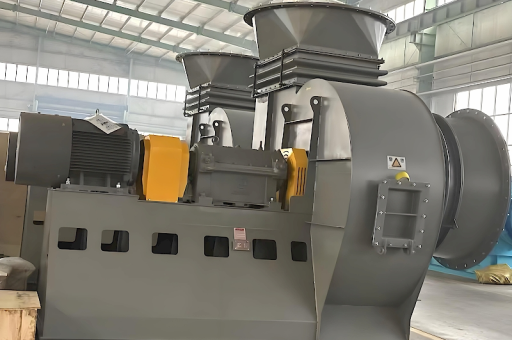
A Coupling Driven High Volume Drying Swsi Centrifugal Fan is a belt-driven or direct-coupling centrifugal fan designed specifically for continuous, high-temperature drying applications. The term "coupling driven" refers to the mechanical connection between the motor shaft and the fan impeller—usually via a flexible coupling or a V-belt pulley system—which allows the fan to operate at a different rotational speed than the motor.
Key Characteristics
- Single Width, Single Inlet (SWSI) Design: Air enters from one side of the impeller, exits radially at 90 degrees. This geometry delivers high static pressure (HSP) needed to push air through drying chambers, ductwork, and filter banks.
- High Volume Airflow: The impeller diameter and blade angle are optimized for volume rather than pure pressure, making it ideal for convective drying tunnels, flash dryers, and fluidized bed dryers.
- Coupling Mechanism: Unlike direct-drive fans where the motor and impeller share a single shaft, a coupling system introduces a decoupling point. This isolates motor vibration from the impeller, reduces bearing wear, and allows easier maintenance—the impeller can be replaced without removing the motor.
- Thermal Resilience: The fan housing and impeller are typically built from carbon steel with heat-resistant coatings, stainless steel (304/316), or aluminum alloys to withstand gas temperatures ranging from 80°C to 350°C.
Core Components and Mechanical Architecture
| Component | Function | Material Options |
|---|---|---|
| Impeller (Rotor) | Accelerates air radially; backward-curved or forward-curved blades | Steel, SS304, SS316, aluminum |
| Housing (Volute) | Collects and directs high-velocity air into discharge duct | Carbon steel, stainless steel, FRP |
| Shaft & Bearings | Supports impeller rotation; double-row spherical roller bearings are common | Hardened steel, sealed or regreasable |
| Coupling | Transfers torque from motor to fan shaft; absorbs misalignment | Flexible (jaw, tire, grid) or rigid |
| Inlet Cone (Bell Mouth) | Guides air smoothly into impeller eye | Same as housing |
| Base Plate & Mounts | Structural support and vibration isolation | Steel channel, rubber isolators |
The coupling assembly deserves special attention. In high-volume drying fans, the coupling must tolerate thermal expansion of the fan shaft during extended runs. A flexible jaw coupling with a spider insert is a common choice because it dampens torsional vibration and accommodates up to 1–2 degrees of angular misalignment.
Performance Characteristics: Why "Coupling Driven" Matters
In a direct-drive configuration, the fan speed is locked to the motor speed (e.g., 1,750 RPM for a 4-pole motor). But in a coupling-driven system, the fan speed can be adjusted via pulley ratios or variable-frequency drives (VFDs). This flexibility is a game-changer for drying processes where airflow demand changes with product moisture content.
Airflow and Pressure Capabilities (Typical Specifications)
- Air Volume: 10,000 – 120,000 CFM
- Static Pressure: 4 – 20 inches w.g.
- Temperature Range: -20°C to 350°C
- Impeller Diameter: 24 – 80 inches
- Motor Power: 10 – 500 HP (7.5 – 375 kW)
Question 1: Why is high static pressure important for drying?
Answer: Drying chambers often have complex ductwork, air distribution plates, and moisture-laden filters. Without sufficient static pressure, airflow becomes non-uniform, leading to "wet spots" and reduced drying efficiency. A coupling-driven SWSI fan can maintain stable pressure even as filters load with dust, ensuring consistent drying speed.
The coupling also acts as a mechanical fuse. If the impeller becomes unbalanced due to material buildup or erosion, the coupling spider will fail before the motor shaft, protecting the expensive motor from catastrophic overload.
Application Scenarios in Industrial Drying
1 Food Industry: Sprays and Granules Drying
In a spray dryer for milk powder or coffee, a coupling-driven SWSI fan draws hot air (200°C) through a drying chamber. The belt-driven arrangement allows operators to tune fan speed to match the inlet air temperature and product throughput. A 48-inch impeller moving 40,000 CFM at 12 in. w.g. is typical.
2 Pulp and Paper: Yankee Hood Dryer
Paper machines use Yankee cylinders with high-velocity hoods that blow hot air onto the paper web. The fan must deliver 60,000+ CFM at 14 in. w.g.. A coupling-driven fan is preferred because the hood requires frequent impeller cleaning—and with a coupling, the motor stays in place while the impeller is removed for steam washing.
3 Chemical Processing: Fluidized Bed Dryers
Fluidized bed dryers rely on a precise balance of air volume and pressure to suspend granular materials. The coupling-driven SWSI fan, paired with a VFD, can adjust airflow in real time as particle size changes, preventing channeling or defluidization.
4 Textiles: Drying Cans and Tenter Frames
In the textile industry, tenter frames use high-volume heated air to dry fabric after dyeing. The fan must operate at temperatures up to 150°C for extended periods. A coupling system provides thermal isolation between the motor and hot air stream, extending motor life.
Comparative Analysis: Direct Drive vs. Coupling Driven
| Feature | Direct Drive (DD) | Coupling Driven (CD) |
|---|---|---|
| Fan Speed Flexibility | Fixed to motor speed | Adjustable via pulleys or VFD |
| Vibration Isolation | Motor vibration translated directly | Coupling dampens vibration |
| Thermal Isolation | Motor close to hot air | Motor can be remotely positioned |
| Maintenance Complexity | Replace complete motor-impeller assembly | Impeller and motor serviced separately |
| Initial Cost | Lower (fewer parts) | Moderate (coupling, belts/guards) |
| Energy Efficiency | Higher at design point | Slightly lower due to belt losses (~3–5%) |
| Ideal Use Case | Clean, constant speed applications | Dirty, hot, variable speed applications |
Question 2: Does belt loss significantly impact drying economics?
Answer: In a 100 HP fan running 8,000 hours/year, a 5% belt loss equals roughly 40,000 kWh of wasted energy. However, modern cogged V-belts or synchronous belts reduce losses to under 2%, and the ability to slow the fan during low-demand periods often offsets the initial efficiency penalty. In high-temperature drying, thermal isolation and ease of maintenance provide greater overall economic value.
Frequently Asked Questions (FAQ)
Q1: What does SWSI mean, and why is it preferred for drying?
A: SWSI stands for Single Width, Single Inlet. It means air enters the impeller from one side only, producing a compact design with high static pressure. Compared to DWDI (Double Width, Double Inlet), SWSI fans have a narrower profile—ideal for duct-mounted installations.
Q2: Can a coupling-driven fan be retrofitted with a VFD?
A: Yes. In fact, VFD + coupling-driven is a powerful combination. The VFD changes motor speed, and the coupling ratio further refines the fan speed. However, at very low speeds, belt-driven fans can experience belt slip; VFDs should be programmed with a minimum speed limit (e.g., 20% of maximum).
Q3: How often should the coupling be inspected?
A: Every 500 operating hours, inspect the coupling spider for cracks, wear, and heat discoloration. Replace the spider every 2,000–3,000 hours in high-temperature applications. Also, check alignment of motor and fan shafts using a dial indicator—misalignment accelerates bearing and coupling wear.
Q4: What causes vibration in a coupling-driven SWSI fan?
A: Common causes include:
- Worn coupling spider
- Loose setscrews on the coupling hubs
- Impeller imbalance from dust buildup or erosion
- Worn bearings on the fan shaft
- Belt tension inconsistent (if belt-driven)
Q5: What is the maximum temperature for the coupling material?
A: Standard nitrile rubber spiders handle up to 80°C. For drying applications above 100°C, use neoprene (120°C) or polyurethane (150°C) spiders. For very high temperatures (200°C+), consider grid couplings with no elastomeric part.
Installation, Maintenance, and Troubleshooting Best Practices
Installation Checklist
- Foundation: Concrete pad or structural steel base, flat within 0.002 in/ft.
- Alignment: Use laser alignment tool; angular misalignment < 0.05°, parallel offset < 0.003 in.
- Belt Tension: Deflection method: press belt at mid-span—deflection should equal 1/64 inch per inch of belt span.
- Inlet Duct: Install a turning vanes or an inlet box to prevent swirl entering the impeller eye.
- Discharge Duct: Keep a straight run of at least 5 duct diameters after the fan outlet.
Routine Maintenance Schedule
- Daily: Check belt tension, coupling temperature (hand touch), unusual noise.
- Weekly: Inspect coupling spider for glazing or cracking; grease bearings if applicable.
- Monthly: Check fan housing for air leaks at flanges; verify VFD output current matches nameplate.
- Quarterly: Remove impeller access panel and inspect blades for erosion, buildup, or cracks.
- Annually: Complete disassembly; replace bearings, coupling spider, and belts; re-align.
Question 3: How do I know if my coupling is failing?
Answer: Three warning signs: (1) A "chattering" sound from the coupling area at startup; (2) visible rubber dust around the coupling; (3) increased vibration amplitude on the fan side compared to the motor side. Immediate inspection is required.
Future Trends in Centrifugal Fan Engineering
The coupling-driven SWSI fan is not static—it is evolving alongside Industry 4.0 and sustainable manufacturing:
- Smart Couplings with IoT Sensors: Some manufacturers now embed temperature and vibration sensors into the coupling spider. Data is streamed to a cloud dashboard that predicts remaining spider life.
- Hybrid Composites: Carbon-fiber-reinforced polymer impellers reduce inertia, allowing smaller coupling sizes and faster speed changes.
- Energy Recovery Integration: Coupling-driven fans are being paired with heat recovery wheels. The flexibility of speed adjustment helps balance the pressure drop across the wheel.
- Multi-Stage Drying Configurations: Two coupling-driven SWSI fans in series can achieve static pressures above 30 in. w.g. without a blower, useful for deep-bed drying of biomass or agricultural grains.
Conclusion
The Coupling Driven High Volume Drying Swsi Centrifugal Fan represents an optimal engineering solution for industries that require reliable, high-volume, high-static-pressure airflow in demanding thermal environments. By decoupling the motor from the impeller, this fan design delivers:
- Operational Flexibility (speed tuning via pulleys or VFD)
- Thermal and Vibration Isolation (protecting the motor from hot gases and imbalance)
- Simplified Maintenance (impeller service without motor removal)
- Field-Proven Longevity (many units surpass 20 years of service in pulp, food, and chemical plants)
When selecting a fan for a drying line, engineers should evaluate not only CFM and static pressure but also the maintenance strategy and thermal operating window. In the majority of high-volume, high-temperature drying applications, the coupling-driven SWSI fan is the most cost-effective and robust choice—balancing energy efficiency with the practical realities of industrial uptime.
For more technical specifications, dimensional drawings, or custom engineering support, consult your industrial fan supplier or visit the technical resources section of the manufacturer’s website. Always refer to local codes and safety standards before installation or modification.





