
This article's table of contents introduction:
- Fan Type: Forward Curved (Forward)
- Pressure: 15,955 Pa
- Potential Application (Most Likely: Induced Draft - ID Fan)
- Common Specifications for this Fan (Typical Data Sheet)
- Important Operational Considerations
- If you are looking for a replacement or new purchase:
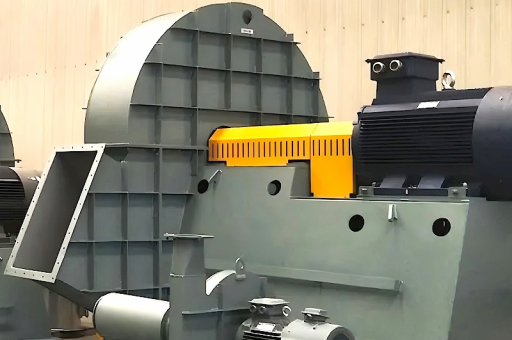
This looks like a request for information or specifications regarding a thermal power plant centrifugal blower fan, specifically a Forward Curved fan with a pressure rating of 15,955 Pa (Pascals) .
Given the high static pressure (approximately 1,600 mmWG or 63 inches WG), this fan is almost certainly an Induced Draft (ID) Fan or possibly a high-pressure Primary Air (PA) Fan, rather than a standard ventilation fan. The "15955pa" likely refers to the total pressure rise or static pressure at the fan's rated point.
Here is a breakdown of what this specification typically means in the context of a thermal power plant:
Fan Type: Forward Curved (Forward)
- Characteristic: High pressure, relatively low volume (compared to Backward Curved or Airfoil fans).
- Blade Shape: Blades curve in the direction of rotation.
- Usage in Power Plants: You see these in Induced Draft (ID) fans for old or small-medium units, or sometimes in Primary Air (PA) fans where high pressure is needed to push coal dust into the boiler.
- Note: For modern large-scale power plants (500MW+), Backward Curved or Airfoil fans are more common due to higher efficiency. A Forward Curved fan at this pressure is likely for an older plant, a Biomass plant, or a specific high-resistance system.
Pressure: 15,955 Pa
- Conversion:
- Static Pressure (SP): ~ 1,600 mmWg (mm of Water Gauge)
- Equivalent: ~ 63 inches w.g.
- Significance: This is a very high resistance. The fan must overcome the pressure drop across the boiler, ductwork, air preheater, dust collector (ESP/Baghouse), and stack.
- Motor Power: For a fan moving air at this pressure, the motor power will be substantial. A rough calculation:
- If flow rate (Q) is, say, 100 m³/s (typical for a small unit ID fan):
- Power (kW) ≈ (Flow m³/s × Pressure Pa) / (Efficiency × 1000)
- Assuming 80% efficiency: (100 × 15,955) / (0.80 × 1000) ≈ 1,994 kW (approx 2,700 HP).
- You would likely see a 5 MW to 3 MW motor for this fan.
Potential Application (Most Likely: Induced Draft - ID Fan)
- Environment: Hot, corrosive flue gas (up to 140-160°C for modern plants, or 120°C for plants with scrubbers).
- Auxiliaries: This fan would be followed by or preceded by an Electrostatic Precipitator (ESP) or Bag Filter.
- Control: Usually controlled via Inlet Guide Vanes (IGV) or a Variable Frequency Drive (VFD) to maintain furnace draft.
Common Specifications for this Fan (Typical Data Sheet)
| Parameter | Typical Value (Based on your input) |
|---|---|
| Fan Type | Single or Double Suction, Forward Curved |
| Rated Flow | 50 – 200 m³/s (Depending on unit size) |
| Total Pressure Rise | 15,955 Pa |
| Static Efficiency | 75% – 85% (Forward curve is less efficient than Airfoil) |
| Impeller Diameter | 5 – 4.5 meters |
| Motor Type | Squirrel Cage Induction Motor (SCIM) |
| Motor Speed | 590 – 990 RPM (Likely via VFD or fluid coupling for speed control) |
| Bearing Type | Sleeve bearings (for large, high-temp applications) |
| Cooling | Shaft cooling fan or external cooling system |
| Application | Induced Draft (ID) or Primary Air (PA) |
Important Operational Considerations
- Erosion: Forward curved blades can be prone to erosion from fly ash. You will need hard-facing on the leading edges of the blades.
- Vibration: This is a critical machine. You will likely have accelerometers (vibration sensors) on both bearings (horizontal, vertical, axial) and a bearing temperature monitoring system (RTDs).
- Horsepower Curve: Forward-curved fans have a "drooping" power curve. This means at low flow (high resistance), the motor can overload. You must never operate this fan against a closed damper (inlet guide vanes must be cracked open before starting).
- Materials:
- Impeller: Corten Steel (ASTM A606) or Hardox for wear resistance.
- Casing: Mild steel (IS 2062) with wear liners.
If you are looking for a replacement or new purchase:
You need to provide the following to a fan manufacturer (like Howden, TLT-Babcock, Robinson Fans, Zander & Ingeström, or Pneumafil):
- Volume Flow Rate (m³/s or CFM): What volume of gas is moving? (e.g., 150 m³/s)
- Gas Density / Temperature: (e.g., Flue gas at 140°C)
- Inlet / Outlet Connections: Layout constraints.
- Efficiency Requirements: Minimum guaranteed static efficiency (e.g., >82%).
- Control Method: VFD or Inlet Vanes?
Summary: The "15955pa" confirms this is a high-pressure, heavy-duty thermal power plant fan (likely ID or PA), requiring robust construction, significant motor power, and careful monitoring to handle hot, abrasive flue gas.





