
This article's table of contents introduction:
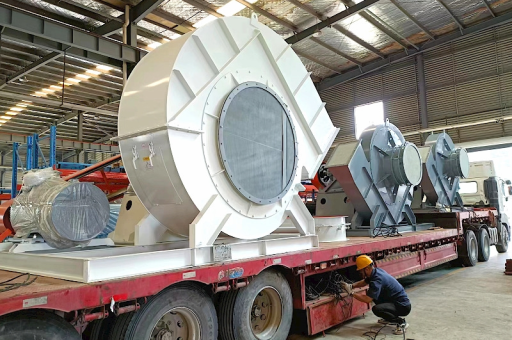
This seems to be a list of technical specifications or keywords for an industrial fan, likely used in a power plant, steel mill, or similar heavy industrial process (like a boiler or furnace exhaust system).
Here is the breakdown of what these terms mean and the critical engineering considerations for this application.
Term Breakdown
- Coupling Driving: This specifies the method of power transmission. The fan is not direct-drive (on the motor shaft). It is coupling-driven, meaning a flexible or rigid coupling connects the fan shaft to the motor shaft. This often implies the motor is mounted on a baseplate alongside the fan.
- Carbon Steel: The material of the fan (impeller, housing, shaft).
- Implication: Standard for clean or mildly corrosive gases. Warning: For an Induced Draft fan, this is often insufficient unless the fuel is very clean (e.g., natural gas). If this is for a coal boiler, Carbon Steel will likely fail rapidly due to acidic condensate (sulfuric acid).
- 30993m³/h: The volumetric flow rate (approx. 31,000 cubic meters per hour). This is a medium-to-large industrial flow rate.
- Context: Equivalent to roughly 18,240 CFM (Cubic Feet per Minute).
- Induced Draft Fan: The function. This fan is located after the heat source (boiler, furnace, kiln). It pulls (sucks) hot, dusty, and often corrosive flue gas through the system and pushes it up the stack.
- Critical Condition: The gas is usually at high temperature (120°C to 180°C), dusty, and the fan handles the dirtiest gas in the system.
Critical Engineering Analysis & Watchpoints
If you are specifying, installing, or maintaining this fan, the following are the most important technical considerations given the combination of a Carbon Steel material and an Induced Draft application.
Material Conflict: Carbon Steel vs. Acid Dew Point (The Big Risk)
This is the most critical issue. An ID fan handles flue gas. When sulfur-containing fuels (coal, heavy oil) are burned, the flue gas contains sulfur dioxide.
- The Problem: If the gas temperature drops below the Acid Dew Point (typically ~120°C-150°C for sulfur fuels), sulfuric acid condenses.
- The Result: Carbon steel corrodes extremely rapidly.
- Recommendation: Verify the gas temperature at the fan inlet. If it drops below ~140°C, Carbon Steel is not acceptable. You would need COR-TEN steel (weathering steel) or a stainless steel (e.g., 316L).
Coupling Type Selection
For 31,000 m³/h, a direct coupling is standard, but the type matters:
- Grid Coupling (e.g., Falk Steelflex): Very common. Handles misalignment and shock loads well.
- Diaphragm Coupling: Used for higher speeds/temperatures; requires no lubrication.
- Lovejoy (Jaw) Coupling: Only for light duty. Avoid for this size ID fan.
- Spacer Coupling: Highly recommended for this size. It allows you to remove the coupling center section to service the fan bearings or motor seal without moving the motor.
Impeller Design & Wear
At 31,000 m³/h, the impeller will be significant.
- Backward Curved (BC): Most energy-efficient. Self-limiting power (will not overload motor at low flow).
- Radial Tip: Used if the gas is heavily dust-laden. Handles erosion better, but is less efficient.
- Wear Protection: Check if the leading edges of the blades or the backplate have wear shields or hard-facing. If the gas has fly ash, raw carbon steel will erode within months.
Drive Power Estimation
You did not supply pressure (Static Pressure / Fan SP).
- To find the Motor Power, you need the Inlet Pressure (usually negative, e.g., -500 to -1500 Pa).
- Formula: $Power (kW) = \frac{Flow (m^3/s) \times Pressure (Pa)}{Fan Efficiency \times 1000}$
- Example: 31,000 m³/h = 8.6 m³/s. If SP = 3000 Pa and Eff = 80%: $kW = \frac{8.6 \times 3000}{0.80 \times 1000} \approx \mathbf{32 kW}$ (Motor likely 37-45 kW for safety margin).
Summary for Procurement / Checklist
If you are ordering this fan, you must clarify:
- Gas Temperature: Is it consistently above 160°C? (If yes, Carbon Steel might be ok).
- Fuel Type: Is this for Natural Gas (OK) or Coal/Heavy Oil (Carbon Steel is wrong)?
- Static Pressure: What is the pressure the fan must overcome (in Pa or mmWg)?
- Speed: What is the RPM (e.g., 960, 1450, 2900)? Coupling type depends on this.
- Dust Content: Is the gas clean, or does it have >50 mg/Nm³ of fly ash?
Final Verdict: "Coupling Driving Carbon Steel 30993m3/H Induced Draft Fan" is a potentially incompatible specification. For an ID fan, Carbon Steel is the cheapest but riskiest material. If this is a new build, strongly consider upgrading to Corten or Stainless Steel. If this is an existing fan, monitor for corrosion closely.





