
This article's table of contents introduction:
- Table of Contents
- Introduction to V Belt Driving Medium Pressure Explosion Proof Centrifugal Flow Fan
- Core Components and Working Principle
- Why is V-Belt Drive Preferred in Medium Pressure Systems?
- Explosion Proof Design Standards and Certifications
- Performance Characteristics and Selection Criteria
- Installation, Maintenance, and Troubleshooting
- Frequently Asked Questions (FAQ)
- Conclusion and Future Trends
Comprehensive Guide to V Belt Driving Medium Pressure Explosion Proof Centrifugal Flow Fan: Design, Safety & Best Practices
Table of Contents
- Introduction to V Belt Driving Medium Pressure Explosion Proof Centrifugal Flow Fan
- Core Components and Working Principle
- Why V Belt Drive is Preferred in Medium Pressure Systems
- Explosion Proof Design Standards and Certifications
- Performance Characteristics and Selection Criteria
- Installation, Maintenance, and Troubleshooting
- Frequently Asked Questions (FAQ)
- Conclusion and Future Trends
Introduction to V Belt Driving Medium Pressure Explosion Proof Centrifugal Flow Fan
In industrial environments where flammable gases, dust, or volatile vapors are present, standard ventilation equipment poses a serious safety risk. The V Belt Driving Medium Pressure Explosion Proof Centrifugal Flow Fan is engineered to address these challenges. This fan combines three critical features: a robust V-belt drive system, medium pressure capability (typically 1,000–3,000 Pa), and explosion-proof construction that meets international safety standards such as ATEX, IECEx, or NEC Class I/II.
Unlike direct-drive fans, the V-belt system allows for speed adjustment, torque control, and isolation of the motor from the airflow. This design is particularly valuable in hazardous locations because the motor can be placed outside the airstream, reducing ignition risk. The centrifugal impeller draws air or gas axially and discharges it radially, making it suitable for medium-pressure ducted systems in chemical plants, oil refineries, paint booths, and grain storage facilities.
Core Components and Working Principle
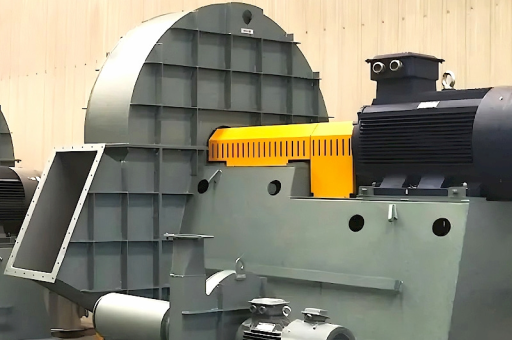
A V Belt Driving Medium Pressure Explosion Proof Centrifugal Flow Fan consists of the following key parts:
- Centrifugal Impeller: Typically backward-curved or radial blades made from non-sparking materials like aluminum bronze or stainless steel. The impeller rotates within a scroll housing to convert kinetic energy into pressure.
- V-Belt Drive System: Includes a motor pulley, fan pulley, and one or more V-belts. This system transmits power from the motor to the fan shaft while allowing for speed reduction or increase.
- Explosion-Proof Motor: Enclosed motors with spark-resistant enclosures, often marked as Class I, Division 1 or Zone 1. The motor is mounted externally or on a separate base frame.
- Housing and Shaft: Heavy-gauge steel or cast iron housing with reinforced joints. The shaft passes through a sealed bearing housing to prevent gas leakage.
- Base Frame and Vibration Isolators: Reduces mechanical stress and noise transmission.
Working Principle:
The motor rotates the V-belt, which drives the fan pulley. The impeller spins at high speed (often between 1,000 and 3,000 RPM depending on application). Air enters the fan inlet axially, is accelerated by the blades, and is discharged radially into the ductwork. In explosion-proof models, the housing is designed to contain any internal explosion and prevent flame propagation.
Why is V-Belt Drive Preferred in Medium Pressure Systems?
The V-belt drive offers several advantages over direct-drive configurations in medium pressure explosion-proof fans:
- Flexibility in Speed Control: By changing pulley diameters, the fan speed can be adjusted to match specific flow and pressure requirements without changing the motor. This is essential in process environments where airflow demand varies.
- Motor Protection in Hazardous Zones: The motor can be located remotely or in a non-hazardous area while the fan operates inside the zone. This reduces the need for expensive explosion-proof motors.
- Torque Management: V-belts absorb startup torque and reduce shock loads on the motor and fan shaft, extending equipment life.
- Lower Initial Cost: For medium pressure systems, a V-belt drive with a standard motor often costs less than a direct-drive explosion-proof motor setup.
However, V-belt systems require periodic tension adjustment and belt replacement. In explosion-proof applications, the belts must be anti-static to prevent spark generation from static electricity buildup.
Explosion Proof Design Standards and Certifications
To operate safely in hazardous environments, these fans must comply with strict design and testing standards:
- ATEX (EU): Directive 2014/34/EU. Fans for Zone 1 or Zone 2 gas groups must have flameproof enclosures (Ex d) and surface temperature limitations (T-rating). Temperature class must be below the ignition temperature of the surrounding atmosphere.
- IECEx (International): Similar to ATEX, ensuring equipment is safe for use in explosive gas or dust atmospheres.
- NEC/CEC (North America): Classification systems such as Class I, Division 1 (gas present in normal operation) or Class II, Division 1 (combustible dust). Explosion-proof fans must have spark-resistant impellers and housings designed to contain an internal explosion.
- UL and CSA: Product safety certifications validating motor and electrical component enclosures.
Key Design Features: | Feature | Purpose | |---------|---------| | Non-sparking impeller material | Prevents ignition from friction | | Conductive V-belts | Dissipates static charge | | Flanged joints with gap control | Contains internal explosion | | Dust seals on shaft | Protects bearings from contaminants |
Performance Characteristics and Selection Criteria
When selecting a V Belt Driving Medium Pressure Explosion Proof Centrifugal Flow Fan, consider these performance factors:
- Airflow (CFM or m³/h): Determine required ventilation volume based on room size and gas concentration.
- Static Pressure (in. w.g. or Pa): Medium pressure systems typically operate at 1,000–3,000 Pa. High-static applications may require series configurations.
- Speed (RPM): Fan speed must not exceed the impeller's maximum safe RPM, which is stamped on the fan nameplate.
- Temperature Rating: Ensure the fan can handle gas temperatures if used in exhaust systems.
- Ambient Conditions: Check for corrosive gases, humidity, and ambient temperature extremes.
Selection Checklist:
- Calculate required airflow and pressure using duct loss formulas.
- Choose impeller type: backward-curved for efficiency, radial for heavy dust.
- Verify motor rating (kW/HP) and electrical classification.
- Check V-belt length and pulley ratio for desired speed.
- Confirm certifications match local codes (e.g., ATEX Zone 1 for paint booths).
Installation, Maintenance, and Troubleshooting
Installation Best Practices:
- Mount the fan on a level, rigid base to prevent misalignment.
- Ensure the V-belt tension is correct: deflection should be approximately 1/64" per inch of belt span when pressed.
- Use flexible connectors at inlet and outlet to reduce vibration transmission.
- Ground all metal parts to prevent static accumulation.
- Locate the motor and electrical connections outside the hazardous zone if possible.
Routine Maintenance:
- Inspect V-belts for wear, cracking, or glazing every 500 operating hours.
- Lubricate bearings according to manufacturer schedule (typically every 3–6 months).
- Check impeller balance and clearance—debris buildup can cause imbalance.
- Verify housing seals are intact.
Common Issues and Solutions: | Problem | Possible Cause | Solution | |---------|---------------|----------| | Excessive vibration | Impeller imbalance or belt misalignment | Rebalance impeller; realign pulleys | | Reduced airflow | Belt slipping or motor overload | Tighten or replace V-belts; check motor | | Motor overheating | Ambient temperature too high or incorrect voltage | Improve cooling; verify electrical supply | | Sparking noise | Impeller rubbing housing | Adjust clearance; check for warpage |
Frequently Asked Questions (FAQ)
Q1: Can I use a standard V-belt fan in an explosion-proof application?
No. Standard fans lack spark-resistant materials, sealed housings, and anti-static belts. Using them in hazardous zones violates safety regulations and poses severe explosion risk.
Q2: What is the difference between medium pressure and high pressure centrifugal fans?
Medium pressure fans typically handle 1,000–3,000 Pa and are used in general ventilation and industrial process systems. High pressure fans (above 3,000 Pa) are for pneumatic conveying or long duct runs.
Q3: How often should V-belts be replaced in an explosion-proof fan?
Replace belts every 2,000–3,000 operating hours or annually, whichever comes first. In dirty or high-humidity environments, inspect more frequently.
Q4: What is the maximum temperature rating for these fans?
Depending on materials and T-rating, explosion-proof fans can handle up to 80°C–120°C ambient. For higher temperatures, consult the manufacturer.
Q5: Can I retrofit an existing fan to be explosion proof?
Retrofitting is generally not recommended because the housing, seals, and impeller must all be certified as a unit. A new certified fan is safer and more cost-effective.
Conclusion and Future Trends
The V Belt Driving Medium Pressure Explosion Proof Centrifugal Flow Fan remains a cornerstone of industrial safety ventilation. Its combination of mechanical flexibility (via V-belt drive), medium pressure capability, and certified explosion-proof construction makes it indispensable in chemical processing, oil and gas, pharmaceutical manufacturing, and mining applications.
Looking ahead, trends include:
- Smart Monitoring: Integration of IoT sensors to monitor vibration, temperature, and belt tension in real time.
- Energy Efficiency: Use of premium efficiency motors and optimized impeller designs to reduce energy consumption.
- Composite Materials: Non-sparking composite impellers that weigh less and resist corrosion better than metals.
- Modular Designs: Easier field servicing and quicker replacement of V-belts and bearings.
For any project involving hazardous atmospheres, always consult with certified fan manufacturers and follow local electrical and safety codes. The right fan not only protects assets but, more importantly, saves lives.





